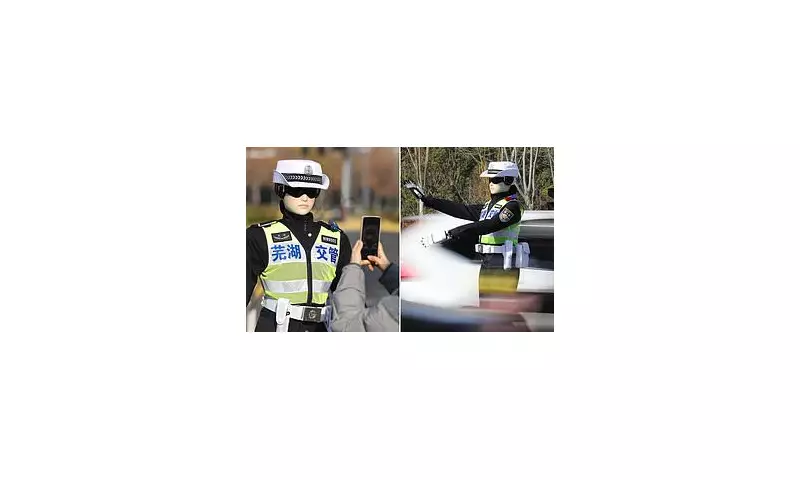
In a striking move towards automated urban management, authorities in eastern China have deployed fully autonomous, AI-powered robot police officers to manage road traffic. The humanoid machines, spotted patrolling the streets of Wuhu City in Anhui Province, represent a significant step in integrating embodied intelligence into public services.
The Dawn of Automated Law Enforcement
Clad in miniature reflective vests and white caps, the so-called 'robocops' have become a familiar sight for locals. Designed to function around the clock, these units are not stationary fixtures but are fully mobile, capable of autonomously navigating to designated locations as commanded. Their primary role is to assist human officers by performing routine traffic control duties and identifying infractions in real-time.
One unit, identified as the Intelligent Police Unit R001, is directly linked to the city's traffic signal infrastructure. This connection allows it to perform standard traffic-control gestures perfectly synchronised with the changing lights. Equipped with high-definition cameras and an intelligent voice-broadcasting system, the robot uses sophisticated algorithms to automatically detect violations by pedestrians and riders of non-motorised vehicles, issuing immediate verbal warnings.

Capabilities and Public Reception
Traffic police officer Jiang Zihao has welcomed the machines as "new colleagues", highlighting their potential to reduce the strain on human personnel, particularly during peak hours or in severe weather conditions. The robot can identify illegal parking and conduct continuous road monitoring, providing a constant surveillance presence.
Their futuristic design has turned them into local celebrities, with pedestrians often stopping to take photographs. The robots have been heard issuing clear instructions, such as advising a cyclist, "For your safety, please ride bicycles in the non-motorised lane."
Part of a Broader National Trend
This deployment in Wuhu is not an isolated experiment but part of China's accelerating adoption of robotic law enforcement assistants. In June of last year, the southwestern city of Chengdu launched a mixed fleet of robotic officers, including quadruped, wheeled, and humanoid models, to patrol alongside humans. This was followed in December by the introduction of an AI traffic policing robot in Hangzhou, Zhejiang Province.
These initiatives underscore a concerted national drive to implement cutting-edge embodied intelligence in practical, real-world scenarios. A report from the Development Research Center of the State Council forecasts enormous growth for the industry, predicting a market scale of 400 billion yuan (about £44.5 billion) by 2030, exceeding 1 trillion yuan by 2035.
Zhang Guibing, general manager of AiMOGA Robotics which manufactures the R001 unit, emphasised the importance of real-world testing. "Only by bringing products into real-life scenarios and collecting real operational data can we achieve rapid iteration," he stated. The company's robots are already operational in over 100 different scenarios, spanning reception, security patrols, and various public services.