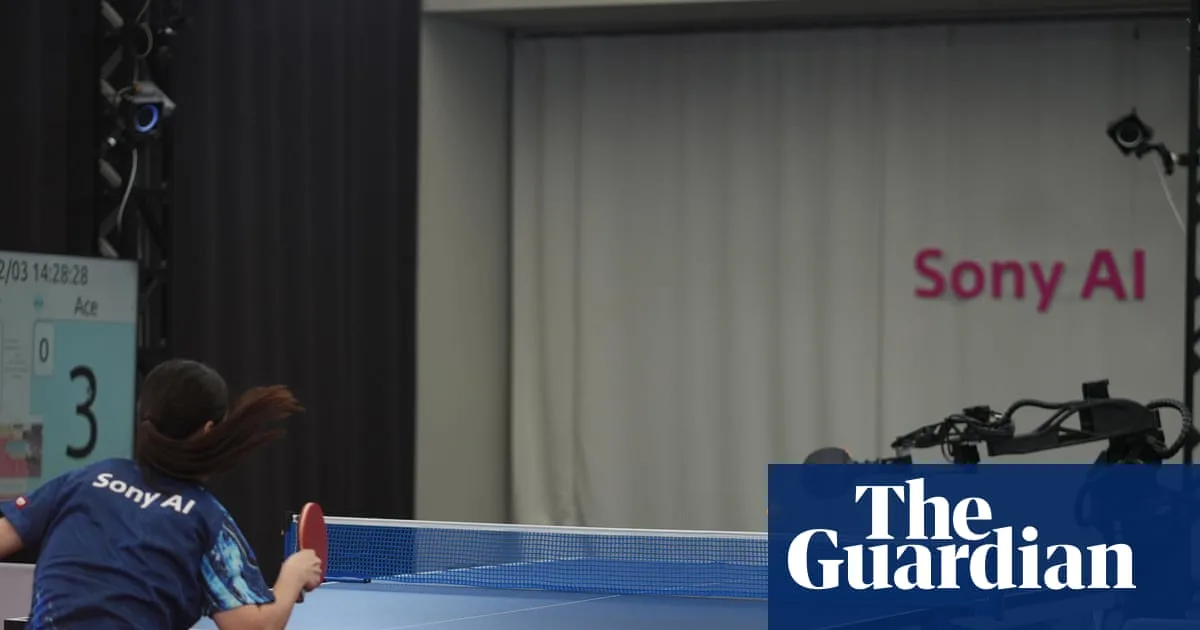
Sony AI's Table Tennis Robot Ace Beats Elite Players in Historic Breakthrough
AI Robot Ace Wins Table Tennis Matches Against Elite Players

Sony AI's Table Tennis Robot Ace Triumphs Over Elite Players in Groundbreaking Demonstration

In a remarkable leap for robotics and artificial intelligence, an autonomous robot named Ace, developed by Sony AI, has achieved victories against three elite table tennis players. This breakthrough highlights the rapid advancement of physical AI agents capable of competing in highly dynamic and complex sports environments.

Advanced Technology Behind Ace's Table Tennis Prowess

The robot is fully autonomous, relying on a sophisticated integration of vision sensors, control systems, and high-speed hardware to respond in real-time during matches. This allows Ace to perceive the ball's trajectory, spin, and speed, making split-second decisions akin to a human player. The system's design includes three critical components: a high-speed perception system, a novel control system, and state-of-the-art robotic hardware, all working in unison to enable precise physical execution.

Incredible footage from the matches showcases Ace winning three out of five games against elite opponents, executing sophisticated moves such as unusual spins and bouncing balls off the net. The robot demonstrated a 75 percent return rate and scored 16 direct 'aces,' underscoring its competitive edge. However, Ace faced limitations when pitted against professional players Minami Ando and Kakeru Sone, both active in the Japanese professional league, losing both matches and indicating room for further development.

Wide Pickt banner — collaborative shopping lists app for Telegram, phone mockup with grocery list

Why Table Tennis Poses a Unique Challenge for Robotics

Table tennis has long been considered one of the most demanding disciplines for robots to master, due to its requirement for rapid decision-making, precise physical actions, and continuous adaptation to unpredictable opponents. The sport's complexity stems from the ball's high speed, intricate spin, and complex trajectories, factors that have often been overlooked in prior robotics research. Sony AI emphasized that this makes table tennis an ideal real-world test for advancing AI capabilities in physical spaces.

Peter Dürr, Director of Sony AI in Zürich and project lead for Ace, commented on the significance of this achievement. 'This research has shown that an autonomous robot can, in fact, win at a competitive sport, matching or exceeding the reaction time and decision making of humans in a physical space,' he said. 'Table tennis is a game of enormous complexity that requires split-second decisions as well as speed and power. This research breakthrough highlights the potential of physical AI agents to perform real-time interactive tasks, and represents a significant step toward creating robots with broader applications in fast, precise, and real-time human interactions.'

Broader Implications for AI and Robotics

This development marks a historic moment in AI research, as it is the first time a robot has surpassed amateur-level performance in competitive table tennis play. Previous robotics efforts in the sport have typically been limited to rallying, without achieving competitive success. The achievement builds on robots' demonstrated 'superhuman' performance in other areas, such as long-distance running, chess, and video games, but table tennis presents unique physical and cognitive challenges.

Peter Stone, Chief Scientist at Sony AI, highlighted the wider implications. 'This breakthrough is much bigger than table tennis,' he stated. 'It represents a landmark moment in AI research, showing, for the first time, that an AI system can perceive, reason, and act effectively in complex, rapidly changing real-world environments that demand precision and speed. Once AI can operate at an expert human level under these conditions, it opens the door to an entirely new class of real-world applications that were previously out of reach.'

The success of Ace suggests promising future applications for robotics in fields requiring fast and precise human interactions, from healthcare to manufacturing. As AI continues to evolve, the line between human and machine capabilities in physical tasks becomes increasingly blurred, paving the way for innovative technologies that could transform various industries.

Pickt after-article banner — collaborative shopping lists app with family illustration