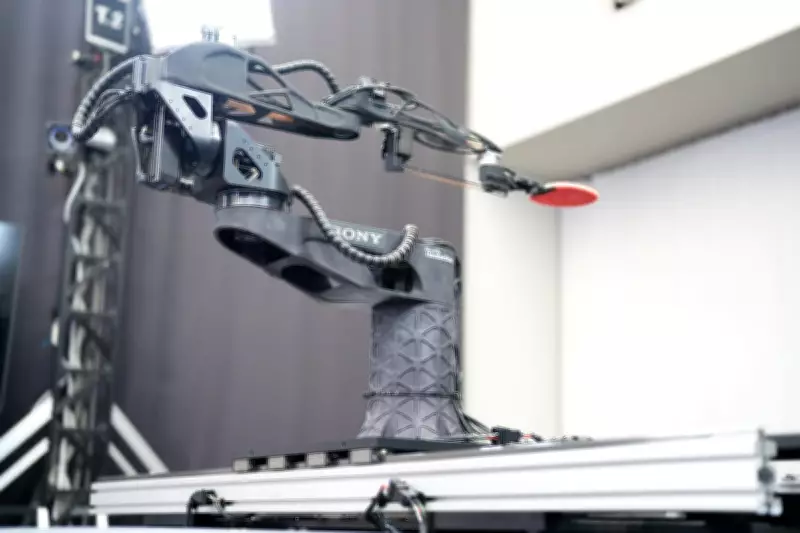
Sony's AI-Powered Robot 'Ace' Triumphs Over Human Table Tennis Professionals
A robotic arm developed by Japanese electronics giant Sony, named 'Ace', is demonstrating remarkable prowess in table tennis, consistently challenging and often defeating elite human players. This achievement, detailed in a new study published in the journal Nature, highlights significant advances in artificial intelligence that are enhancing robot agility and adaptability in dynamic physical environments.
Reinforcement Learning Drives Unprecedented Robot Performance
The robot learned to play table tennis using reinforcement learning, an AI method where it improves through experience rather than pre-programmed instructions. Sony AI researcher Peter Dürr, co-author of the study, emphasized that programming a robot manually for such a complex task is impossible. "There’s no way to program a robot by hand to play table tennis. You have to learn how to play from experience," Dürr stated in an interview with The Associated Press.
To ensure fair competition, Sony constructed an Olympic-sized table tennis court at its Tokyo headquarters, providing a "level playing field" for professional athletes. The custom-built robot features eight joints, or degrees of freedom, allowing it to position its racket, execute shots, and respond swiftly to opponents' rallies. Its nine camera eyes track the ball's logo to measure spin, giving it an uncanny ability to anticipate movements.

A Milestone in AI and Robotics Research
Sony describes this as the "first time a robot has achieved human, expert-level play in a commonly played competitive sport in the physical world—a longstanding milestone for AI and robotics research." Michael Spranger, president of Sony AI, noted that while factory robots are fast, they repeat fixed trajectories. In contrast, Ace demonstrates adaptability in uncertain, changing environments, a crucial step for applications in manufacturing and beyond.
Spranger explained that the goal was not to create a superhuman robot with unfair advantages, such as excessive speed or reach, but to achieve comparability with skilled athletes training over 20 hours weekly. "The robot cannot just win by hitting the ball faster than any human ever could, but it has to win by actually playing the game," he said, emphasizing tactics and decision-making over brute force.
Overcoming Challenges in Human-Robot Interaction
Building parity with humans in split-second interactions poses a significant challenge. Spranger likened recent progress to a "kind of ChatGPT moment for robotics," with AI-driven approaches enabling robots to tackle physically demanding tasks in real-world settings. This contrasts with earlier benchmarks like chess or video games, where simulations dominated.
John Billingsley, a retired mechatronics professor who pioneered robot table tennis in 1983, acknowledged Sony's achievement but noted its reliance on extensive computer vision and motion detection. "I would not want to belittle the achievement, but they have gone at the task mob-handed, and used sledgehammer techniques," he commented, adding that such contests drive true progress, whether in sports or space exploration.
Human Players React to Robot's Advanced Capabilities
Japanese professional players Minami Ando and Kakeru Sone competed against Ace, with umpires from the Japanese Table Tennis Association overseeing the games. After peer review, Sony continued experiments, with Ace accelerating shot speeds and playing more aggressively. In December, it defeated three out of four high-skill players.
Kinjiro Nakamura, a 1992 Barcelona Olympian, observed Ace executing a shot he deemed impossible for humans. "No one else would have been able to do that. I didn’t think it was possible," he remarked, suggesting that the robot's success might inspire new human techniques.
This breakthrough not only showcases robotics' potential in sports but also hints at future applications in industries requiring speed and adaptability, though ethical considerations around uses in areas like warfare remain. As AI continues to evolve, Sony's Ace sets a new standard for machine-human competition in the physical realm.