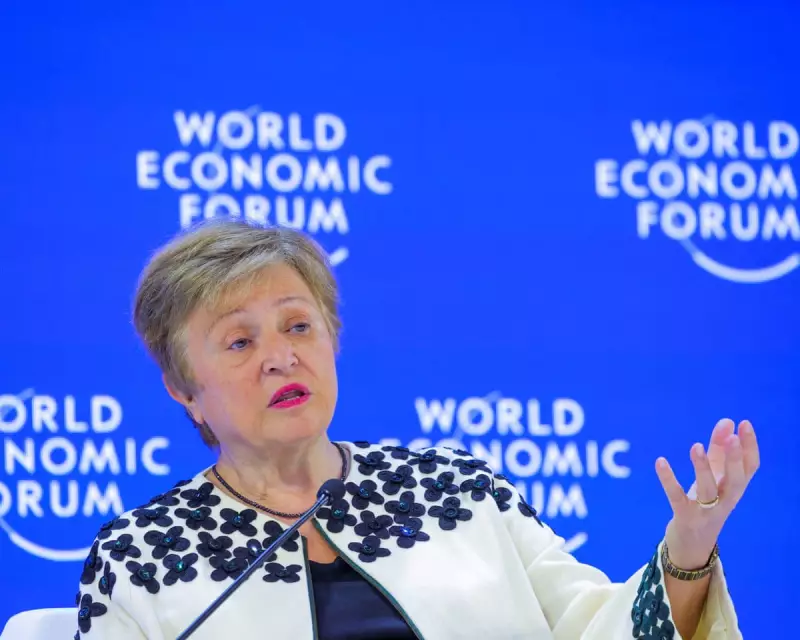
Kristalina Georgieva, the head of the International Monetary Fund, has issued a stark warning that artificial intelligence will act as a "tsunami hitting the labour market," with young people expected to suffer the most severe consequences. Speaking at the World Economic Forum in Davos, she highlighted that the IMF's research indicates a significant transformation in skill demand as AI technology becomes more pervasive.
Widespread Impact on Employment
Georgieva stated, "We expect over the next years, in advanced economies, 60% of jobs to be affected by AI: either enhanced or eliminated or transformed – 40% globally." She described this as a monumental shift that will reshape the workforce, emphasising that the effects are already being felt. In advanced economies, approximately one in ten jobs have already been enhanced by AI, leading to increased pay for those workers and broader economic benefits.
Youth and Entry-Level Jobs at Greatest Risk
However, the IMF chief warned that AI poses a particular threat to younger workers. "Tasks that are eliminated are usually what entry-level jobs do at present, so young people searching for jobs find it harder to get to a good placement," she explained. This could exacerbate challenges for those entering the job market, potentially widening the gap between experienced and novice workers.

Middle Class Squeeze and Regulatory Concerns
Georgieva also predicted that the middle class will inevitably be affected, as workers whose jobs are not directly changed by AI may see their pay fall without corresponding productivity gains. She expressed her greatest fear as the lack of sufficient regulation for AI, stating, "This is moving so fast, and yet we don't know how to make it safe. We don't know how to make it inclusive. Wake up, AI is for real, and it is transforming our world faster than we are getting ahead of it."
Broader Debates at Davos
While much of the discussion at the World Economic Forum was overshadowed by geopolitical issues, such as Donald Trump's tariff threats, many delegates focused on the risks and benefits of AI. Christy Hoffman, general secretary of the UNI global union, told the Guardian, "It's just a basic premise that the point of AI, on the business side, is to increase productivity, therefore lower costs – which will be cutting jobs." She called for fair distribution of productivity gains and urged employers to involve workers in discussions about AI implementation.
Global Cooperation and Inequality Warnings
On a panel with Christine Lagarde, president of the European Central Bank, Georgieva heard warnings that the AI boom could be hindered by growing mistrust between economies. Lagarde pointed out that AI is capital, energy, and data intensive, and without cooperative efforts to define new rules, there could be less capital and data available. She also highlighted deepening global inequality, describing it as a "disparity that is getting deeper and bigger."
Earlier in the week, Microsoft CEO Satya Nadella cautioned that AI might lose its "social permission" if benefits are concentrated among a few tech firms, rather than leading to broader advancements like new drug development. Meanwhile, Canadian Prime Minister Mark Carney spoke of a permanent "rupture" in the global economic order, though Lagarde offered a more nuanced view, suggesting alternatives rather than rupture.
Overall, the message from Davos is clear: AI's rapid advancement demands urgent attention to regulation, inclusivity, and equitable distribution of its impacts to mitigate risks to jobs, particularly for the younger generation.