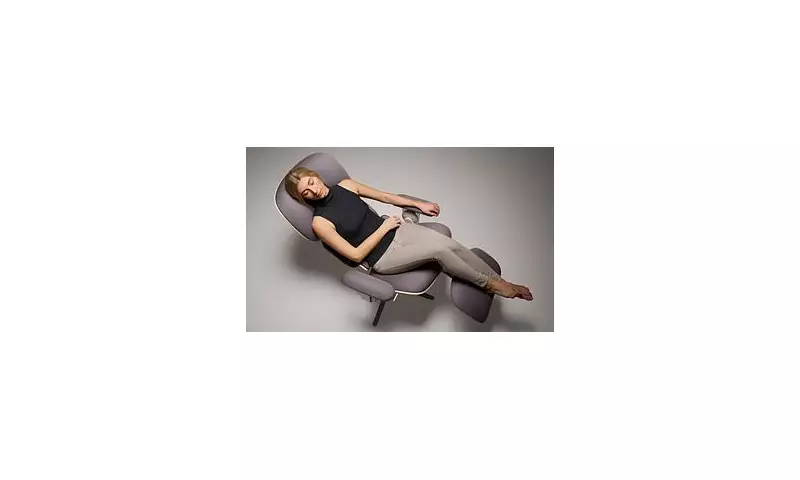
Would you dare to take a seat on a chair that promises to transport you into an 'altered state of mind' within mere minutes? This is the bold claim behind the Aiora chair, a cutting-edge piece of furniture crafted by researchers from the University of Essex in collaboration with the British design firm DavidHugh LTD.
How the Aiora Chair Works
Employing an innovative technology termed 'pure planar motion mechanics', the Aiora chair replicates the sensation of floating in zero-gravity. According to its creators, this effect closely mirrors the experience of being suspended in a sensory deprivation flotation tank.
Each component of the chair – including the headrest, arms, backrest, and seat – moves along individual horizontal trajectories. This design ensures that the parts are not accelerated by gravity, unlike traditional rocking chairs. Additionally, ultra-smooth bearings minimise resistance and friction, allowing the chair to seamlessly follow the body's natural movements.

Dr David Wickett, the chair's designer and co-founder of DavidHugh Ltd, notes that the system is so sensitive that 'even breathing can lift the entire body'. As a result, users do not feel pressure in any specific area, creating an illusion of floating rather than sitting.
Brain Activity and Meditative States
Since 2018, psychologists have been investigating how this unique chair influences brain activity. Lead researcher Dr Nick Cooper, from the Centre for Brain Science, states: 'Several of our studies have revealed patterns of brain activity similar to those reported in long-term Buddhist meditators, and remarkably, in people with no prior meditation experience.'
Dr Cooper and his team at the University of Essex have observed that individuals tend to enter a 'non-ordinary state of consciousness' within five to ten minutes of using the chair. He explains: 'We see increases in slow wave brain activity over time, when using the chair. These changes are particularly pronounced over the right frontal areas, which are associated with various brain control mechanisms, and the fronto-central cortex, linked to cognitive tasks requiring concentration or attention.'
The researchers are particularly intrigued by changes in 'frontal midline theta' brain waves, which closely resemble those seen in expert meditators. Although a peer-reviewed paper on these findings is forthcoming, the exact mechanisms remain unclear. Dr Cooper hypothesises: 'At the moment, we hypothesise that this has something to do with the way that the chair dramatically reduces the amount of sensory input that the brain is receiving, and so therefore allows a more internally based attentional focus to take over.'
Comparisons to Sensory Deprivation
If this hypothesis holds, the Aiora chair may produce effects akin to sensory deprivation flotation chambers. These chambers use highly saline water to achieve neutral buoyancy, eliminating the sensation of gravitational pressure. Combined with darkness and soundproofing, they significantly reduce sensory input, leading to benefits such as deep meditative states and lowered blood pressure.
Dr Wickett adds: 'Whilst floating in weightlessness is extraordinary in itself, what is even more remarkable is what people report after experiencing the chair with eyes closed. People often report being in a boundless space, experiencing illusions of movement, and being without thought.'
Cost and Accessibility
However, the opportunity to relax like a seasoned meditator comes at a premium. The Aiora chair carries a substantial price tag of £9,950, positioning it as a luxury item for those willing to invest in advanced wellness technology.
In contrast, traditional methods like Transcendental Meditation (TM) offer alternative pathways to altered states. TM involves silently repeating a personalised mantra to induce a trance-like state, with costs varying based on instruction and subsidies available through organisations like the David Lynch Foundation.
The Aiora chair represents a fusion of scientific innovation and furniture design, offering a novel approach to mental relaxation and brain health. As research continues, it may pave the way for new applications in wellness and therapeutic settings.