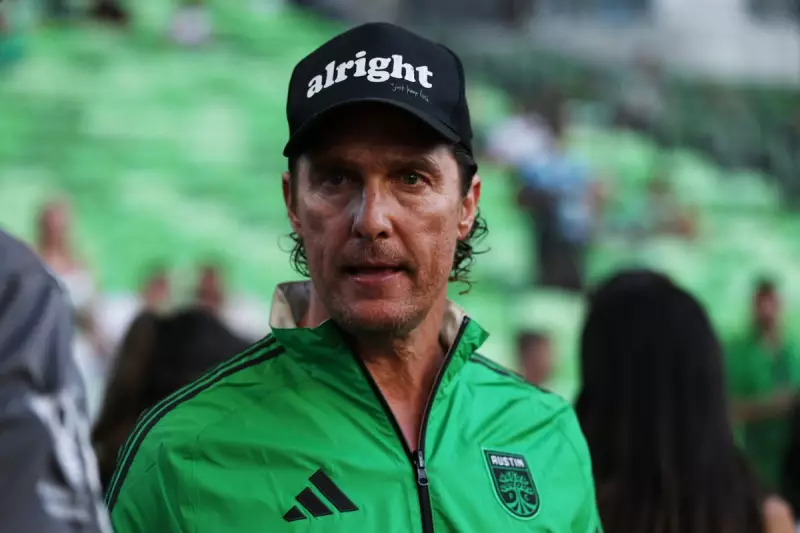
Academy Award-winning actor Matthew McConaughey has taken a significant legal step to protect his identity in the digital age, successfully trademarking his iconic catchphrase "alright, alright, alright" as a weapon against artificial intelligence deepfakes.
A Federal Shield Against Digital Impersonation
The 56-year-old star recently secured eight separate trademarks designed to shield his likeness from unauthorised AI exploitation. The protections extend beyond his famous phrase to include his distinctive voice, his smile, and specific audio-visual clips. This strategic move, orchestrated by attorneys from the entertainment law firm Yorn Levine, transforms McConaughey's personal brand elements into federally protected intellectual property.
The trademark for the phrase meticulously details its unique delivery, noting in the registration that "the mark consists of a man saying 'ALRIGHT ALRIGHT ALRIGHT,' wherein the first syllable of the first two words is at a lower pitch than the second syllable, and the first syllable of the last word is at a higher pitch than the second syllable." This precise definition, first reported by Variety, closes loopholes for potential imitators.

From Improvised Line to Legal Property
The journey of "alright, alright, alright" from improvised line to trademarked property began over three decades ago. McConaughey first coined the phrase in Richard Linklater's seminal 1993 coming-of-age comedy Dazed and Confused. What started as an off-the-cuff moment for his character, Wooderson, evolved into his signature greeting and a pop culture staple.
The legal process to secure this protection was initiated in December 2023, with the U.S. Patent and Trademark Office granting final approval in December 2025. The suite of trademarks approved in recent months is comprehensive, including:
- Audio of McConaughey saying, "Just keep livin', right? I mean, what are we gonna do?"
- A three-second video clip of him seated before a Christmas tree.
- A seven-second video recording of him standing on a porch.
While existing state laws already prevent the use of a celebrity's likeness to sell products without consent, McConaughey's new federal trademarks are far broader. They empower him to sue in federal court over general "misuse" on the internet, even if an AI-generated video featuring his image or voice isn't explicitly advertising a product.
Setting a Precedent in an Unregulated Landscape
Jonathan Pollack, a lawyer at Yorn Levine, highlighted the significance of this strategy to Variety. "In a world where we're watching everybody scramble to figure out what to do about AI misuse," Pollack stated, "we have a tool now to stop someone in their tracks or take them to federal court."
McConaughey himself explained his motivation to the Wall Street Journal, emphasising control and consent. "My team and I want to know that when my voice or likeness is ever used, it's because I approved and signed off on it," the actor said. "We want to create a clear perimeter around ownership with consent and attribution the norm in an AI world."
This stance does not mean McConaughey is wholly opposed to AI technology. In a controlled partnership, he collaborated with AI audio firm ElevenLabs in November 2025 to create a synthetic version of his voice. This authorised clone was used to produce a Spanish-language audio version of his weekly newsletter, 'Lyrics of Livin'. This distinction between consented use and malicious deepfakes is at the heart of his legal strategy.
McConaughey's proactive measures reflect a growing trend among public figures. As AI tools become more accessible and are used to create everything from fake endorsements to non-consensual explicit imagery, celebrities and politicians alike are seeking legal and legislative remedies. Figures like Alexandria Ocasio-Cortez are pushing for laws to ban deepfakes, while individuals like McConaughey are fortifying their personal legal arsenals, setting a potential precedent for how identity is protected in the artificial intelligence era.