Sprout: The Friendly Humanoid Robot Designed for Homes, Not Factories
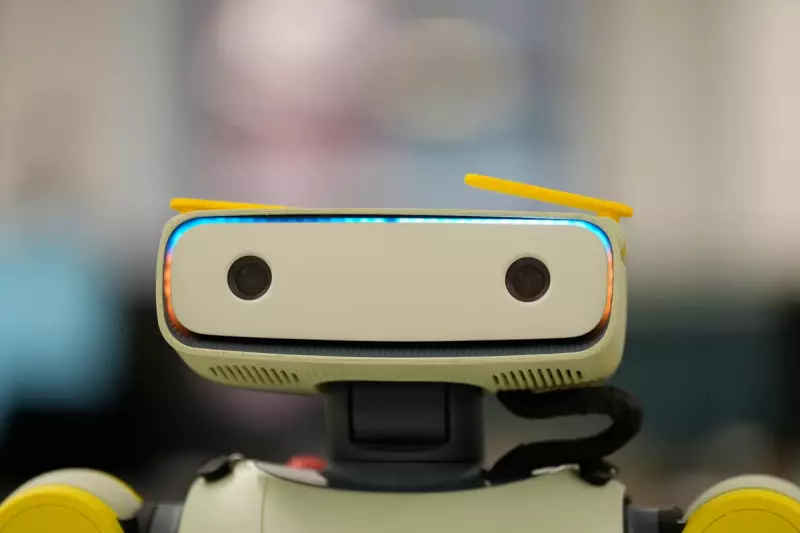
A new humanoid robot named Sprout, developed by the stealth startup Fauna Robotics, is making its public debut with a mission to change perceptions about robots in domestic environments. Standing at 3.5 feet tall and featuring a soft, padded exterior of sage-green foam, Sprout presents a stark contrast to the sleek, intimidating designs often associated with humanoid robotics.
Charm Over Intimidation: A New Approach to Robotics
As Sprout walks around a Manhattan office, nodding its rectangular head, lifting its windshield wiper-like "eyebrows," and offering to shake hands with its grippers, it embodies an entirely different philosophy from companies like Tesla. The robot's charm is intentional, designed so that even a five-year-old child could comfortably interact with it at eye level.
Forged over two years of secret research and development, Sprout's public debut aims to jump-start a new industry focused on building "approachable" robots for homes, schools, and social spaces. This represents a significant departure from the conventional path for humanoid robot commercialization, which typically targets industrial applications first.

Inspired by Fiction, Built for Reality
"Most people in this industry take inspiration from the science fiction that we grew up with," said Fauna Robotics co-founder and CEO Rob Cochran. "I think some do so from 'Westworld' and 'Terminator.' We do from WALL-E and Baymax and Rosie Jetson."
This inspiration is evident in Sprout's emotive expressions and blinking lights, which evoke generations of Star Wars droids and other endearingly clunky robotic sidekicks from animation studios and children's literature. The robot represents what Cochran believes is a pivotal moment in robotics development: "I do think we're right on the precipice now where you could build a companion that is present, engaging, delightful to be around, and can also move around a space in a way that nothing ever has before."
Skipping the Factory Floor for Developer Platforms
While companies like Tesla and Boston Dynamics envision their humanoid prototypes working in warehouses or factories, Fauna Robotics is targeting a different clientele: robot tinkerers and developers. Sprout functions primarily as a software developer platform, drawing parallels to how early personal computers and smartphones sparked cultures of innovation through third-party applications.
Priced at $50,000, Sprout represents a mechanically complex platform that Fauna claims is "the first American company to be actively shipping robots as a developer platform." Early customers include Disney and Boston Dynamics, with the company hand-delivering the first models.
Marc Theermann, chief strategy officer at Boston Dynamics, noted in a recent interview: "You take it out of the box and you can start walking it around immediately. Seeing their robot for the first time really lets you see the future a little bit. And if you squint, you can see how a robot like that would be welcomed into people's homes."
Capabilities and Testing in Real Environments
During demonstrations at Fauna's headquarters in New York City's Flatiron District, Sprout showcased its abilities to dance the Twist or the Floss, grab toy blocks or teddy bears, and hoist itself from chairs to take strolls along wood floors. The robot walks slowly but steadily on uneven ground and can navigate around obstacles, planning new paths when people step in front of it.
Ana Pervan, a Fauna research scientist who works on the robot's mapping and navigation, explained: "It's cute, and it's not too humanoid, and I think that actually makes it a lot more fun. It's not verging on creepy or trying to be too human. It's like your buddy, your pal, that's a different thing than you."
Technical Foundations and Design Philosophy
The development of Sprout benefits from recent improvements in artificial intelligence, motors, and batteries that have accelerated humanoid development. Co-founder Josh Merel, an expert in robot locomotion who previously worked for Google's DeepMind, brought expertise in teaching robots using AI learning techniques in simulated environments.

However, the founders recognized that the "dystopian aesthetic" of many prototypes—what Cochran calls "industrial automotive machismo"—conveyed strength and confidence but wouldn't work for intimate human spaces. "They were generally quite big and physically dangerous to be around," Cochran noted. "Strong, heavy. If they fell on you, it'd be a real problem."
To address this, the team brought in Anthony Moschella, who helped design Peloton's exercise equipment and admires the abstract designs of Star Wars robots like R2-D2 and BB-8. "Let's build a system that human beings actually want to be around," said Moschella, now Fauna's vice president of hardware. "I think it's incredible that so many robotics companies are not versed in the cultural context of what it means to be around a robot."
A Challenging Industry with New Possibilities
Starting a robot company focused on personal robots remains challenging, as evidenced by the recent bankruptcy filing of Roomba maker iRobot after decades of operation, and the failures of companies like Anki and Jibo. Cochran acknowledges these challenges but believes the technology has now reached a tipping point.
What happens next with Sprout will depend largely on how developers experiment with the platform and what they learn from their interactions. For Cochran, some of the most important validations have already come from personal experience: in a home video on his phone, his two-year-old twins excitedly jump up and down as Sprout greets them, suggesting the robot might indeed be ready for domestic environments.