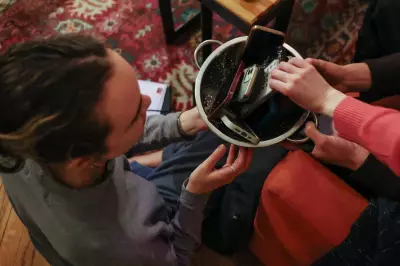
Darren Lewis Calls for a Return to Human Connection Over Phone Obsession
In a poignant commentary, columnist Darren Lewis has issued a stark warning about modern society's troubling instinct to film conflicts rather than intervene. Recent footage of a heated row on the streets of London serves as a chilling example, where bystanders instinctively reached for their phones to capture the altercation instead of offering assistance.
The Glasgow Tragedy and Social Media's Dark Side
Lewis recalls the harrowing images from twelve years ago, when a runaway bin lorry killed six people in Glasgow. He notes that the tragedy was compounded by a stampede of social media users racing to post the graphic scenes on Twitter. "So many among us have learned little if anything since then," he laments, highlighting how lives are increasingly lived through a lens, with ethical boundaries frequently crossed.
While acknowledging that many people, including himself, are guilty of innocuous acts like photographing food at events, Lewis argues that the explosion of podcasts and primary sources has made it harder to dismiss social media users as mere attention seekers. However, he points to horrendous examples of societal decay, such as the London row where bystanders filmed the incident, potentially viewing it as content rather than a crisis.

London Incident: A Case Study in Bystander Apathy
The altercation in London involved two women, and footage shot from multiple angles suggests some onlookers saw it as an opportunity to capture engaging material. "Shameful," Lewis declares, noting that while news organisations might need first-person images for verification, these recordings often serve to drive engagement on platforms. In a related event, a woman was arrested on suspicion of attempted murder after a car hit pedestrians in central London, critically injuring social media influencer Klaudia Zakrzewska, known as Klaudiaglam.
Lewis observes that spending just an hour on social media reveals a global trend: individuals' first instinct is to reach for their phones during notable incidents. This phenomenon is epitomised by the iconic Phone Free Old Lady photograph from the 2015 Black Mass film premiere in Brookline, Massachusetts. In it, an elderly woman smiles while simply watching the event, surrounded by fans frenetically capturing stars like Johnny Depp on their devices.
Theatrical Outrage and Societal Wake-Up Calls
The columnist expresses sympathy for actress Lesley Manville, who was vilified for criticising theatre-goers taking photos during curtain calls as "insulting." Manville questioned why people couldn't "let it live in their souls for five minutes?" yet was dismissed as out of touch. Lewis argues that events like the London row demonstrate how far this phone obsession has escalated, with some individuals banking violent or confrontational footage for social media likes and retweets.
He concludes that while most people aren't ghouls addicted to such content, society is guilty of believing it can't cope without capturing special moments, even when danger arises. "We're obsessed with living life through our phones," he warns, noting that wake-up calls have been plentiful, yet change remains elusive. Lewis's message is clear: to stay in touch with humanity, it's time to put the phones down and reconnect with the real world.