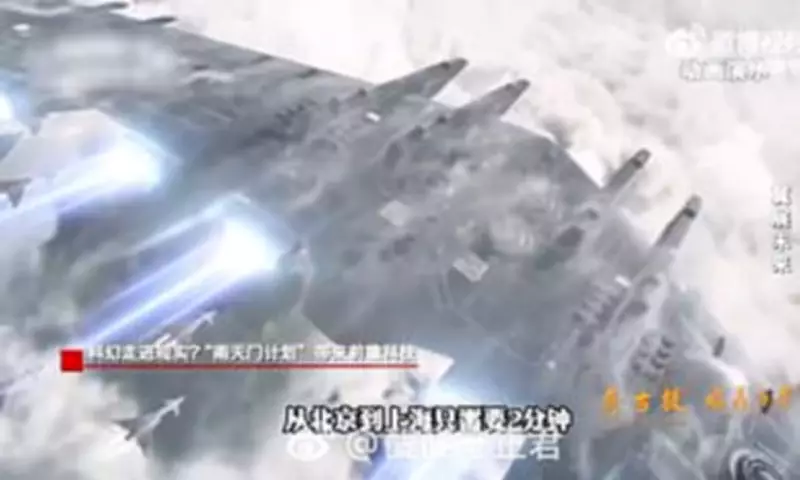
China has disclosed ambitious blueprints for a futuristic 'Star Wars'-style space carrier, designed to deploy nearly one hundred unmanned fighter jets and operate at the edge of Earth's atmosphere. The proposed vessel, named the Luanniao, represents a significant leap in military aerospace technology, though experts remain divided on its practical feasibility.
Specifications and Capabilities of the Luanniao
The Luanniao is slated to be an immense structure, measuring 794 feet in length and 2,244 feet in width, with a takeoff weight of 120,000 tonnes. If constructed, it would become the largest warship globally. Its primary function would be to carry up to 88 unmanned Xuan Nu fighter jets, which are currently in the conceptual phase. These aircraft are intended to be highly manoeuvrable stealth platforms capable of launching hypersonic missiles, enhancing China's strategic reach.
Timeline and Project Background
Chinese authorities have projected that the Luanniao could be operational within the next 20 to 30 years. The warship was first conceived a decade ago, initially dismissed by many as science fiction. It forms part of China's broader 'Nantianmen' Project, meaning 'South Heavenly Gate', developed by the Aviation Industry Corporation of China to advance the nation's space and air capabilities.

Expert Analysis and Feasibility Concerns
Defence analysts express scepticism regarding the technical viability of the Luanniao. Peter Layton, a defence expert and visiting fellow at Australia’s Griffith Asia Institute, noted that if completed, the carrier would 'outclass pretty much everyone'. He explained to the Telegraph that it could fly beyond the range of surface-to-air missiles and most defensive systems, positioning itself directly above targets for more effective strikes.
However, significant hurdles exist. The technology required for any aircraft, especially one of this magnitude, to hover at the atmospheric boundary does not currently exist. It would demand an enormous amount of fuel and a novel propulsion system. Alternatively, placing the ship into full orbit would expose it to vulnerability from space debris, and China lacks proven reusable rocket technology necessary for such a launch.
Strategic Motivations and Public Perception
Given these challenges, some experts speculate that the announcement may serve as a publicity stunt aimed at inspiring the Chinese public and bolstering the nation's international standing. Layton suggested that for external audiences, it paints a picture of China working on advanced 'Star Wars' technology that other regions cannot aspire to, thereby enhancing its geopolitical influence.
Despite the doubts, the Luanniao project underscores China's growing ambitions in aerospace and defence, marking a potential shift in global military dynamics if the plans ever materialise.