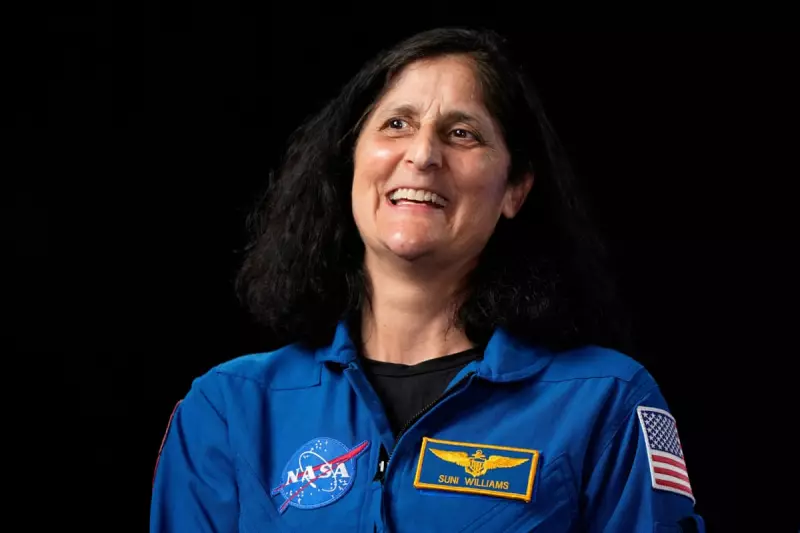
NASA Astronaut Suni Williams Concludes Illustrious 27-Year Career
NASA astronaut Suni Williams has officially retired from the United States space agency after a remarkable twenty-seven years of service. The announcement was made in a press release issued by NASA on Tuesday, confirming that the sixty-year-old former navy captain departed in December. Her retirement marks the end of an era for one of the agency's most accomplished and pioneering figures.
A Trailblazing Legacy in Human Spaceflight
Jared Isaacman, NASA's new administrator, lauded Williams as "a trailblazer in human spaceflight" in the official statement. Her career is distinguished by numerous records and historic achievements. Williams retires holding the record for the most accumulated spacewalk time by any woman, with more than sixty-two hours logged across nine separate extravehicular operations. This feat alone cements her status as a pivotal figure in the annals of space exploration.
In total, Williams launched into space three times. Her missions included a December 2006 flight aboard the US space shuttle Discovery, a July 2012 journey on a Russian Soyuz spacecraft, and the notable Boeing Starliner mission in June 2024. Cumulatively, she spent six hundred and eight days in space, ranking her second among all NASA astronauts, behind only Peggy Whitson's six hundred and ninety-five days.

The Extended Starliner Mission and Political Controversy
Williams will perhaps be best remembered for her role in the ill-fated first crewed flight of Boeing's new Starliner capsule. In June 2024, Williams and fellow astronaut Barry "Butch" Wilmore launched on what was intended to be a brief ten-day test mission to the International Space Station. However, technical problems with the spacecraft transformed the mission into a two hundred and eighty-six-day odyssey aboard the ISS.
This prolonged stay ignited a political firestorm on Earth. Figures such as Donald Trump and SpaceX chief Elon Musk publicly insisted the astronauts were "stuck" and had been "abandoned" by the Biden administration. Their eventual return home in March of the following year aboard a SpaceX Dragon capsule was framed by Trump as "a rescue" by his then-ally Musk.
At a post-landing press conference, both Williams and Wilmore, who retired last summer, were reluctant to engage with the political narrative. They denied ever feeling marooned or abandoned. Wilmore conceded that "in certain respects, maybe we were stuck", while Williams adopted a more diplomatic tone, stating, "We were just really focused on what we were doing and trying to be part of the team. Of course, we heard some things..."
Historic Achievements and Inspirational Impact
Beyond her spacewalk records, Williams achieved several other historic firsts. She became the first astronaut to run a marathon in orbit, officially participating in the Boston Marathon in April 2007 by running on a treadmill aboard the ISS as the event unfolded two hundred and fifty miles below.
Vanessa Wyche, director of the Johnson Space Center in Houston, Texas, praised Williams in the NASA statement. "Over the course of Suni's impressive career trajectory, she has been a pioneering leader," Wyche said. "Her exceptional dedication to the mission will inspire the future generations of explorers."
A Generational Transition and the Artemis Era
The announcement of Williams's retirement, made on the ninety-sixth birthday of Apollo astronaut Buzz Aldrin, symbolises a generational passing of the torch within NASA. It coincided with significant developments in the agency's Artemis programme. Just three days prior, NASA moved the Artemis II rocket, which is set to take humans around the Moon for the first time since 1972, to its launchpad at Florida's Kennedy Space Center.
Administrator Isaacman highlighted this transition in his tribute, noting that Williams's work has "laid the foundation for Artemis missions to the moon and advancing toward Mars." He added, "Her extraordinary achievements will continue to inspire generations to dream big and push the boundaries of what's possible."

The launch window for the Artemis II mission is scheduled to open on 6 February. The crew will consist of NASA astronauts Reid Wiseman, Victor Glover, and Christina Koch, along with Canadian astronaut Jeremy Hansen. In preparation, NASA will soon conduct a critical "wet test" dress rehearsal to assess the rocket's readiness.
In a related educational initiative, NASA reported that more than two point five million people have claimed a digital "boarding pass" for the flight. Their names will be stored on an SD card that will travel around the Moon inside the Orion crew capsule. A successful ten-day Artemis II mission is crucial for advancing plans for Artemis III, which aims to achieve the first human lunar landing in over fifty years, currently slated for next year.
Reflecting on her career and the future, Williams expressed that the International Space Station and its "awe inspiring people, engineering and science" have opened a clear pathway for new exploration of the Moon and Mars. Her retirement concludes a chapter defined by resilience, record-breaking accomplishment, and an unwavering commitment to expanding humanity's presence in the cosmos.