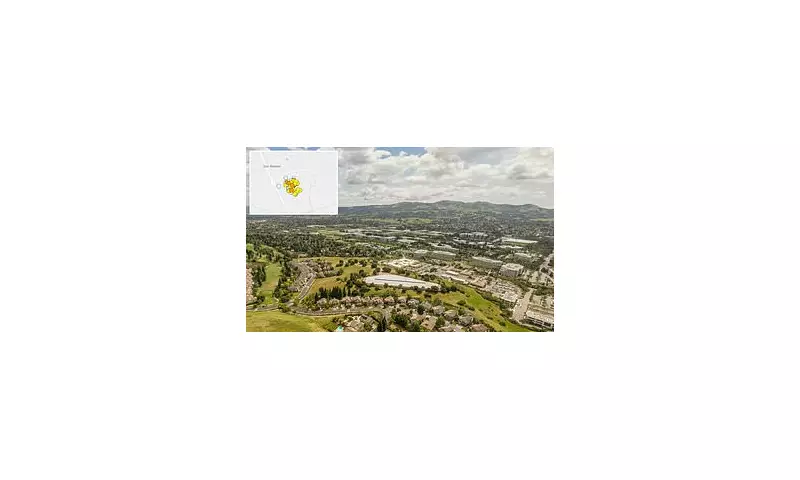
The San Francisco Bay Area has been experiencing a persistent and unsettling series of minor earthquakes over the past four days, centred on the city of San Ramon in the East Bay. This latest flurry of seismic activity is part of a longer trend that has seen the region shaken by dozens of tremors in recent weeks.
A Persistent Seismic Unrest
The most recent significant tremor was a magnitude 3.1 quake that struck at 5:53 am Pacific Time on Tuesday near San Ramon. This event was preceded by a dozen smaller quakes, with magnitudes between 1.1 and 1.6. The activity is not isolated to this week. Records show a consistent pattern of shaking:
- December 13: Magnitudes 2.9, 2.3, and 2.2.
- December 14: A 2.8-magnitude quake.
- December 15: Quakes of magnitude 2.4 and 2.1.
In total, San Ramon has endured more than 90 earthquakes in the past month alone, with 21 of those ranging from magnitude 2.9 to 4.0 over the last two months. The sequence began in early November with a magnitude 3.8 event, and the ground has not been still since.

Expert Analysis: Swarm, Not a Warning
The heightened activity has naturally sparked concern among residents, with many fearing it could be a foreshock sequence to a much larger, damaging earthquake. However, scientists from the United States Geological Survey (USGS) are urging calm based on the data.
Annemarie Baltay, a USGS research geophysicist, stated clearly that these small events are not indicative of an impending large earthquake. "These small events, as all small events are, are not indicative of an impending large earthquake," she told local media. Her colleague, Sarah Minson, reinforced this, noting, "This has happened many times before here in the past, and there were no big earthquakes that followed."
The scientific consensus points to the unique geology of the area as the cause. San Ramon sits atop the Calaveras Fault, an active branch of the wider San Andreas Fault system. Unlike the main San Andreas, this area features a complex network of smaller, interconnected fractures. Researchers believe movement of underground fluids through these narrow cracks can destabilise rock, triggering clusters of minor quakes.
"It is also possible that these smaller earthquakes pop off as the result of fluid moving up through the earth's crust," Baltay explained. Historical data shows similar swarms occurred in 1970, 1976, 2002, 2003, 2015, and 2018 without leading to a major seismic event.
The Constant Need for Preparedness
While experts are not unusually concerned about this specific swarm leading to a catastrophe, they issue a stark reminder about living in earthquake country. The Calaveras Fault itself is capable of producing a magnitude 6.7 earthquake, which would impact millions in the densely populated Bay Area.
Annemarie Baltay highlighted the long-term statistical risk: "There is a 72 percent chance of a M6.7 or larger anywhere in the Bay Area, between now and 2043. So we should all be aware and be prepared."
This latest period of seismic unrest serves as a timely drill and a reminder for residents to ensure their emergency kits are stocked, their family plans are in place, and their homes are as secured as possible against seismic shaking. The earth's movements may be small for now, but preparedness for the larger event that will one day come remains a critical priority for California communities.