A thick, persistent fog that has shrouded California's Central Valley for hundreds of miles since late November has triggered online speculation about a mysterious and hazardous 'radiation fog'. However, atmospheric scientists have moved swiftly to dispel these fears, explaining the phenomenon is a common and natural weather pattern for the region, posing no unusual risk to public health.
What is 'Radiation Fog' and Why is it Misunderstood?
The term 'radiation fog' refers to the radiation of energy, specifically heat, from the Earth's surface into the atmosphere, and has no connection to nuclear or radioactive material. In California, this phenomenon is traditionally known as 'tule fog', named after a native marsh plant. It forms on clear, calm nights when moist ground cools rapidly, causing water vapour in the air to condense into a dense, low-lying blanket.
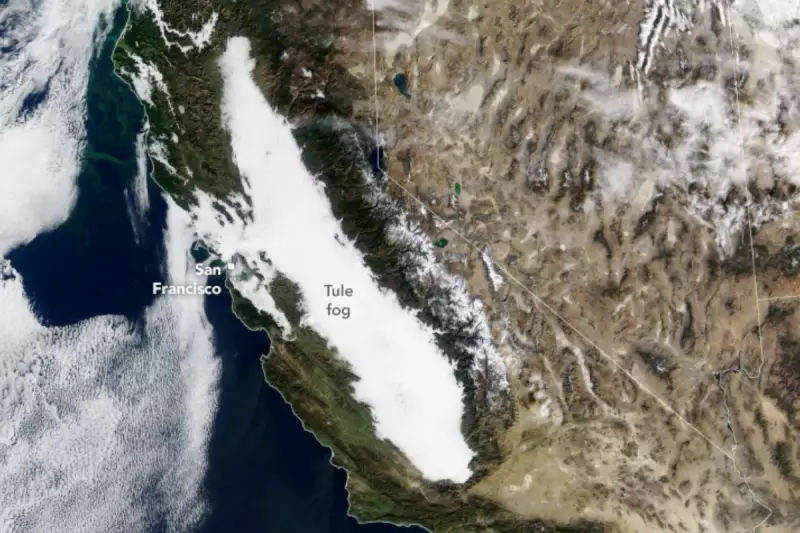
This season's particularly intense and widespread fog bank, often stretching 400 miles through the state's centre, has been exacerbated by a rainy autumn and a high-pressure system that settled over California in late November. Despite dramatic online posts, such as one from the popular X account Wall Street Apes showing a resident wiping soot from a truck, researchers stress the fog itself is a natural occurrence.

Resident Experiences and Historical Context
For those living under the dense, cold blanket, the experience has been eerie. David Mas Masumoto, a peach farmer in the San Joaquin Valley, described it to The New York Times as akin to entering a dream state or a twilight zone, with near-zero visibility. He remarked that in his 50 years, he could not recall a period of such persistently thick fog.
Interestingly, scientists note that tule fog events may actually be becoming less frequent compared to historical trends, making this prolonged event more notable. Satellite imagery from NASA has captured the vast, hundreds-of-miles-long fog bank lying over central California between late November and December.
Particles in the Fog: An Air Quality Issue
The particles or 'soot' some residents have observed are attributed to the region's well-documented air quality challenges, not the fog's origin. Peter Weiss-Penzias, a fog researcher at UC Santa Cruz, told the Los Angeles Times that 'fog is highly susceptible to pollutants.'
The heavily agricultural Central Valley, crisscrossed by major highways and farming operations, is known for trapping pollutants. As Dr. Weiss-Penzias explained, the fog can interact with and hold a complex mix of particles from the air, which could appear as visible residue. 'It could be a whole alphabet soup of different things,' he added.
The fog, which continued through the week beginning Sunday 21 December 2025, was expected to finally thin out as forecasted heavy rains arrived to disrupt the stable weather patterns that had allowed it to persist.