The Met Office, the United Kingdom's national weather and climate service, has announced a significant expansion of its forecasting capabilities with the launch of a new two-week weather prediction system. This innovative move aims to provide the public with more detailed and extended weather outlooks, enhancing the accuracy and utility of forecasts for everyday planning and safety.
Enhancing Forecast Accuracy with Extended Predictions
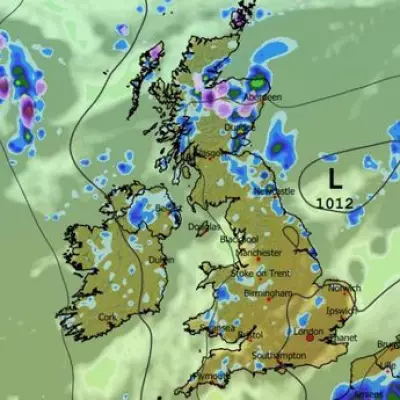
Currently, the Met Office offers a seven-day forecast on its digital platforms, featuring hourly breakdowns for the initial five days and three-hourly intervals for the final two. However, starting in the coming months, this will be extended to a comprehensive 14-day forecast. This new system will cover key weather elements such as rainfall, wind speed, and temperatures, offering a more prolonged view of potential weather patterns.
Probability-Based Forecasting: A Game-Changer
Recent research conducted by the Met Office has highlighted the benefits of adopting a probability-based approach to weather forecasting, particularly for extended ranges. This method involves calculating the likelihood of specific weather events, such as snow or rain, which can provide users with a clearer understanding of potential outcomes and risks.

Ken Mylne, a Met Office science fellow and author of the research, explained, "Most previous discussions on expressing probabilities in forecasts started from an assumption that they can be hard for people to understand and that expressing uncertainty could undermine people's confidence in the forecast and therefore undermine their ability to make decisions. However, this research suggests that this assumption is wrong. People can understand probabilistic forecasts and could indeed find it more useful for informing weather-based decisions."
Innovating Weather Science for Public Benefit
The Met Office's initiative is part of its broader mission to innovate in weather science, helping individuals and communities make better-informed decisions to stay safe and thrive. The organisation stated, "Developing communication of the forecast in this way is part of our role as the UK's national weather forecaster, innovating weather science to help people to make better decisions to stay safe and thrive."
While many third-party weather apps and websites already offer forecasts spanning two weeks or more, the Met Office has previously been cautious due to accuracy challenges. The new probability-based system aims to address these concerns by providing forecasts that, while potentially less precise, are still considered highly beneficial for decision-making.
Collaborations and Technological Advancements
This development comes amid a period of renewed collaboration and technological progress in the field of meteorology. In October of last year, the BBC announced its reunion with the Met Office for weather forecasts and climate updates, ending an eight-year separation. This partnership is expected to enhance the dissemination of accurate weather information to the public.
Furthermore, artificial intelligence is playing an increasingly pivotal role in advancing weather forecasting models. Companies like Nvidia have introduced Earth-2 models, claiming to make predictions faster and more accurate. Similarly, Google DeepMind reported in December 2024 that its AI weather programme outperformed the European Centre for Medium-Range Weather Forecasts' ENS system by up to 20%, showcasing the potential for AI to revolutionise long-range weather predictions.
Implications for Public Safety and Planning
The introduction of the two-week forecast is poised to have a significant impact on how people across the UK plan their activities and respond to weather-related risks. By providing extended outlooks with probability-based data, the Met Office aims to empower users with the information needed to make proactive decisions, whether for travel, agriculture, or emergency preparedness.
As weather patterns become increasingly unpredictable due to climate change, such advancements in forecasting technology are crucial. The Met Office's commitment to extending its services reflects a dedication to public service and innovation, ensuring that Britons have access to reliable weather information to navigate daily life safely and efficiently.