Mississippi Grapples with Historic Ice Storm Aftermath
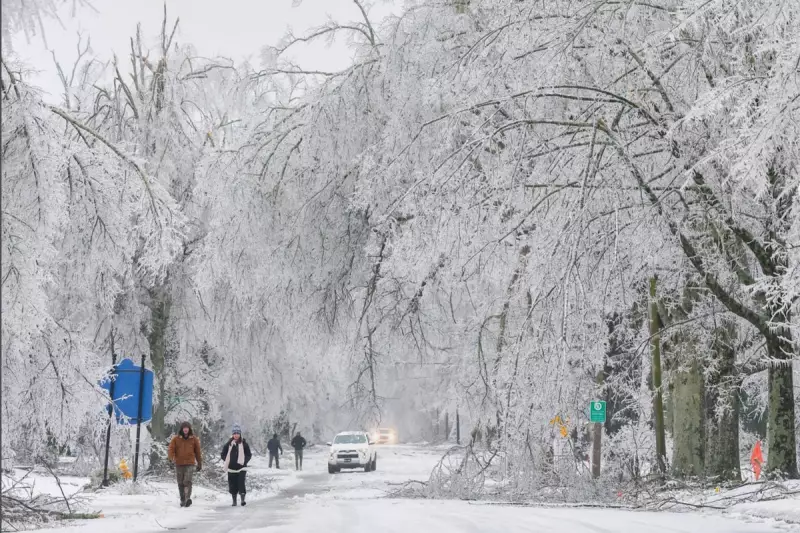
Residents across Mississippi are confronting a harsh reality as they endure freezing temperatures in darkened homes, with officials warning that recovery from the state's most severe ice storm in over three decades could extend for a week or longer. The crisis, which began over the weekend, has left communities struggling with extensive damage to infrastructure and essential services.
Widespread Devastation Across the Region
While the winter storm affected tens of millions of Americans nationwide, the most persistent impacts have concentrated in a band stretching from eastern Texas through northern Louisiana, Mississippi, and into Nashville, Tennessee. In Mississippi specifically, the situation has become particularly dire, with residents facing multiple overlapping challenges.
Power infrastructure has suffered catastrophic damage, leaving nearly 10% of the state's electricity customers without power by Monday afternoon - the highest percentage of any state in the nation. The Alcorn County Electric Power Association reported that all 19,000 of its electrical meters were completely dark at midday Monday, highlighting the scale of the disruption.

Critical Infrastructure Failures
Utility officials face complex challenges in restoring services. High-voltage transmission lines from the Tennessee Valley Authority have been knocked out, preventing local cooperatives from even assessing their own damage until upstream power is restored. Scott Brooks, a TVA spokesperson, confirmed that the power provider couldn't deliver electricity to 12 of its 153 local utilities due to substation damage.
The situation extends beyond electricity, with many areas losing running water and natural gas service. In Tippah County, the combination of power loss and utility failures has created what state Representative Jody Steverson described as "life-threatening" conditions, particularly given the forecast for continued extreme cold.
Personal Accounts of Destruction
Adrian Ronca-Hohn, a resident of Iuka in northeastern Mississippi, described the scene around his property as resembling "a war zone," with approximately 40 trees toppled by the storm. The 23-year-old football coach and storm chaser recounted the terrifying sounds of destruction during the storm's peak.
"We couldn't go 10 seconds without hearing what sounded like a gunshot," Ronca-Hohn said. "You'd hear a pop, a hard pop, and you'd hear the whistle of it falling, and then it would crash to the ground and just kind of explode. And every now and again, you'd hear one real close, like, right outside. It was a sleepless night."
Emergency Response Efforts
The Mississippi Emergency Management Agency has mobilized resources to address the crisis, attempting to distribute supplies to more than 60 safe rooms across the hardest-hit areas. Agency spokesperson Scott Simmons confirmed they've received 30 generators from the Federal Emergency Management Agency, which are being deployed to critical facilities including:
- Nursing homes and hospitals
- Rural water providers
- Emergency shelters and safe rooms
Additional supplies being distributed include cots, blankets, prepackaged meals, and bottled water to support residents without basic necessities.
Community Adaptation and Challenges
In Oxford, home to the University of Mississippi, parents expressed concern about students in off-campus apartments while trying to organize transportation to warming centers. The university has canceled classes for the remainder of the week as the community focuses on basic survival needs.
Marshall Ramsey, a journalism professor at Ole Miss and longtime editorial cartoonist, described the combination of breaking trees, exploding transformers, and thunder during the storm as a "demonic symphony." His family has been relying on a generator to power essential devices, with indoor temperatures dropping to around 50 degrees Fahrenheit.
"Apparently, the new status symbol in this town is having electricity," Ramsey observed. "It's a mess."

Jackson Mills, a 25-year-old Corinth resident, highlighted the practical challenges families face, having traveled to Tennessee to obtain gasoline for a generator after local stations closed. His family has consolidated at his grandfather's home to utilize a gas fireplace for warmth.
"We'd like for all this to mostly go away, just melt away, but it's just so dadgum cold that it's not melting," Mills lamented, capturing the frustration of many Mississippians facing an extended recovery period with no immediate relief in sight.