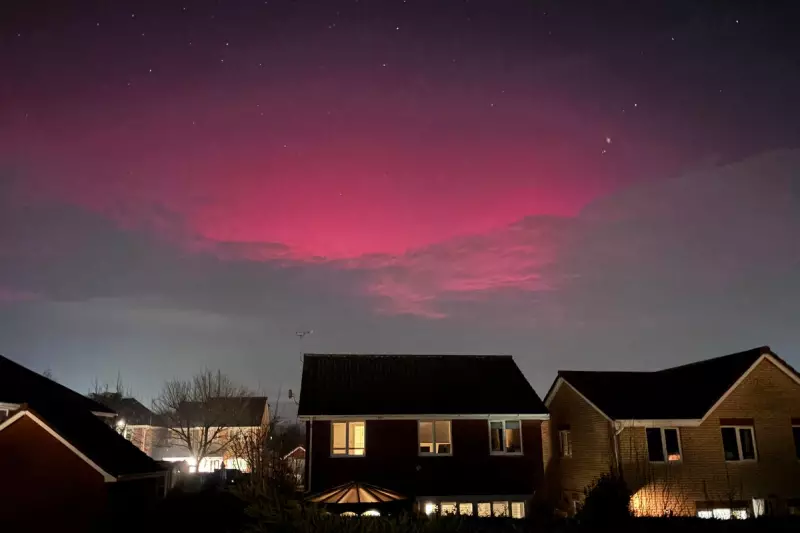
A rare and breathtaking display of the aurora borealis, or Northern Lights, painted the skies over the United Kingdom in vibrant hues of green and pink on Monday night, in a celestial show that reached remarkably far south.
Widespread Spectacle Driven by Solar Storm
The Met Office confirmed that the extraordinary light show was caused by a severe geomagnetic storm, the result of a significant Coronal Mass Ejection (CME) from the Sun. This event, which saw the Sun expel vast clouds of charged particles towards Earth, made the aurora visible across the nation, with reports even extending to northern Italy.
Typically a sight reserved for the Arctic Circle, the phenomenon was captured by photographers from Scotland and Northern Ireland right down to parts of south-west, southern, eastern, and northern England. Images shared from locations like Ipswich in Suffolk showed the lights illuminating the cloud cover, proving the scale of the event.

Viewing Prospects and Expert Insight
Krista Hammond, the Met Office Space Weather Manager, provided an update on the ongoing activity. "The CME is likely to result in geomagnetic storming, giving the potential to view the aurora," she stated. However, she cautioned that clear, dark skies are essential for sightings, and cloud and rain forecast for Tuesday evening could hinder views.
The effects of the storm were expected to linger, with chances of further sightings on Tuesday night primarily across Scotland, and possibly Northern Ireland and northern England where skies clear. Activity is predicted to wane significantly by Wednesday.
How and When to See the Northern Lights
For those hoping to catch a glimpse, experts advise getting away from light-polluted areas and allowing your eyes to adjust to the darkness. According to the US National Oceanic and Atmospheric Administration (NOAA), the best viewing window is usually within an hour or two of midnight.
The vibrant colours are created when solar particles collide with gases in our atmosphere. Oxygen produces the familiar green glow, while nitrogen is responsible for shades of purple, blue, and pink.
While the peak of the display has passed, the Met Office indicated that some glimpses may still be possible in parts of Scotland and Northern Ireland on Tuesday night, serving as a final reminder of the Sun's powerful influence on our planet.