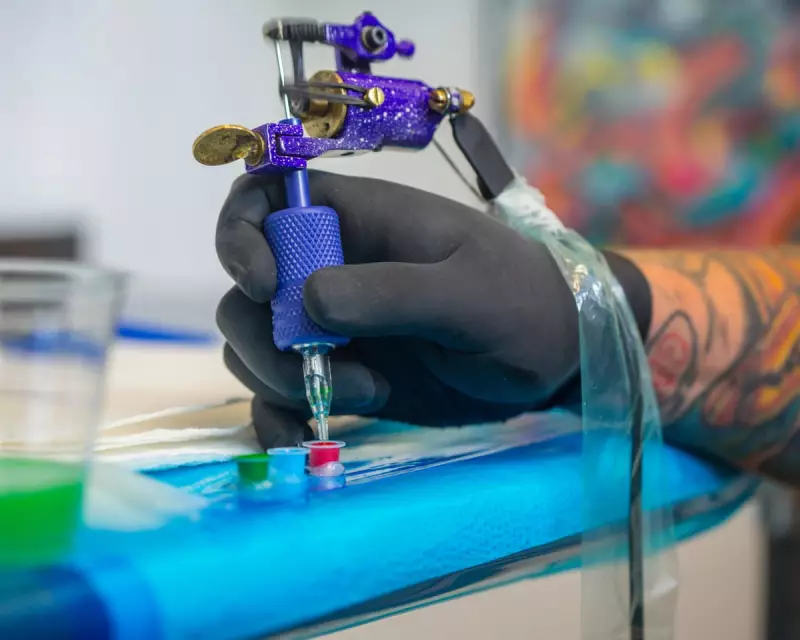
A new scientific study has raised significant concerns about the safety of tattoo inks widely available in Australia, revealing many contain toxic metals and carcinogenic chemicals at levels that would breach European Union safety regulations.
Widespread Practice, Minimal Oversight
Body art has become mainstream in Australia, with an estimated 30% of adults now sporting at least one tattoo. Of those, more than a third have five or more pieces. Despite this popularity, there is minimal national oversight of what these inks contain, leaving consumers with limited information about the substances being injected permanently into their skin.
Published in the Journal of Hazardous Materials, the research was conducted by a team from the University of New South Wales (UNSW), led by Professor William Alexander Donald and postdoctoral fellow Jake P. Violi. The project was inspired by a question from a high school student, Bianca Tasevski, highlighting a significant public knowledge gap.

Inks Fail European Safety Benchmarks
The researchers analysed 15 different black and coloured tattoo inks from major international brands sold and used in Australia. Using standard laboratory methods, they screened for a broad range of metals and organic compounds.
The findings were stark: every single ink tested would have failed at least one current EU safety requirement. The team detected multiple toxic metals, including arsenic, cadmium, chromium, and lead, at concentrations exceeding the legal limits enforced in the EU since 2022.
Furthermore, some inks contained restricted aromatic amines, organic compounds suspected of having carcinogenic potential. The study noted distinct patterns: black inks contained a wider range of regulated metals, while brightly coloured inks often had very high levels of specific pigment-associated metals like titanium, aluminium, and zirconium.
A Clear Regulatory Void in Australia
The situation in Australia contrasts sharply with the regulatory framework in Europe. The EU now enforces binding chemical limits on tattoo inks. Australia, however, has no equivalent national framework. Oversight relies on voluntary compliance, with the last government survey conducted in 2016 and updated in 2018—a survey that already found many inks wouldn't meet older, less restrictive European guidelines.
There is no requirement for routine batch testing of inks sold domestically. This regulatory gap means consumers and tattoo artists have little assurance about the safety of the products being used. Similar issues with inaccurate labelling and elevated metal concentrations have been identified in studies from the United States, Sweden, and Turkey.
"The findings point to a clear regulatory gap in consumer protection," the authors state. "Many tattoo inks available in Australia wouldn’t meet current EU standards and there’s no routine system in place to identify or address this blind spot."
Chemistry vs. Health Risk: A Note of Caution
The researchers are careful to note that their study analysed chemical composition, not direct health effects. They did not measure how much of these substances are absorbed by the body or their long-term behaviour.
Health outcomes depend on many factors, including chemical form, dose, and individual biology. The Cancer Council Australia advises that tattoos have not been shown to cause cancer, but acknowledges concerns about ink composition. Interpreting long-term health studies is challenging without directly measuring exposure from the inks themselves.
Metals are often integral to achieving bright, stable colours in pigments and can be residues from the manufacturing process. However, the presence of high concentrations, coupled with permanent exposure in the skin, raises unanswered questions about chronic effects.
The study authors advocate for a sensible, practical step forward: increasing monitoring of tattoo inks and aligning Australian standards with international best practice, such as the EU's framework. This would improve transparency, inform consumers, and help reduce unnecessary exposure to potentially hazardous substances.

As tattoos remain a valued form of self-expression for millions, the call is clear: knowing what is being injected into the body is a fundamental starting point for both proper oversight and informed personal choice.