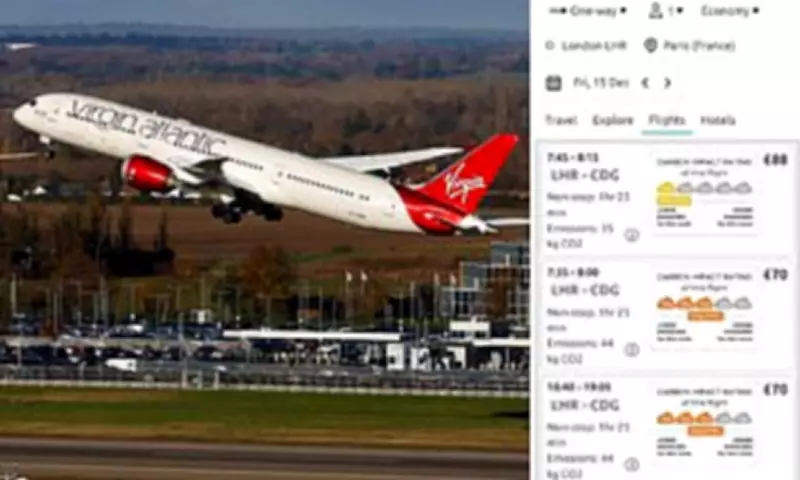
Carbon Emission Warnings Could Appear on UK Flight Bookings
The British government is exploring the introduction of carbon emission warning labels for flight bookings as part of efforts to meet ambitious Jet Zero targets. New Department for Transport research indicates that displaying environmental impact information could significantly influence consumer choices toward more sustainable aviation options.
Research Findings on Consumer Behaviour
The comprehensive 89-page DfT study, titled 'exploring the effect of carbon labels on consumer flight choices', revealed that carbon labels increased self-reported intent for sustainable flight choices to a statistically significant degree. Researchers determined that a five-point rating scale using amber-orange-red colour gradients would be most effective, deliberately avoiding green colours to prevent perceptions of greenwashing.
According to the research, when flights were priced identically, the five-point scale increased the likelihood of selecting lower-carbon options by 30 percentage points. This impact decreased to 26 percentage points when sustainable flights cost 5% more, and further reduced to 16 percentage points with a 25% price premium.

Political Criticism and Industry Concerns
Reform UK deputy leader Richard Tice criticised the proposal, telling the Daily Mail that travellers already face increasing ticket prices through air passenger duty and would now face being 'guilt-tripped' when booking flights. He described the initiative as 'yet another piece of green regulation that patronises passengers, inconveniences airlines while adding extra costs with no meaningful benefit.'
Conservative shadow transport secretary Richard Holden added that 'slapping carbon warning labels on flights will not make air travel cheaper, more reliable, or easier to access for families.' He accused the government of 'nudging, signalling, and moralising instead of backing growth, connectivity, and choice.'
Consumer Response and Implementation Challenges
The study found that approximately 90% of participants considered the carbon label designs easy to understand, though 16% felt overwhelmed by the additional information. Interestingly, 13% of participants discovered flights' carbon emissions were lower than expected, while 14% reported that the labels made them feel they could take more flights annually.
Despite these findings, 82% of participants acknowledged that mandatory environmental impact disclosures might prove impractical and could burden airlines. The research highlighted that access to clear, consistent carbon information remains a key barrier for consumers making sustainable flight choices, with most online booking platforms currently providing limited or no emissions data.
Regulatory Developments and Industry Targets
The Civil Aviation Authority has issued guidance encouraging airlines and travel companies to provide understandable, comparable emissions data for flights departing from or arriving at UK airports. The regulator has set an April 2027 deadline for compliance, after which it will review emissions data provision across airlines, travel agents, and flight comparison websites.
The Jet Zero strategy requires UK domestic aviation and English airports to achieve Net Zero carbon emissions by 2040, with the broader aviation industry targeting 2050. Additionally, airlines operating in the UK must ensure sustainable aviation fuel comprises at least 10% of their jet fuel by 2030, increasing to 22% by 2040.
Sustainable Aviation Fuel Development
The government has avoided direct calls for reduced flying, instead focusing on developing sustainable aviation fuel and zero-emission aircraft. SAF production reduces carbon emissions by approximately 80% compared to traditional jet fuel, though it remains more expensive. Made from sustainable sources including agricultural waste and used cooking oil, SAF can be blended with standard aviation fuel up to 50% concentrations.
In November 2023, Virgin Atlantic operated the first transatlantic flight using pure sustainable aviation fuel from Heathrow to New York aboard a Boeing 787 Dreamliner. This milestone followed the establishment of the Jet Zero Council in June 2020, a partnership between the DfT and aviation sector to develop zero-emission flying.

Broader Policy Context and Future Considerations
The Jet Zero initiative forms part of the wider Net Zero strategy enacted into law in 2019. In April 2024, MPs on the Environmental Audit Committee recommended ministers develop proposals such as a frequent flyer tax should other aviation emissions reduction measures prove insufficient.
A Department for Transport spokesperson stated: 'Our research suggests that clear carbon labelling when booking flights could be a sensible, and effective way to help consumers make informed choices. These findings have supported the regulator's new guidance for airlines and booking platforms.'
The report concluded that carbon labels should be implemented to support consumers in making more sustainable flight choices, potentially creating upstream impacts that incentivise airlines to compete on emissions reduction, thereby benefiting all flyers regardless of individual environmental concerns.