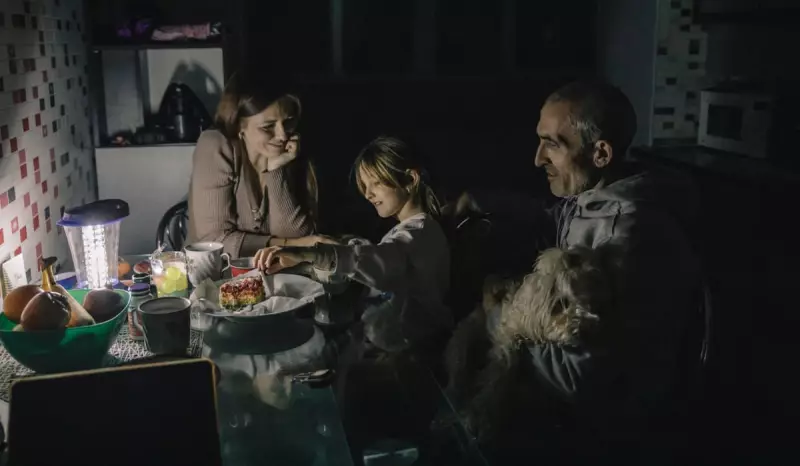
Life in Darkness: Chernihiv's Daily Struggle for Power
The ancient Ukrainian city of Chernihiv, known for its medieval cathedrals, now endures a modern-day siege of darkness. Residents face up to 14 hours without electricity daily as Russia intensifies attacks on energy infrastructure, creating what locals describe as the most difficult winter since the 2022 invasion.
Valentyna Ivanivna, like many Chernihiv residents, has adapted to life in near-constant blackout. Her most prized possession? A head torch gifted by her grandson. "It's impossible to plan anything without power," she explains while using the torch to cook dinner in her darkened apartment. "You can't even invite people round for a cup of tea because the kettle won't work. It's stressful and exhausting for everyone."
Invincibility Points: Community Resilience in Crisis
Across Chernihiv, warm tents known as "invincibility points" have become essential community hubs. Located in shopping centre car parks, these shelters offer power sockets, Starlink internet, and hot drinks. Pensioner Liudmyla Mykolayivna regularly visits to charge her phone and access TikTok before returning home to read detective stories by torchlight.

The situation is particularly severe in Chernihiv region, alongside Sumy and Kharkiv - all bordering Russia. During blackouts, lifts in nine-storey apartment buildings cease functioning, and electric pumps fail, cutting off water supply above the fourth floor. The city's pre-war population of 280,000 has dwindled as many young people have left.
Deliberate Destruction: Targeting Civilian Infrastructure
Russian forces have launched a systematic campaign to plunge Ukraine into darkness. Two weeks ago, Shahed drones spent three days attacking a critical 110kW substation in Chernihiv oblast. Despite protective concrete walls, the facility lacked a roof, making it vulnerable to aerial assault.
Serhii Pereverz, deputy director of Chernihivoblenergo, walked through the wreckage of the destroyed substation. "The Russians are trying to make a total blackout for the civilian population," he stated. "There's nothing military here. It's deliberate genocide against peaceful people." The attack killed two workers travelling from another damaged site.
At Chernihiv's Hospital No 2, director Vladyslav Kukhar reported that non-urgent operations are frequently cancelled during power outages. "This situation weighs on the soul," he admitted. "There's a psychological and emotional cost. Our doctors and nurses are people too, who live in the city."
Families Adapt to the New Normal
For families with children, the blackouts present additional challenges. Anna Kulieva and her husband Maksym worry about their seven-year-old daughter Yeseniia's education. Their eighth-floor apartment becomes inaccessible during outages, and bathing becomes impossible without electricity.
"We've got used to everything apart from the absence of the lift," Anna explained, wearing a head torch while her daughter completed homework under LED lighting. "Children go to school, but there are a lot of air raids and Shaheds. The power goes off and they sit in the dark for a few hours."
Despite the hardships, residents demonstrate remarkable resilience. Local journalist Andriy Podverbnyi remains optimistic: "We've been through German, Soviet and Russian occupation. We are strong and resilient. The Russians won't succeed in breaking us."
As darkness envelops Chernihiv each evening, portable lamps create dainty rectangles of light in apartment windows, while the golden domes of St Catherine's church stand dimly visible in the distance. For residents like Anna Kulieva, the true challenge isn't living without electric light, but maintaining illumination within. "It's not hard to live without a light in your home," she reflects. "It's hard to live without a light in your heart."