American Drivers Confront Staggering Fuel Costs as Middle East Conflict Intensifies
Motorists across the United States are flooding social media with images of astonishing gasoline bills as escalating tensions with Iran trigger nationwide fuel price increases. The national average for regular gasoline surged to $3.54 per gallon on Tuesday, marking a six-cent jump from Monday according to AAA data. This upward trend is accelerating even more rapidly in certain states as oil markets respond to the intensifying geopolitical situation.
Critical Shipping Route Disruption Sparks Global Energy Crisis
The dramatic price surge originates from a severe shock to global energy supplies following attacks and shipping threats that have effectively shuttered the Strait of Hormuz. This narrow maritime passage typically facilitates the daily transit of approximately twenty million barrels of oil. The disruption initially propelled Brent crude oil to $119.50 per barrel on Monday, representing its highest valuation in four years. Although prices have since retreated below $90, they remain approximately $25 higher than pre-conflict levels.
State-by-State Impact Reveals Extreme Regional Variations
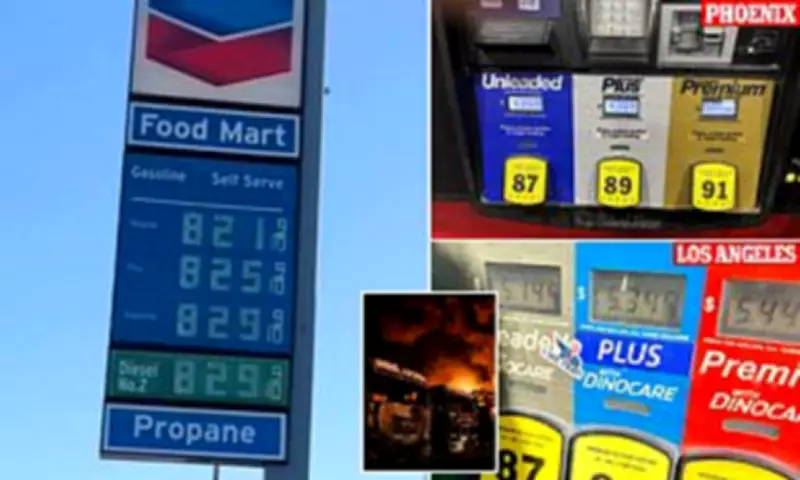
Fuel costs continue climbing most dramatically in traditionally high-expense states including Alaska, Hawaii, Nevada, Oregon, and Washington. California, long notorious for elevated gasoline prices, witnessed its average increase by 8.6 cents overnight to reach a staggering $5.29 per gallon. Social media platforms are overflowing with documentation of this crisis, with one Reddit user in Phoenix, Arizona, sharing a photograph showing regular gasoline priced at $4.359 per gallon—39 cents above the state's current $3.968 average.

Vermont resident Mark Doran expressed frustration to 6ABC News while refueling, describing the prices as "crazy" and "not needed," emphasizing that many Americans are "already struggling" financially. Political figures have also joined the conversation, with Illinois Representative Eric Sorensen posting a local station's pricing to his social media account on Monday, noting a 48-cent weekly increase that he attributed to "Donald Trump's war in the Middle East."
Extraordinary Localized Price Spikes Documented Nationwide
Former U.S. Ambassador Bridget Brink shared images from Lansing, Michigan, revealing gasoline at $3.69 per gallon—a full dollar increase from the previous month and above the state's $3.61 average. Another social media user documented Los Angeles pricing at $5.15 per gallon with the ominous warning to "buckle up" for further increases. Perhaps most astonishingly, multiple internet users captured images from a notorious Los Angeles Chevron station charging $8.21 for regular gasoline, with one customer reporting a $107 bill for approximately thirteen gallons.
Unprecedented Market Volatility and Dire Expert Predictions
This surge follows the largest weekly gain ever recorded for U.S. crude oil, with prices escalating more than $40 per barrel in just over a week. Qatar's Energy Minister Saad al-Kaabi cautioned that prices could potentially reach $150 per barrel if tankers remain unable to navigate the Strait of Hormuz safely. JPMorgan Chase analyst Natasha Kaneva told the Wall Street Journal that the strait's closure represents an "unthinkable scenario," noting that "in the whole written history of the strait, it has never been closed, ever."
Geopolitical Tensions and Production Disruptions Compound Crisis
President Donald Trump stated Monday that U.S. military operations against Iran were initially projected to last four to five weeks but could extend further if necessary. He issued a stark warning on Truth Social, threatening that if Iran impeded oil passage through the strait, they would be struck "TWENTY TIMES HARDER" than previously. The president emphasized his commitment to keeping the Strait of Hormuz secure despite Iranian attacks that have made tankers reluctant to traverse the waterway.

With shipping companies avoiding the risky passage, regional oil producers are implementing production cuts. Kuwait, OPEC's fifth-largest producer, announced precautionary output reductions citing threats to vessels. Iraq's production from three major southern oilfields has reportedly collapsed by approximately 70 percent, decreasing from over four million barrels daily to about 1.3 million. The United Arab Emirates is carefully managing offshore production as storage capacity fills with unshipable oil.
International Response and Unprecedented Energy Market Conditions
The dramatic disruption has prompted urgent discussions among major global economies. Finance ministers from the Group of Seven nations—including the United States, Britain, Germany, France, Italy, Canada, and Japan—were scheduled for an emergency conference call Monday morning to consider releasing strategic oil reserves to stabilize markets. This action would mirror measures taken during the energy crisis following Russia's invasion of Ukraine.
Analysts emphasize that current global energy market conditions are historically unprecedented. Neil Atkinson, former head of oil markets at the International Energy Agency, warned that the effective closure of the Strait of Hormuz could create an "unprecedented energy crisis" unlike anything previously witnessed. He stated unequivocally, "There is no precedent for this. If the Strait remains closed and production stays shut in across the region, we are entering a crisis the likes of which we have never seen before."