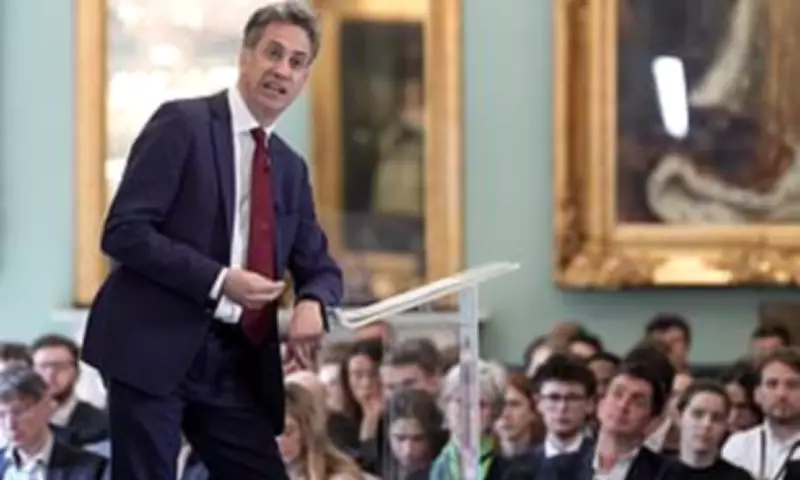
Miliband Unveils Major Push for Renewable Energy on Government Land
Energy Secretary Ed Miliband has declared that wind turbines and solar farms will be constructed on extensive areas of public land across the United Kingdom, ranging from railway corridors to forested regions. In a significant address delivered today, Miliband emphasized that utilizing approximately 8 per cent of land controlled by the government and its agencies to advance green power generation is an obvious and essential step forward.
Collaborative Efforts to Boost Clean Energy
Miliband outlined his intention to collaborate with key entities including the Ministry of Defence, Network Rail, and Forestry England to install wind, solar, and battery storage systems. The objective is to transform these public lands into net contributors to the nation's electricity supply. According to the Department for Energy Security and Net Zero (DESNEZ), this initiative has the potential to generate sufficient power for five million households, even if only a small portion of the available government land is utilized.
Additional Initiatives and Political Stance
In a separate development, Miliband expressed support for installing solar panels on an additional 100 schools and colleges within the current year. Speaking at the National Growth Debate in Westminster, he reaffirmed his commitment to expanding renewable energy sources, stating he would "double down not back down" on these plans despite calls from critics to instead exploit oil and gas reserves in the North Sea.

"Honestly this is a no-brainer, we have got vast amounts of public land that could be used to make us more secure and indeed generate revenue," Miliband asserted. "So we are going to harness untapped public assets from railway warehouses to unused brownfield sites to significantly expand the pipeline of renewables."
Addressing Energy Pricing and Market Reforms
Miliband also confirmed strategies to weaken the connection between global gas market prices and UK electricity costs, particularly as conflicts in the Middle East drive up energy bills. He proclaimed that the "era of fossil fuel security is over" and indicated that existing measures to gradually decouple these prices are insufficient on their own.
To support consumers and businesses facing rising expenses in the short term, Chancellor Rachel Reeves plans to increase the Government's windfall tax on low-carbon electricity generators from 45 per cent to 55 per cent, thereby raising Treasury funds. However, Conservative critics have warned that this approach could inadvertently lead to higher prices, noting that fuel costs constitute only a minor component of overall bills.
Industry Response and Economic Considerations
The current energy pricing system, where gas-fired power stations often set wholesale electricity rates even when cheaper renewables are generating power, has resulted in elevated bills for consumers and windfall profits for nuclear and older renewable energy providers following conflicts in Ukraine and Iran.
Rain Newton-Smith, Chief Executive of the Confederation of British Industry (CBI), commented: "The government is right to focus on energy security by pressing ahead with the expansion of renewable energy as a core part of the UK's energy mix – alongside oil and gas. If implemented correctly, voluntary contracts for difference could reduce the impact of gas on retail electricity prices and ensure the benefits of clean power can be realised across the economy."
Newton-Smith also highlighted the importance of clarity and confidence in government policy, especially during periods of extreme volatility. "Government messaging on next steps on the Electricity Generators Levy must be backed by clear timelines to avoid compounding uncertainty and further undermining investor confidence – something already evident in recent weeks," she added.