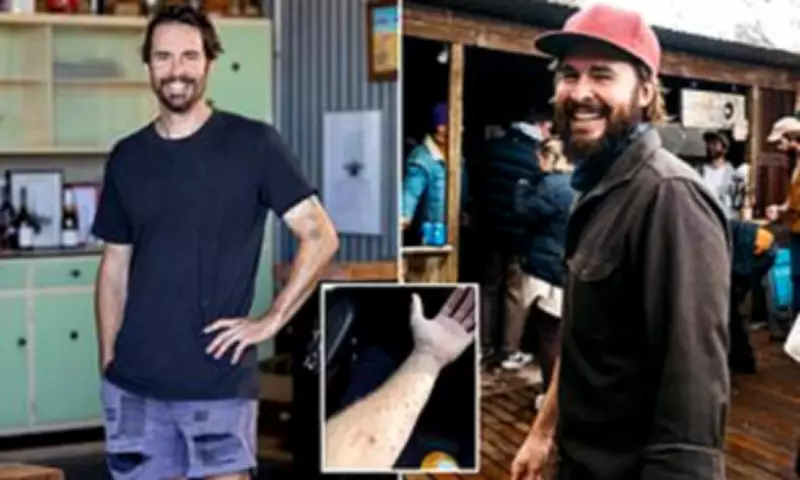
A South Australian winemaker has revealed how a mysterious, full-body rash he suffered just months before being diagnosed with bowel cancer set him on a years-long investigation into one of the world's most widely used chemicals.
Nick 'Duggie' Dugmore, 41, believes the unexplained reaction he experienced in 2022, after unknowingly sleeping on land sprayed with glyphosate, was the first warning sign of the disease that would later change his life.
Now living with stage four bowel cancer, the father-of-two is speaking out, urging Australians to question what he claims is a 'slow' and 'insidious' exposure happening through everyday life.

'I don't want people to think I just chose glyphosate to blame for my cancer,' he told Daily Mail. 'This rash is the reason for and the starting point of my research into glyphosate,' he said, referring to the active ingredient in many widely used weed killers sprayed on farms, crops and public spaces.
The Rash That Changed Everything
The moment that changed everything came during a short stay on a private property outside his Adelaide vineyard in 2022. Duggie had been sleeping in a swag and walking barefoot around the farm when a rash suddenly appeared across his forehead while he was having dinner on his second evening. At first, it seemed minor, but within days, the rash and its 'unbearably' symptoms escalated dramatically across his entire body.
'It was only on day four that I went to emergency because my face swelled up so much,' he recalled. What followed was a week of intense, relentless symptoms that left him unable to sleep for six nights, describing the itching as 'torturous'. 'The only relief I could get from the itching was scalding hot showers… I was having to have around eight to ten a day and nearly running our tanks dry.'
Doctors initially suggested it could have been a spider bite, but with no clear cause or bite marks detected, it was impossible for experts to ever confirm at the time.
Connecting the Dots After Diagnosis
It wasn't until more than a year later, after a devastating cancer diagnosis, that Duggie began to connect the dots. In 2023, he was told he had stage three bowel cancer after a tumour was discovered in his bowel. His surgeon estimated the tumour had been growing for around 14 to 16 months. 'These words changed my life and gave me a starting point for investigation.'
Looking back through photos on his phone, Duggie realised the timing aligned almost exactly with the rash he had experienced after camping on the sprayed land. 'It was exactly that amount of time before I slept on the ground… and I got this rash,' he said. While he acknowledges the link is not definitive, the discovery prompted him to begin researching glyphosate and its potential impact on human health.
'The biggest issue… is not acute exposure, it's chronic exposure,' he said. 'It's the stuff in our food, in our water, in everything, so very slow exposure of this stuff is consistent.' Duggie now believes the chemical may disrupt biological processes in the body, particularly in the gut, and has become increasingly concerned about its presence in everyday environments.
Scientific Perspectives and Controversy
Backing some of his concerns is Dr Stephanie Seneff, a senior research scientist at the Massachusetts Institute of Technology, who has studied glyphosate extensively and believes the chemical may interfere with the body in a unique way. 'I believe that this is its primary mechanism of toxicity,' she said, referring to glyphosate's ability to substitute for the amino acid glycine during protein synthesis. 'The best way to explain that is to assume that it is getting into the protein in place of glycine.'
Dr Seneff added that glyphosate is widely known to suppress the shikimate pathway - a biological process found in plants and microbes - which some researchers believe may play a role in gut health. However, the scientific community remains divided on the issue. While some studies have raised concerns about potential links between glyphosate and disease, regulatory bodies in Australia and around the world continue to maintain that the chemical is safe when used as directed.

The Australian Pesticides and Veterinary Medicines Authority (APVMA) recently reapproved glyphosate for use until 2035, citing insufficient evidence to restrict it. For Duggie, though, the question goes beyond official guidance urging Australians not to ignore it, especially as the potent chemical has been banned in 33 other countries. He has since sent off samples of rainwater, creek water and tap water for testing from his Adelaide home, driven by concerns about long-term exposure. 'I think parts per billion can actually make a difference… especially over years,' he said.
However, industry voices say the conversation is shifting, but still very slowly. Blair Beattie, Executive Director of Farmers Footprint, said glyphosate remains deeply embedded in Australian agriculture, but attitudes are beginning to change. 'Glyphosate is still deeply embedded in Australian agriculture, but the old model of heavy reliance is being challenged,' he said. 'Farmers are being told it's safe, but many are quietly asking 'safe for how long, and at what cost?'' He added that while alternatives exist, they require a broader shift in farming systems rather than a simple replacement. 'There are alternatives, but they are usually system alternatives, not silver bullets.'
Turning Pain into Action
Now, Duggie is turning his focus to action, having already presented to his local South Australian council to urge a rethink on glyphosate use in public spaces, while also calling for a broader national review. He hopes sharing his story will encourage others to question what they're exposed to, as well as to think more deeply about the systems around them. 'I think people need to slow down a little bit… and think about what it truly means to be a part of this planet,' he said.
Despite his diagnosis now progressing to stage four, with small metastases in his lungs, Duggie said his outlook has shifted completely. 'Cancer is death by a thousand cuts, but glyphosate was a big one,' he said. 'Once you start looking into this stuff, you can't unsee it.'