

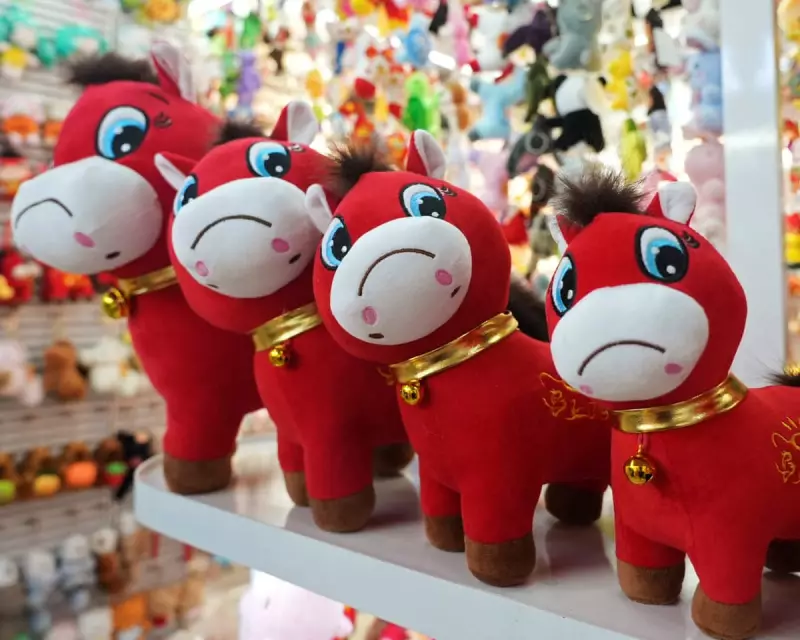
Ahead of the Chinese Lunar New Year celebrations welcoming the Year of the Horse, an unexpected viral sensation has emerged from a manufacturing mishap. Plush toy horses intended to display cheerful grins have instead hit the shelves with what appears to be a despairing grimace, capturing the imagination of consumers across China and beyond.
From Factory Flaw to Cultural Phenomenon
The red horse toy, produced by Happy Sister in the city of Yiwu in western China, was designed to feature a broad, welcoming smile. However, a factory error during production resulted in the horse's snout being sewn on upside down. This simple mistake transformed the intended grin into a distinct frown, with the horse's nostrils now resembling streaming tears.
Rather than being rejected as defective merchandise, these "crying horse" toys have become an unexpected commercial success. They have spread rapidly across Chinese social media platforms, resonating deeply with white-collar workers experiencing corporate fatigue and burnout.

Capturing the Zeitgeist of Worker Exhaustion
"People joked that the crying horse is how you look at work, while the smiling one is how you look after work," explained Zhang Huoqing, owner of Happy Sister, in comments to Reuters. This sentiment has struck a chord with many Chinese professionals who have endured demanding work schedules.
For years, many Chinese white-collar workers have faced the notorious 996 system—working from 9am to 9pm, six days a week. Although this practice was officially outlawed in 2021 following the sudden death of an e-commerce employee after a late-night shift, long overtime hours remain commonplace across various industries.
"This little horse looks so sad and pitiful, just like the way I feel at work," wrote an online buyer using the name Tuan Tuan Mami, according to reports from SCMP.
The Rise of 'Ugly-Cute' Trends and Emotional Expression
The crying horse phenomenon taps into a broader cultural trend for so-called "ugly-cute" toys that has gained popularity in recent years. Characters like Pop Mart's toothy monster Labubu have paved the way for unconventional aesthetics that challenge traditional notions of cuteness.
Jacob Cooke, CEO of e-commerce consulting firm WPIC Marketing + Technologies, noted to Business Insider that "consumer products and internet memes can act as outlets for discussing work pressure, especially on platforms like Xiaohongshu, where consumer culture and emotional expression are tightly intertwined."
Commercial Success and International Appeal
The unexpected demand for the crying horse toys has created significant commercial opportunities. By mid-January, Happy Sister was receiving daily orders exceeding 15,000 units, prompting the factory to establish ten additional production lines to meet the surging demand.
Interest has extended beyond China's borders, with wholesale orders arriving from South Africa, East Asia, and the Middle East. The distinctive image of the despairing horse is expected to appear on a new range of merchandise throughout the coming year.
Manufacturing Mystery and Unexpected Bonuses
Despite the toy's success, the origin of the manufacturing error remains a mystery. Zhang Huoqing admitted that the factory never discovered which worker sewed the horse's snout on upside down. "Since we can't figure out exactly whose mistake it was, we'll just give everyone a bonus," she declared, turning what could have been a quality control failure into a celebratory moment for the entire production team.
As China prepares to celebrate the Year of the Horse—traditionally associated with high energy, hard work, and perseverance—this accidental symbol of workplace fatigue serves as a poignant cultural commentary. The crying horse plush toy has transformed from a simple manufacturing defect into a powerful emblem of contemporary work-life pressures, demonstrating how consumer products can sometimes articulate collective emotions that might otherwise remain unspoken.






