

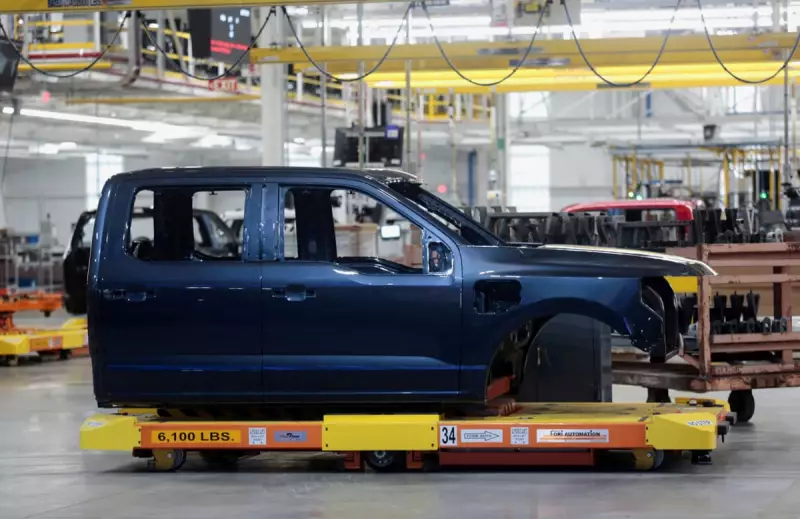
In a seismic shift for the American automotive industry, Ford Motor Company has announced a staggering $19.5bn financial writedown and the cancellation of several high-profile electric vehicle models. The move marks a dramatic retreat from its ambitious electrification strategy, a direct response to weakening consumer demand and a starkly altered regulatory landscape under the Trump administration.
A Strategic Pivot: From EVs to Gas and Hybrid
The Dearborn, Michigan-based automaker confirmed on Monday that it will cease production of the battery-electric F-150 Lightning pickup truck, a model launched with great fanfare in 2022. Instead, Ford will pivot to producing an extended-range electric vehicle (Erev), a hybrid variant that uses a petrol-powered generator to recharge its battery.
Furthermore, the company is scrapping its next-generation electric truck, codenamed T3, which was intended to be a cornerstone of its second-generation EV lineup. Planned electric commercial vans have also been axed. Ford's new strategy involves a hard turn back towards traditional internal combustion engine and hybrid models, with plans to eventually hire thousands of workers, despite near-term layoffs at a jointly owned battery plant in Tennessee.

The company now expects its global mix of hybrids, extended-range EVs, and pure electric vehicles to reach 50% by 2030, a significant recalibration from its earlier, more aggressive targets. This shift reflects a broader industry trend as carmakers grapple with the reality of a cooling EV market.
The Financial and Political Backdrop
The colossal $19.5bn writedown will be spread out, primarily impacting the fourth quarter and continuing through 2027. Of this total, approximately $8.5bn is linked to cancelling the planned EV models. A further $6bn is tied to the dissolution of a battery joint venture with South Korea's SK On, and $5bn is attributed to "program-related expenses."
This strategic reversal is deeply intertwined with US politics. The outlook for electric vehicles dimmed considerably this year as President Donald Trump's policies removed federal support for EVs and eased stringent tailpipe-emissions rules. These changes effectively encourage manufacturers to sell more petrol-powered cars.
The impact on sales has been immediate and severe. US sales of electric vehicles plummeted by roughly 40% in November, following the September 30 expiration of a longstanding $7,500 consumer tax credit. The Trump administration's July tax and spending bill also included a freeze on fines for automakers who violate fuel-economy regulations.
"Rather than spending billions more on large EVs that now have no path to profitability, we are allocating that money into higher-returning areas," stated Andrew Frick, head of Ford's gas and electric-vehicle operations.
The Rise and Stall of the F-150 Lightning
The F-150 Lightning's journey epitomises the volatile EV market. Launched in 2022 to significant hype—even prompting a song by comedian Jimmy Fallon—the truck saw an initial influx of 200,000 orders, leading Ford to ramp up production. However, sales failed to maintain that momentum.
Through November of this year, Ford sold just 25,583 Lightning models, representing a 10% decrease compared to the same period last year. The planned successor, the T3 truck, was to be built from the ground up at a new complex in Tennessee but will now not see the light of day. Production at that Tennessee factory will instead be dedicated to new petrol-powered trucks starting in 2029.
With this announcement, Ford has effectively terminated its entire announced second-generation EV portfolio. For its future electric ambitions, the company is shifting focus to more affordable models developed by a skunkworks team in California. The first model from this team is slated to cost around $30,000 and go on sale in 2027, with production set for Ford's Louisville plant.
This dramatic course correction by one of America's industrial giants signals a challenging new chapter for the electric vehicle transition, heavily influenced by political winds and market realities.






