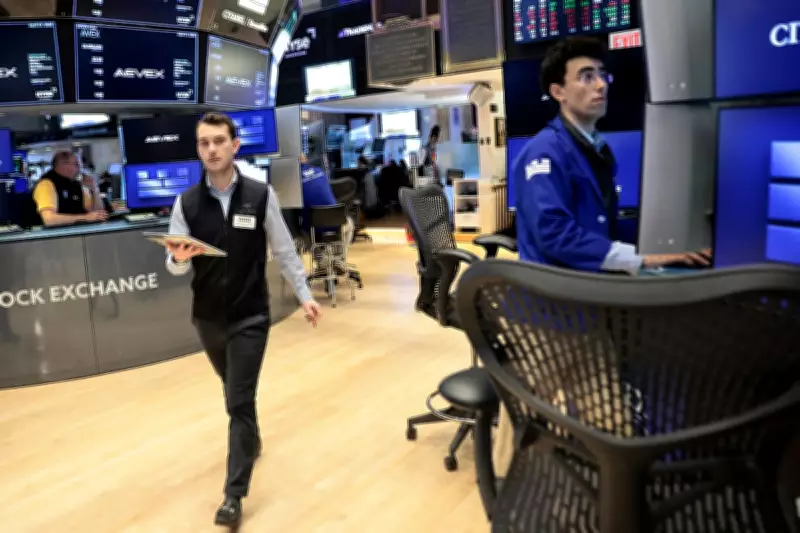
Global stock markets have suffered significant declines at the start of the week, with investors receiving stark warnings to brace for further volatility as tensions in the Middle East escalate once again. The uncertainty follows a weekend of renewed geopolitical strife, with Iran announcing the re-closure of the Strait of Hormuz and refusing further diplomatic talks, while US forces intercepted an Iranian-flagged cargo vessel attempting to evade their blockade.
Market Performance and Immediate Impacts
London's FTSE 100 index was down more than 0.5 percent by 10am BST on Monday, reflecting a broader downturn across European markets. France's CAC 40, Germany's DAX, and Spain's IBEX 35 each fell by over 1 percent, with the Euro Stoxx 50 declining by 1.3 percent. In the United States, futures indicated that major indices, including the Dow Jones, Nasdaq, and S&P 500, were poised to drop by more than 0.5 percent when markets opened later in the day.
This sharp reversal comes after a strong end to the previous week, when sentiment had turned positive on hopes that the Strait of Hormuz would be reopened, boosting stocks and causing oil prices to plummet. However, Iran's latest declaration has swiftly undone those gains, reigniting fears of prolonged disruption to global trade routes and energy supplies.

Expert Analysis and Investor Sentiment
Richard Hunter, head of markets at interactive investor, described the situation as an "all too familiar theme," with markets taking "two steps forwards and then one step back," driven almost entirely by news flow from the Middle East. He noted that on Friday, Iran's announcement that the strait was "completely open" had ignited a rally in stocks, particularly in sectors like airlines and cruise ship operators that had been heavily affected by the conflict. However, oil prices have since risen again as the prospect of normality receded.
Despite the current turmoil, Hunter emphasized that for long-term investors, avoiding the temptation to sell underperforming assets remains crucial. He pointed out that the FTSE 100, despite its weaker open after the weekend's developments, is still up more than 7 percent for the year to date, serving as a "poster child" for an investment mentality that looks beyond short-term noise.
Geopolitical Developments and Future Outlook
Derren Nathan, head of equity research at Hargreaves Lansdown, highlighted that further talks between nations would dictate the next market movements. He noted that attention has shifted towards a potential second round of negotiations between Tehran and Washington in Pakistan, but it remains unclear whether these discussions will actually take place. Nathan warned that more volatility is the most likely outcome until a resolution is reached.
Susannah Streeter, chief investment strategist at Wealth Club, reminded investors that "deep reserves of patience are needed" during such tense times. She cited industries like airlines, which are facing jet fuel shortages, as examples of sectors under severe pressure, with valuations reflecting the heightened uncertainty. Although Asian indices remained steady, with investors still hopeful for resumed negotiations, stocks on Wall Street appeared set for a stumble, with S&P 500 futures indicating a small retreat from record highs.
Russ Mould, investment director at AJ Bell, added that last week's market enthusiasm over the Strait of Hormuz reopening may have been premature, underscoring the unpredictable nature of the current geopolitical landscape. As the situation continues to evolve, experts agree that investors must navigate a parlous course marked by violent swings and uncertainty, while maintaining a focus on long-term stability and economic fundamentals.