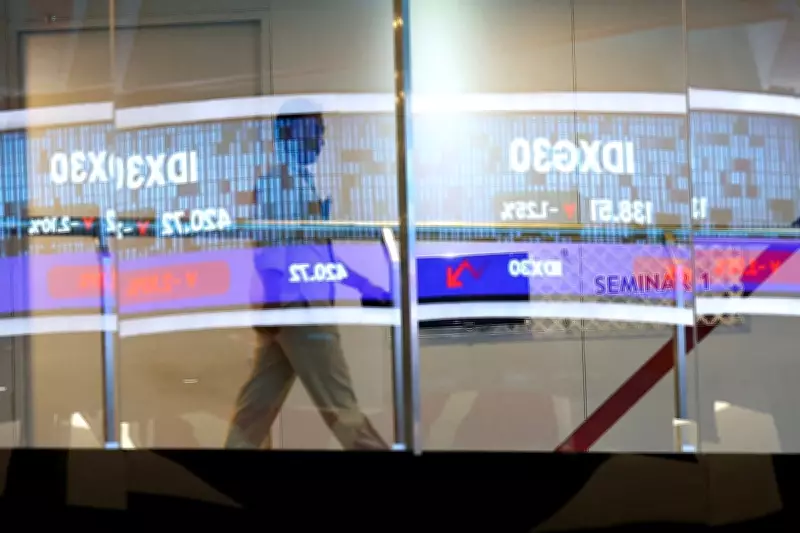
Oil prices fell and Asian stock markets rose significantly on Tuesday, as global financial markets reacted to growing optimism that the United States and Iran might resume diplomatic negotiations before their fragile two-week ceasefire expires. This sentiment persisted despite Tehran's lack of immediate commitment to attending fresh talks and ongoing mutual accusations of truce violations between the two nations.
Market Movements and Geopolitical Tensions
Brent crude oil slipped 0.4 per cent to $95.09 per barrel, while US West Texas Intermediate experienced a more pronounced decline of 1.7 per cent to $88.07. These movements represented a pullback from substantial gains in the previous trading session, when both benchmarks surged more than $5 per barrel amid rapidly shifting signals regarding potential negotiations and maritime security in the Strait of Hormuz.
Shipping traffic through this critical waterway remains severely disrupted, with approximately 10 million barrels of crude oil per day still shut in. This ongoing blockade continues to push freight prices and insurance costs higher, though oil prices remain well below their conflict peak of $119 per barrel for Brent crude earlier in the hostilities.

Analyst Perspectives on Market Volatility
Lukman Otunuga, head of market research at trading broker FXTM, observed: "Uncertainty remains the dominant force in global markets as investors navigate an increasingly complex geopolitical landscape. The situation around the Strait of Hormuz has amplified volatility, particularly in oil markets where prices are highly sensitive to supply disruptions."
The ceasefire is scheduled to expire on Wednesday evening Washington time. US President Donald Trump revealed in a Monday interview with Bloomberg that JD Vance would travel to Islamabad on Tuesday night or Wednesday morning to resume direct talks with Iranian representatives. However, Tehran made no immediate commitment to participate in these discussions.
Diplomatic Standoff and Economic Consequences
Mizuho Bank noted in a market commentary: "The current dynamic is one of a precarious balance of truce. As the ceasefire draws to its 2-week deadline, the all-consuming question is whether both sides can seize on the talks to land on a US-Iran deal that ends the war."
President Trump stated it was "highly unlikely" he would extend the truce without a concrete agreement. On social media, he emphasized: "THE BLOCKADE, which we will not take off until there is a 'DEAL', is absolutely destroying Iran," claiming the country was losing $500 million daily.
Iran's lead negotiator, Parliament Speaker Mohammad Bagher Ghalibaf, rejected this framing, writing on X: "Trump, by imposing a siege and violating the ceasefire, seeks to turn this negotiating table into a table of surrender or to justify renewed warmongering. We do not accept negotiations under the shadow of threats." Despite this rhetoric, a senior Iranian official later told Reuters that Tehran might still send delegates to talks in Islamabad.
Regional Market Performance
Asian equity markets largely shrugged off the geopolitical uncertainty. South Korea's Kospi rose 2.1 per cent to achieve a fresh record high for the first time since the conflict began. Japan's Nikkei climbed 1.2 per cent, while MSCI's broadest index of Asia-Pacific shares outside Japan increased by 0.9 per cent.
Other regional indices showed mixed results: Taiwan's Taiex advanced 1.7 per cent, Hong Kong's Hang Seng edged up 0.1 per cent, Australian shares slipped 0.3 per cent, and the Shanghai Composite lost 0.2 per cent. On Wall Street, the S&P 500 retreated 0.2 per cent from its all-time high on Monday, while the Nasdaq snapped a remarkable 13-day winning streak that represented its longest such run in over three decades.
Broader Economic Impact and Corporate Earnings
The economic consequences of the maritime disruption continued to spread across global markets. Kuwait declared force majeure on shipments of crude oil and refined products after the blockade prevented vessels from entering the Persian Gulf, hindering its ability to meet customer commitments. Additionally, crude oil loadings from Saudi Arabia's Red Sea port of Yanbu fell 17 per cent week-on-week, averaging approximately 3.5 million barrels per day.

Despite the geopolitical uncertainty, the broader corporate earnings picture in the United States remained robust. Approximately ten per cent of S&P 500 companies have reported first-quarter results, with nearly ninety per cent exceeding analyst expectations. According to FactSet data, if remaining companies match forecasts, overall earnings per share for the index will finish thirteen per cent higher than the previous year.
Several major US banks indicated last week that they anticipate continued economic resilience supported by solid consumer spending. Market attention also focused on upcoming earnings reports from UnitedHealth Group on Tuesday, Tesla on Wednesday, and Procter & Gamble on Friday.
Currency and Commodity Markets
Investors monitored a Senate confirmation hearing for Kevin Warsh, President Trump's nominee to lead the Federal Reserve, scheduled for Tuesday. The dollar index held steady at 98.08, while gold edged up 0.1 per cent to $4,824.83 per ounce, reflecting ongoing safe-haven demand amid the geopolitical tensions.