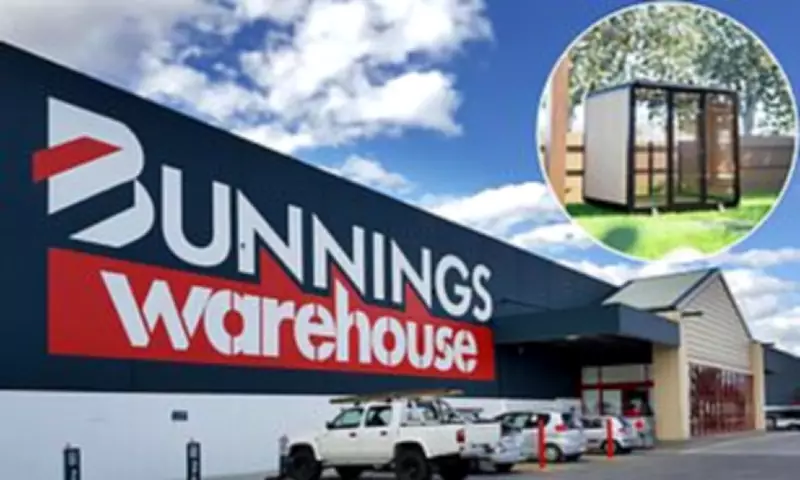
Australia's premier hardware retail chain has discreetly launched one of its most ambitious ventures to date, marking a significant departure from its traditional product lines.
Major Retail Expansion Into Modular Housing
Bunnings Warehouse, the nation's most prominent hardware retailer, has commenced selling flat-pack homes with prices beginning at $26,100. This strategic move represents a substantial expansion beyond the brand's conventional offerings of tools and timber, propelling it directly into the rapidly growing modular housing sector. This development occurs as Australia's persistent housing crisis shows little indication of abating, with soaring property prices and rental shortages affecting communities nationwide.
Partnership With Innovative Start-Up
The retail behemoth has formed a collaborative partnership with Australian start-up Elsewhere Pods to provide compact, prefabricated pod homes. These dwellings are available for purchase either through Bunnings' online platform or via their Special Orders desk located within physical stores. The current product range features two distinct models: a compact 2.7 metre by 2.4 metre pod priced at $26,100, alongside a more spacious 4 metre by 2.4 metre studio unit costing $42,900.

Although modest in dimensions, these pods are being promoted as versatile solutions suitable for numerous applications. Potential uses include home offices, guest accommodation, teenage retreats, crisis housing provisions, and short-term rental opportunities. Delivered as flat-pack kits, these units arrive with pre-fabricated wall panels, insulation materials, and eaves already prepared, enabling assembly within approximately two days. This positions them as a do-it-yourself friendly alternative to conventional construction methods.
Regulatory Advantages And Market Response
In certain local council jurisdictions, these structures can be installed without activating full building or planning approval processes, representing a significant attraction for purchasers seeking expediency and simplicity. However, industry specialists emphasise that regulations differ considerably between various councils and states, advising prospective homeowners to verify local requirements thoroughly before commencing any construction.
Bunnings has indicated that these pods address increasing customer demand for rapid, cost-effective methods to augment functional space on existing properties. Ryan Baker, Bunnings Chief Operating Officer, stated: 'They provide an affordable way for customers to add functional space to their homes.' This retail initiative emerges as Australians confront escalating property values, diminishing rental availability, and extended construction timelines for detached homes, which frequently exceed one year.
Broader Housing Market Transformation
As conventional building expenses rise and project schedules extend, numerous homeowners and investors are progressively considering modular, prefabricated, and kit-built housing as practical alternatives. One observer remarked: 'Some of them are very nice and while small, it's better than nowhere.' Matt Decarne, founder of Elsewhere Pods, noted that demand has accelerated substantially as buyers pursue housing solutions that circumvent traditional bottlenecks.
Decarne explained: 'Many tiny homes, including some of our designs, don't trigger planning or building approvals, which is a huge drawcard.' Since its market introduction, Elsewhere Pods has achieved over $9 million in sales, highlighting the substantial appetite for compact housing solutions across Australia. The company reports that nearly one third of its sales originate from off-grid accommodation and eco-tourism projects, particularly within regional and lifestyle destinations where speed, sustainability, and adaptability are paramount considerations.
Industry Growth And Future Projections
This development reflects a wider transformation within Australia's housing landscape. Major financial institutions, including Commonwealth Bank, have indicated increasing support for prefabricated construction, while kit-home manufacturers have proliferated nationwide. State governments in Queensland and Victoria have additionally moved to relax planning regulations concerning secondary dwellings, such as granny flats, attempting to alleviate housing pressures.

According to industry statistics, builders now anticipate delivering approximately ten times more granny flats than during 2022, as families explore methods to accommodate adult children, ageing parents, or generate rental income from existing properties. Market analysts suggest this momentum is merely commencing, with evaluations indicating Australia's prefabricated buildings market – encompassing modular and flat-pack homes – is projected to expand by around seven percent annually, potentially reaching an estimated $18 billion by 2030.
For Bunnings, this venture signifies a notable brand evolution, transitioning from supplying construction materials to providing complete, ready-made housing solutions directly to consumers.