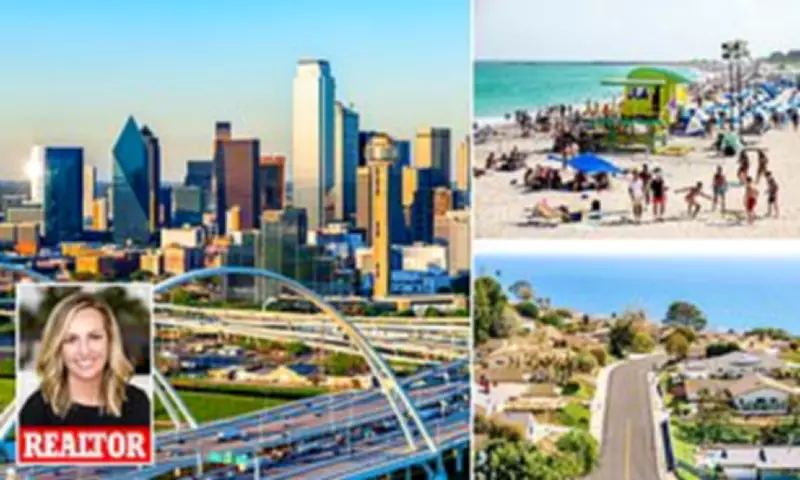
Dallas Emerges as Premier Destination for Coastal Exodus
For several years, affluent Americans have been exchanging metropolitan penthouses for pastoral landscapes, trading expensive coastal skylines for expansive Texas acreage and exorbitant tax burdens for the wide-open horizons of the Lone Star State. No location has reaped greater benefits from this demographic shift than Dallas, which has transformed into one of the nation's most sought-after relocation hubs.
Migration Statistics Reveal Dramatic Shift
According to comprehensive data from Texas Realtors, the Dallas-Fort Worth metropolitan area has emerged as a leading destination for out-of-state movers. Remarkably, approximately one-third of new Texas residents originate from just four states: California, Florida, New York, and Colorado. Among these interstate migrants, roughly 30 percent specifically choose Dallas as their new home.
Texas Realtors chair Jennifer Wauhob explained this phenomenon to Fox News, stating, 'Americans are voting with their feet. They want places that are livable. They want places that are workable. They want places that are sustainable and affordable. This migration is genuinely transforming into a long-term structural shift.'

Pandemic Accelerates Existing Trends
The transition from coastal urban centers to Texas communities accelerated dramatically during the COVID-19 pandemic. The widespread adoption of remote work liberated employees from traditional office environments, prompting many to reconsider the rationale behind paying premium prices for cramped urban accommodations. With spacious living arrangements suddenly outweighing proximity to city centers, the allure of larger homes, reduced living expenses, and warmer climates became increasingly irresistible.
Recent migration patterns indicate that one-third of new Texas residents are relocating from California, Florida, New York, and Colorado, with 30 percent of these interstate movers specifically selecting Dallas as their destination.
Economic Advantages Driving Relocation
Texas presents compelling financial incentives for prospective residents. The state's median home price currently stands at $335,000, significantly below the national median of approximately $415,000. Furthermore, Texas imposes no state income tax, providing substantial financial relief compared to high-tax coastal states.
Dallas's housing market vividly reflects these broader migration patterns. In November, PwC and the Urban Land Institute released their annual Emerging Trends in Real Estate 2026 report, ranking the top ten real estate markets to monitor. The Dallas-Fort Worth market secured the premier position for the second consecutive year, achieving first-place rankings for both commercial real estate prospects and homebuilding opportunities.
Business Environment and Infrastructure
The Dallas region distinguishes itself through exceptional transportation infrastructure, relatively low living costs, and a notably business-friendly regulatory climate. Between 2018 and 2024, the area successfully attracted 100 corporate headquarters, solidifying its reputation as an advantageous location for commercial operations.
Andrew Alperstein, partner with PwC's US real estate practice, told CNBC, 'The financial services sector's shift to Dallas has accelerated considerably in recent years. While corporate and population movements aren't exclusively about financial services, Dallas boasts a remarkably diverse economy, maintains relative affordability, and offers excellent accessibility. Dallas presents a compelling narrative that will likely sustain migration patterns alongside ongoing development and expansion.'
Jennifer Wauhob elaborated on housing market dynamics, noting, 'This substantial migration is generating consistent housing demand across all market segments. We're observing robust demand for entry-level properties alongside sustained interest in luxury housing. Currently, we're experiencing a balanced, healthy real estate market.'

Lifestyle Transformations
This migration represents more than beach enthusiasts abandoning oceanfront properties. Urban high-rise dwellers are exchanging skyscrapers for saddle-ready ranches, trading skyline sunsets for sprawling Texas horizons. Even major financial institutions have recognized this shift, with the New York Stock Exchange establishing an 'NYSE Texas' presence in Dallas—a development former President Donald Trump characterized as 'unbelievably bad' for New York City.
Alongside numerous Silicon Valley technology firms selecting Austin, this widespread migration demonstrates that even America's most prominent industries are gravitating southward.
Personal Migration Stories
Millionaire business owner Frederic Lepoutre relocated his family from South Florida's coast to Texas Hill Country, discovering the process considerably less cumbersome than attempting to move within Florida. Lepoutre acquired an 11-acre Texas estate for just $26,000 per acre, with initial property taxes—including agricultural exemptions—amounting to merely $8 annually.
Beyond financial advantages, construction of Lepoutre's Texas residence required only one-third the time needed to build a comparable property in South Florida. He explained, 'In Florida, constructing a house typically requires three years. In Texas, we completed the process from ground preparation to move-in within one year, requiring only permits for the water well and sewer system. The contrast is dramatic—a complete 180-degree difference.'
The Lepoutre family discovered that Texas offered intangible benefits often unavailable in bustling coastal communities. Lynn Lepoutre remarked, 'We sought peace, quiet, tranquility, privacy, and a slower pace of life.' Her husband added, 'We wanted somewhere you can observe stars at night without artificial light interference, without visible neighbors. From our current residence, we enjoy 40-mile vistas—properties like this have become exceptionally rare in contemporary America.'
The Lone Star State continues to provide elements increasingly scarce in crowded coastal enclaves: genuine peace, authentic quiet, meaningful tranquility, substantial privacy, and a deliberately slower lifestyle rhythm that appeals profoundly to former urban residents.