

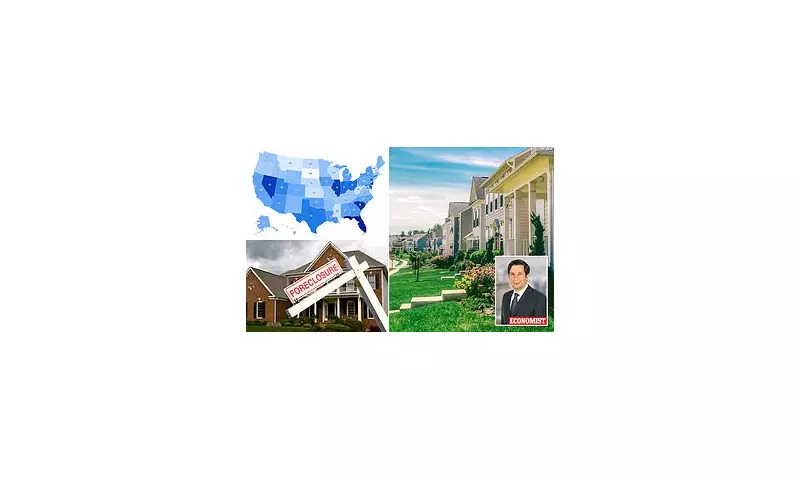
The past twelve months proved a stern test for American homeowners, yet financial analysts are sounding the alarm that the coming year could present even steeper challenges. New data reveals a sharp increase in the number of families losing their homes, with the situation poised to deteriorate further if economic conditions soften.
A Nationwide Spike in Repossessions
According to the latest figures from property data firm ATTOM, foreclosure filings rose by 14 percent across the United States in 2025 compared to the previous year. In concrete terms, this troubling trend impacted 367,460 US properties, each entering some stage of the foreclosure process where a bank or lender moves to repossess the home due to missed mortgage payments.
Economist Michael Szanto provided a grim prognosis for the year ahead. "If the job market weakens, and it may very well, then we could unfortunately down the road see the increase in the foreclosure rate significantly accelerate," he warned. The underlying economic data supports this concern; the US economy added only around 584,000 jobs in 2025, marking the weakest year for employment growth outside a formal recession since 2003.

Regional Hotspots and Ripple Effects
The crisis is not evenly distributed, with several states bearing the brunt of the distress. Florida experienced the highest rate nationally, with one foreclosure filing for every 230 homes. Szanto pointed to the state's ongoing condo crisis as a key driver, noting, "Florida is being uniquely affected by a massive rise in assessments for older condo buildings in response to the tragic Surfside collapse."
Delaware and South Carolina followed closely, with rates of one in every 240 and one in every 242 housing units, respectively. Illinois and Nevada completed the top five, each reporting roughly one foreclosure for every 248 homes. This geographic spread indicates that financial strain is a widespread issue, not confined to a single area.
The picture becomes even more acute at the metropolitan level. Among larger cities, Lakeland, Florida, had the highest rate in the nation, with one in every 145 homes facing foreclosure. It was followed by Columbia, South Carolina (one in 165) and Cleveland, Ohio (one in 187). Florida's Cape Coral and New Jersey's Atlantic City also featured prominently on the list of most-affected areas.
Major Cities Under Pressure
The pressure is also mounting in the country's largest urban centres. For cities with populations over one million, Jacksonville, Florida posted the worst rate (one in 200), followed by Las Vegas (one in 210), Chicago (one in 214), and Orlando (one in 217).
The consequences of this surge extend far beyond individual homeowners. As neighbourhoods absorb an influx of discounted, bank-owned properties, nearby home values are dragged down. This means owners can lose equity through no fault of their own, simply due to their postcode. Furthermore, missed mortgage payments are often a symptom of a deeper financial crunch, where households squeezed by higher taxes and interest costs also fall behind on credit card, car loan, and other debts.
A Symptom of Broader Economic Malaise
This dangerous dynamic is reviving uncomfortable memories of the 2008 financial crisis. When Americans struggle to pay their mortgages, they are invariably forced to cut back on essentials like food, transport, and healthcare. This affordability crisis acts as a dead weight on broader economic growth.
Rob Barber, CEO of ATTOM, offered a contrasting perspective, suggesting the data reflects a "continued normalisation of the housing market following several years of historically low levels." However, the month-on-month trajectory is unmistakably upward. As recently as November 2025, 35,651 properties had a foreclosure filing—a startling 21 percent increase from the same month just one year earlier.

Szanto also highlighted fundamental weaknesses underpinning the market, stating, "The main weakness of our housing market is still a major supply shortage combined with factors like higher mortgage rates locking out many would-be new homebuyers." As 2026 begins, homeowners, lenders, and policymakers alike are bracing for a year that could define the next chapter of the American housing story.





