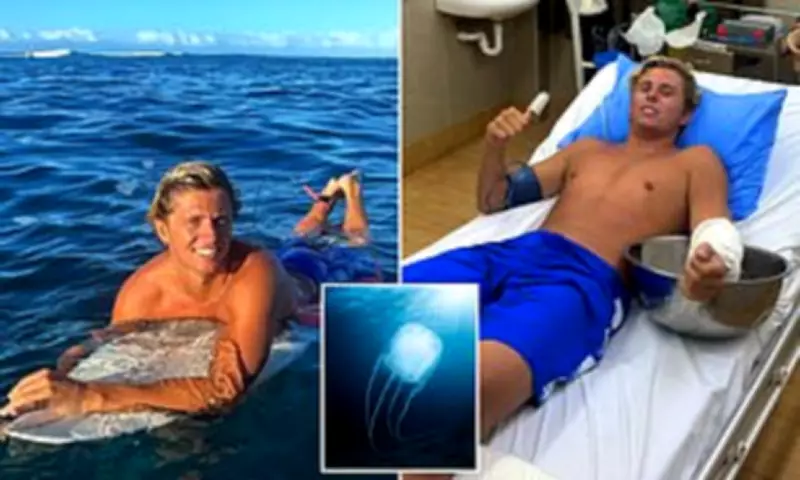
An Australian surfer faced a harrowing brush with death after being stung by a box jellyfish in Fiji, one of the world's most perilous marine creatures, amid a concerning uptick in such incidents. Guy Rowles was enjoying a surf trip with his father at Sujees Surf Stay on Cloudbreak, a renowned reef break in the Mamanuca Islands celebrated as one of the globe's top ten waves.
A Terrifying Ordeal Unfolds
On the inaugural day of their adventure, Rowles described feeling 'something hectic' strike his arm, prompting him to roll off his board and frantically tear away the jellyfish tentacles. He was swiftly pulled onto a boat, where he experienced a burning arm, chest tightness, and convulsions on the deck. The journey to Nadi hospital, over an hour away, was a race against time.
'Got stung surfing by a box jellyfish or Irukandji in Fiji… pretty wild experience,' Rowles recounted. 'Definitely puts things into perspective.' In an interview with the surfing publication Stab, he revealed his panic, saying, 'I'm looking at my dad going, "F** Dad, am I going to die?"' Symptoms included shaking, vomiting, leg numbness, and widespread tingling.

Emergency Response and Medical Intervention
Before the frantic drive to the hospital, which he likened to a scene from Fast and the Furious, Rowles phoned his mother to express his love. At the medical facility, doctors delivered grim news: it was too late for antivenom, as the venom had been in his system for an hour. His only recourse was vinegar to neutralise remaining stinging cells and morphine for pain relief, alongside careful removal of any tentacles.
Stings covering more than half a limb are deemed life-threatening, yet Rowles miraculously survived. Medical staff emphasised his fortune, noting that the sting avoided his face or neck and that his youth and health were critical factors. By Sunday, he was back in the water, sharing photos of his recovery.
Understanding the Box Jellyfish Threat
Box jellyfish, named for their distinctive body shape, possess tentacles stretching up to 10 feet, adorned with nematocysts—tiny harpoons linked to venom-filled bulbs. This venom can prove fatal within five minutes. While found in warm coastal waters globally, the most lethal varieties inhabit the Indo-Pacific region and northern Australia.
Government Warnings and Precautionary Measures
A week prior to Rowles' incident, Fiji's government issued a health alert regarding box jellyfish presence in local waters. The Ministry of Health and Medical Services, in collaboration with the Ministry of Fisheries, urged caution after multiple patients presented with breathing difficulties post-sea exposure.
Symptoms to watch for include severe burning pain, visible tentacle marks, breathing challenges, and potential collapse. To mitigate risks, authorities recommend wearing protective clothing like full-body Lycra or neoprene suits covering 75-80% of the body, heeding local warnings, and avoiding swimming at dawn or dusk when jellyfish numbers peak.
In case of injury, victims should be promptly removed from the water and emergency services alerted. This advisory underscores the growing concern over marine hazards in popular tourist destinations.