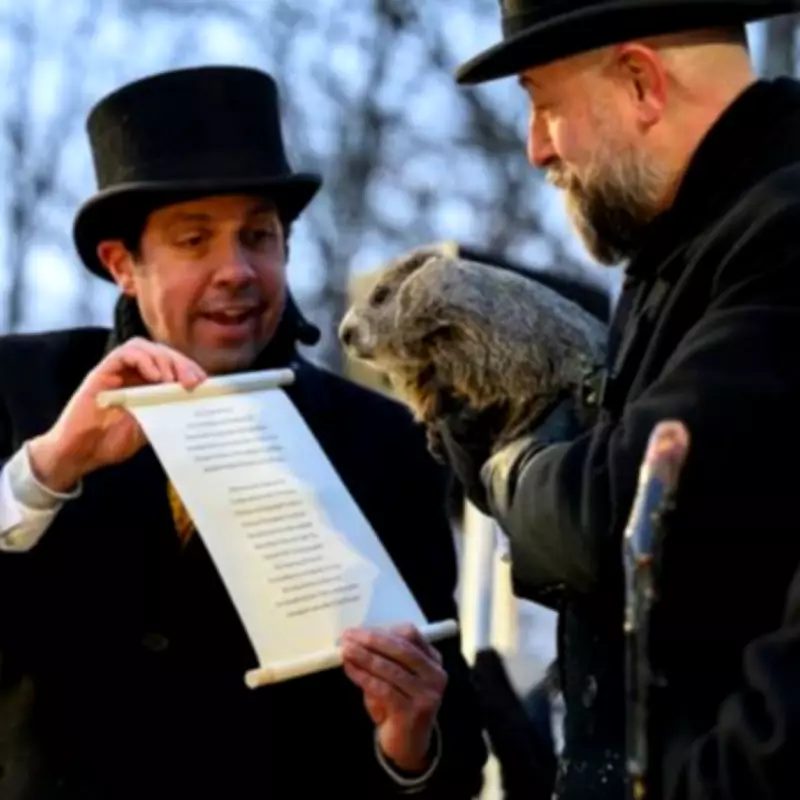
People across the United States are only just discovering the truly peculiar historical origins behind the annual celebration of Groundhog Day, a popular holiday that has captured the imagination through films and television shows. While many associate the day with the comedic premise of reliving the same day repeatedly, as depicted in the classic Bill Murray movie, the actual roots of this tradition are far stranger and more fascinating than most realise.
From European Customs to American Tradition
For approximately 150 years, February 2nd has been officially marked as Groundhog Day in the United States. This unique celebration, however, did not emerge from American soil alone. When European settlers began emigrating to the US in significant numbers, they brought with them a rich tapestry of traditions and customs, seeking to maintain cultural practices in their new homeland. Over time, these imported rituals gradually adapted to better suit the American environment and available resources.
The Candlemas Connection
One particularly significant European tradition that underwent this transformation was Candlemas, a Christian feast day marking the presentation of Jesus at the Temple and the purification of the Virgin Mary, occurring precisely forty days after Christmas. This observance traditionally signified the conclusion of the Christmas season, featuring ceremonies where candles were blessed to represent Christ as the "Light of the World."

Meanwhile, across Germany and other European regions, a separate folk custom involved observing the behaviour of badgers or hedgehogs on this date. According to this tradition, if the animal emerged from its burrow on a sunny Candlemas day and saw its shadow, it predicted four additional weeks of winter weather. If no shadow appeared, an early spring was anticipated.
The Birth of Groundhog Day
As Randy Wentworth of the social media account 'Wentworth Bros' recently explained in an educational video, these two distinct traditions eventually merged in America to create what we now know as Groundhog Day. "The tradition dates back to when Dutch settlers began migrating to the Pennsylvania area," Randy clarified. "They carried over their holiday of Candlemas, also known as Badger day in some regions."
Pennsylvanian settlers preserved the core concept but adapted it to their geographical context. "Throughout the years, Pennsylvanians upheld the tradition, but just tweaked it to fit their location," Randy elaborated. "Instead of a badger, they used a groundhog. And instead of predicting four more weeks of winter, the forecast extended to six weeks."
The First Official Celebration
The inaugural official Groundhog Day celebration occurred in 1887 in Punxsutawney, Pennsylvania, where a group of local citizens consulted a groundhog about forthcoming weather patterns. "Every February 2nd, Punxsutawney Phil emerges from his burrow," Randy described in his video. "If he sees his shadow and retreats, that means six more weeks of winter. But if he doesn't see his shadow, we're getting an early spring."
This small Pennsylvania town has remained the epicentre of Groundhog Day festivities ever since. "Given that this was the birthplace of the event, this is where the groundhog watching is held every February 2nd," Randy noted, adding with a touch of scepticism about the longevity claims: "They maintain that the groundhog forecasting the weather today is the same Punxsutawney Phil from 1887. I'll let you be the judge of whether that's plausible or not."
This peculiar fusion of European religious observance and folk meteorology has evolved into one of America's most distinctive and enduring cultural traditions, demonstrating how immigrant customs can transform into something entirely new while retaining echoes of their original purpose.