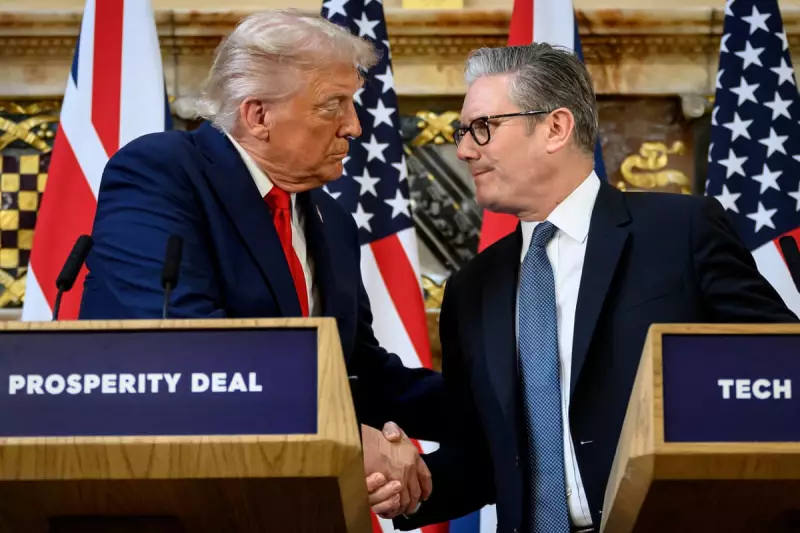
A series of newly announced commercial agreements between British and American entities has thrust the crucial trade relationship between the two nations back into the political and economic spotlight. The deals, spanning multiple sectors, arrive at a sensitive juncture, prompting analysis of their strategic significance and the underlying health of the transatlantic partnership.
Details of the New Transatlantic Agreements
The agreements, confirmed on Tuesday, 16th December 2025, involve several high-profile companies and institutions. A significant pact has been struck between the UK's Rolls-Royce and the US aerospace giant Lockheed Martin, focusing on advanced propulsion systems for future aircraft. This collaboration is seen as a major boost for the UK's aerospace engineering sector.
In the financial services domain, Barclays has entered into a strategic partnership with a consortium of US-based investment firms to streamline cross-border capital flows and investment products. Simultaneously, a landmark deal in the life sciences sector will see the UK's Oxford Biomedica and a prominent US pharmaceutical company co-develop a new generation of cell therapies.

These commercial deals, while not a formal government-to-government free trade agreement, represent substantial economic linkages. They come after years of stalled negotiations on a comprehensive UK-US trade treaty following Brexit, making these private-sector-led initiatives particularly noteworthy.
Political Reactions and Strategic Implications
The announcement has elicited a mixed response from political figures and trade experts. Proponents argue that the deals demonstrate the enduring strength and dynamism of the UK-US economic relationship outside of formal state negotiations. They highlight job creation, technology transfer, and reinforced supply chains as key benefits.
However, critics have been quick to voice concerns. Some opposition MPs and trade analysts question whether these piecemeal agreements can compensate for the absence of a broad free trade deal, which was once heralded as a major prize of Brexit. There are pointed questions about whether the UK is conceding too much in regulatory alignment or intellectual property rights to secure these partnerships.
"While business-led deals are welcome, they are no substitute for a coherent, strategic trade policy that protects British standards and interests," remarked one senior trade policy analyst, capturing the sceptical mood in some quarters. The debate underscores the ongoing tension between pragmatic commercial cooperation and the broader geopolitical trade strategy.
The Future of the Special Relationship in Trade
These agreements inevitably lead to a broader assessment of the so-called 'special relationship' in the realm of commerce. The flurry of activity suggests a relationship that is evolving, moving beyond political rhetoric into complex, sector-specific collaborations driven by industry needs.
The deals are likely to be used by the UK government as evidence of global Britain's appeal and its ability to forge strong bilateral economic ties independently. For the US, they represent continued access to British innovation and niche market expertise. Yet, the underlying desire in many British business circles for the stability and market access provided by a comprehensive trade pact remains largely unaddressed.
As 2025 draws to a close, the new UK-US trade deals have successfully shifted attention back to transatlantic commerce. They serve as both a testament to ongoing economic bonds and a reminder of the unresolved, larger trade architecture between the two allies. The spotlight is now firmly on how this mix of private deals and public policy will define the next chapter of UK-US trade relations.