New import tariffs are casting a shadow over America's festive season, pushing up the cost of artificial Christmas trees and starkly revealing the nation's continued reliance on overseas manufacturing for its holiday staples.
The Price of Festive Dependence
According to the American Christmas Tree Association, new import taxes have driven prices for artificial trees up by 10 to 15 per cent this year. This increase is forcing retailers to make difficult choices, cutting orders and absorbing higher costs themselves. The situation underscores a persistent reality: despite financial pressures and political pushes for domestic production, a significant shift of large-scale manufacturing back to the United States remains unlikely.
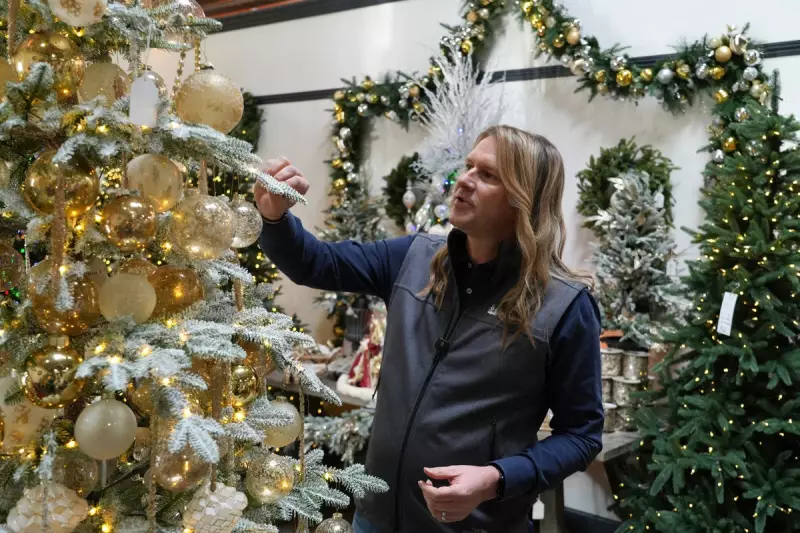
This reliance is rooted in decades of production moving to Asia. Chris Butler, CEO of National Tree Company, which sells over a million trees annually, explains the core issue. Artificial trees are inherently labour-intensive and require components, like strings of holiday lights, that are no longer readily produced within the US.

American consumer behaviour further complicates any potential reshoring. "Putting a ‘Made in the U.S.A.’ sticker on the box won’t do any good if it’s twice as expensive," Mr Butler stated bluntly. "If it’s 20 per cent more expensive, it won’t sell."
Why Fake Trees Rule and Production Moved
The preference for artificial trees is deeply entrenched in the US, with roughly 80 per cent of households opting for a fake tree this year—a statistic stable for at least 15 years. Mac Harman, founder of Balsam Brands, cites convenience, longevity, and allergies to real trees as key drivers. A major factor is the pre-strung lights found on 80% of artificial trees sold, a feature whose labour demands first pushed production to Thailand in the early 1990s, then to China.
"Where are we going to get 15,000 people in America who want to string lights on Christmas trees?" Harman questioned. The manufacturing process for a single tree takes one to two hours. In China, which produces 90 per cent of the world's fake trees, workers earn between $1.50 to $2 per hour. Harman describes the efficiency of workers at Balsam Hill's Chinese partners as "like watching an Olympian."
During the first Trump administration, Balsam Brands seriously explored making trees in Ohio. After consulting experts and considering automation, they concluded a tree retailing for $800 would cost $3,000 if made domestically. The company even struggled to find a US manufacturer for the simple pair of gloves included in each box for fluffing branches.
Tariff Impacts and Supply Chain Shifts
The tariff landscape is directly affecting both large importers and the few remaining US manufacturers. National Tree Co. imported fewer trees this year and raised prices by 10%, using much of the extra revenue for discounts due to weak demand. "It’s a discretionary item. People say, ‘I can wait one more year,’" explained CEO Chris Butler.
Balsam Brands absorbed the hit by cutting its workforce by 10 per cent, cancelling travel, freezing pay rises, and stopping office perks, alongside a 10% price increase. Harman noted a 5-10% drop in US sales this year, contrasting with growth in Germany, Australia, Canada, and France, suggesting tariffs have specifically dampened American demand.
Some companies are diversifying supply chains away from China. National Tree Co. moved some manufacturing to Cambodia in 2024 and could source all trees from outside China next year. However, this offers no guaranteed relief; the Trump administration threatened a 49% tariff on Cambodian goods in April, later reduced to 19%. Tariffs on Chinese-made trees now average 20 per cent.
One rare domestic producer, Lee Display in Fairfield, California, continues its craft. Founded in 1902, it makes about 10,000 trees annually. Owner Mark Latino values the control of domestic production but even his firm felt the pinch, avoiding Chinese-made lights and decorations this year due to tariff costs.

As Mac Harman sombrely concluded, "If a merry Christmas is measured in how many decorations people put up, by that measure it’s going to be a slightly less merry Christmas." The festive season now highlights enduring global trade realities and the high price of bringing manufacturing home.