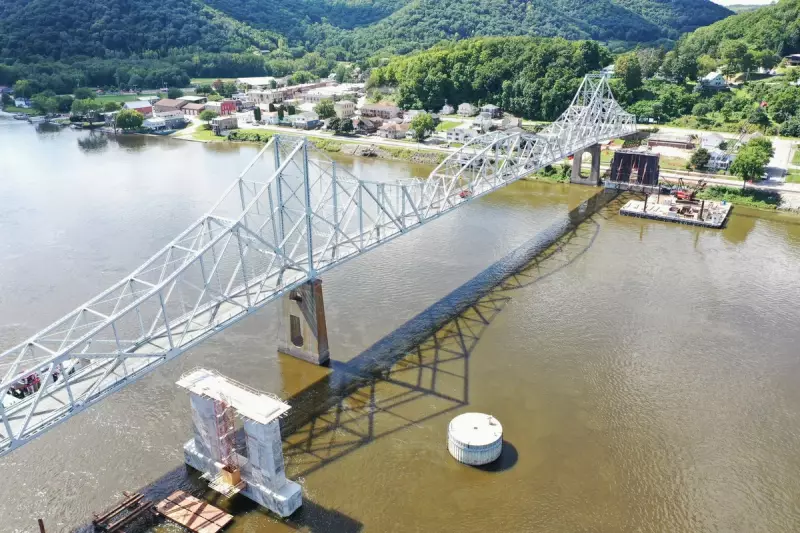
Crews have carried out a controlled implosion to bring down a historic bridge spanning the Mississippi River between the US states of Iowa and Wisconsin. The nearly century-old structure, known as the Black Hawk Bridge, was demolished on Friday to make way for a contemporary replacement.
A Sentimental Landmark Makes Way for Progress
The Black Hawk Bridge was completed in 1931, serving as a vital link between Lansing, Iowa, and Wisconsin for 94 years. Its distinctive cantilever design, featuring a central arch and two tower-like trusses, made it a unique landmark. Mayor of Lansing, Michael Verdon, emphasised the structure's profound emotional significance, stating it held "a lot of sentimental value to literally tens of thousands of people."
Despite its beloved status, the narrow bridge presented significant challenges. Mayor Verdon noted that encounters between two large trucks could be harrowing, and the river's geography led to barges occasionally striking the bridge piers. It was closed to traffic in October 2023, having carried roughly 2,100 vehicles daily as the only crossing for about 30 miles in either direction.

The Demolition Process and Community Impact
Officials anticipated a large crowd gathering to witness the unusual spectacle, with a live video stream also provided online. Daniel Yeh, a spokesperson for the Iowa Department of Transportation, explained that while some parts had been pre-removed, imploding the largest sections of the superstructure was the most efficient method.
The demolition sequence saw the centre span imploded first, followed by the eastern section later the same day. The western section will be dismantled conventionally in the future due to its proximity to homes and a railway line.
For now, drivers are using a ferry service. The community of Lansing, a river town with deep roots in steamboats and fishing, plans to salvage material from the old bridge for keepsakes and to construct a permanent tribute. The new $140 million replacement bridge is scheduled to open in 2027.
Looking to the Future
The implosion marks the end of an era for a structure that defined the local landscape for generations. Its removal paves the way for a safer, modern crossing intended to serve the region's needs for the next century. The event underscores the constant balance between preserving historical infrastructure and addressing contemporary safety and transport requirements.