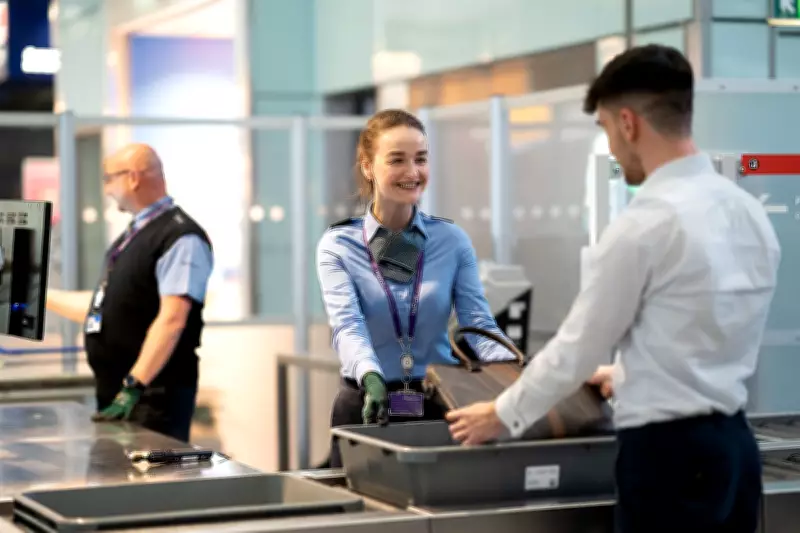
For many travellers, the airport security checkpoint represents the most stressful part of any journey. Globally, around half a million people navigate these procedures every single hour. At London Heathrow alone, approximately 7,000 passengers pass through security each hour, often grappling with restrictive rules on liquids and electronics.
A Temporary Measure That Lasted Decades
The infamous 100ml limit on liquids, aerosols, and gels (LAGs) in cabin baggage was introduced hastily in 2006 as a temporary security measure following a foiled terror plot. Despite repeated governmental promises to ease these restrictions, they have persisted for nearly two decades. In 2019, then-Prime Minister Boris Johnson pledged that major UK airports would relax the rules by 2022, a deadline later extended by Rishi Sunak's government to June 2024.
Technological Advancements Drive Change
The key to modernising these procedures lies in advanced computed tomography (CT) scanners. Similar to technology used in medical imaging, these scanners analyse the molecular structure of a bag's contents, creating detailed 3D images for security staff. This allows for the detection of potential threats while permitting passengers to leave laptops, tablets, and liquids inside their cabin baggage. At airports where this technology is operational, the liquid limit has been increased to two litres per container.

The primary aims of this upgrade are twofold: to enhance security through more sophisticated threat assessment and to significantly improve the passenger experience by reducing queue times and the need to unpack bags.
The Rollout: A Patchwork of Progress
While the government's initial 2024 deadline was missed by several airports, many have since implemented the new systems. However, the rollout has been inconsistent. In a surprising reversal in June 2024, the Department for Transport (DfT) temporarily reinstated the 100ml limit at some airports that had already installed the new scanners, citing the need for further system improvements.
Which UK Airports Have Changed Their Rules?
Since summer 2025, airports satisfying DfT inspectors have been permitted to relax the rules. Heathrow, having completed its £1 billion security upgrade in January 2026, is the latest and largest hub to receive approval. Passengers can now leave liquids and laptops in their bags where the new scanners are operational.
Other major airports that have eased restrictions include:
- Birmingham: The first major hub to relax the rules, advising passengers to leave all liquids and electronics in their hand luggage.
- Edinburgh: Scotland's busiest airport hailed the change as a momentous day for a generation of travellers only familiar with the 100ml limit.
- Gatwick: The UK's second-largest airport now allows liquids in containers up to two litres to remain in cabin baggage.
Notably, Manchester Airport, the UK's third-busiest, has installed the new scanners but, as of now, has not yet received DfT approval to lift the 100ml limit.
Navigating the New Normal: Key Considerations for Travellers
Passengers must remain vigilant, as rules are not uniform across all airports. The relaxation at your departure airport does not guarantee the same rules apply on your return journey or at a connecting hub.
Duty-Free Purchases and International Travel
The patchwork of regulations creates particular complexity for duty-free purchases, especially on multi-leg journeys. At airports like Dublin and Rome, which allow two-litre limits, taking duty-free alcohol through security is straightforward. Elsewhere, passengers may rely on Secure Tamper-Evident Bags (STEBs), though these are not infallible.
International disparities are significant. The European Union reverted to the 100ml limit at all airports from September 2024. Of Europe's ten busiest hubs, only Dublin and Rome currently permit two-litre containers. The United States maintains its 100ml (3.4oz) limit for inbound flights and has additional rules for powders.

The Future of Airport Security
The long-term vision, as outlined by the International Air Transport Association (IATA), is for Smart Security systems. This envisages a process where passengers walk unobtrusively through detection corridors, with technology handling most threat assessment and security staff focusing on behavioural analysis.
However, the reversals seen in 2024 demonstrate that this journey is far from complete. While the new scanners at Heathrow and other UK airports mark a substantial step forward, passengers are advised to always check the specific rules of their departure and arrival airports before travelling. The era of universally relaxed liquid rules is not yet here, but for millions passing through Heathrow, the security experience has just become significantly smoother.