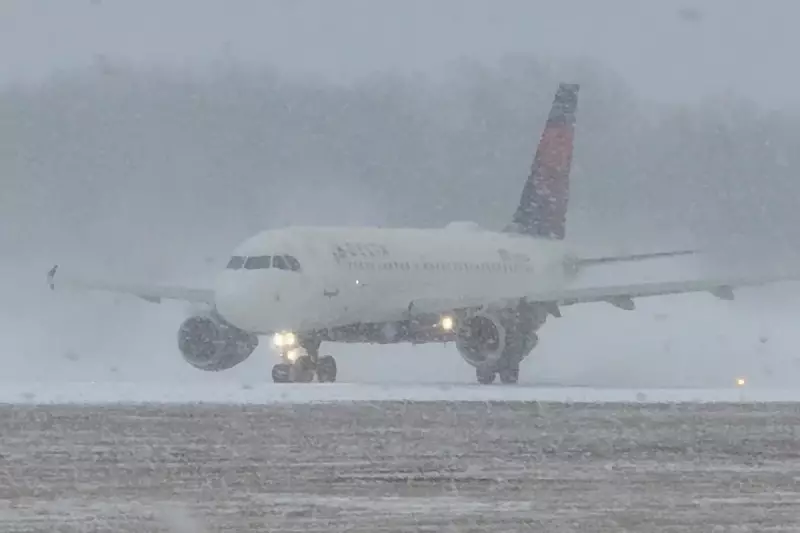
A powerful winter storm has unleashed travel chaos across the northeastern United States, leading to the cancellation and delay of thousands of flights during one of the year's busiest travel periods.
Storm Brings Region to a Standstill
The storm swept through the region early on Saturday 27 December 2025, coating New York City and surrounding areas in snow and ice. The treacherous conditions created hazardous situations on both roads and airport runways. According to the National Weather Service (NWS), an area stretching from Syracuse to Long Island and into parts of Connecticut saw between six and ten inches of accumulation. In New York City itself, Central Park recorded 4.3 inches of snow overnight.
Meteorologist Bob Oravec from the NWS provided a glimmer of hope for stranded travellers, stating to Reuters that the heaviest snowfall had concluded. "Only a few flurries remain this morning and those will taper off by the afternoon," he said.

Preemptive Cancellations to Avoid Operational Collapse
Despite the easing weather, the damage to air travel was severe. By mid-morning on Saturday, flight tracking service FlightAware reported that more than 14,000 domestic flights had been canceled or delayed. The epicentre of the disruption was the New York area, impacting major hubs like John F. Kennedy International, LaGuardia, and Newark Liberty International airports. The ripple effect was felt globally, with approximately 2,100 international flights bound for the US also canceled.
Airlines revealed that a strategy of preemptive cancellation was key to managing the crisis. Speaking to the New York Times, Southwest Airlines spokesman Chris Perry explained the industry's rationale. "The worst thing you can do for your whole operation is to cancel flights really close into the time they’re supposed to depart," he said. Such last-minute decisions strand aircraft, crews, and passengers alike, potentially triggering a cascading failure that can take days to resolve.
"It’s not worth the risk to put our airplanes and our crews there waiting to see if they’re going to be able to depart," Perry added, highlighting that early cancellations have become a standard tactic to preserve wider network stability.
Chaos During Peak Holiday Travel
The timing of the storm could hardly have been worse. According to industry body Airlines for America, the period from 19 December to 5 January was forecast to be a record-setting travel window, with an estimated 52.6 million passengers. The days affected by the storm—Friday and Saturday—were predicted to be among the very busiest.
While the disruption caused immense frustration for countless travellers trying to return home after the holidays, the snowy scene brought joy to some. Jennifer Yokley, a tourist visiting New York from North Carolina, told the Associated Press she was delighted to see the city dusted in white. "I think it was absolutely beautiful," she said.
As the flurries subsided on Saturday morning, airlines and airports began the mammoth task of recovering schedules and reuniting passengers with their luggage, a process expected to continue for several days following the significant operational disruption.