Cuba's Underwater Bus Becomes Vital Amid Severe Fuel Crisis in Havana
In the heart of Havana, a unique underwater bus has transformed into a lifeline for commuters as Cuba grapples with its most severe energy crisis in decades. The Ciclobús, a specially adapted vehicle, is now essential for navigating the city's transportation challenges.
Rising Demand for the Ciclobús
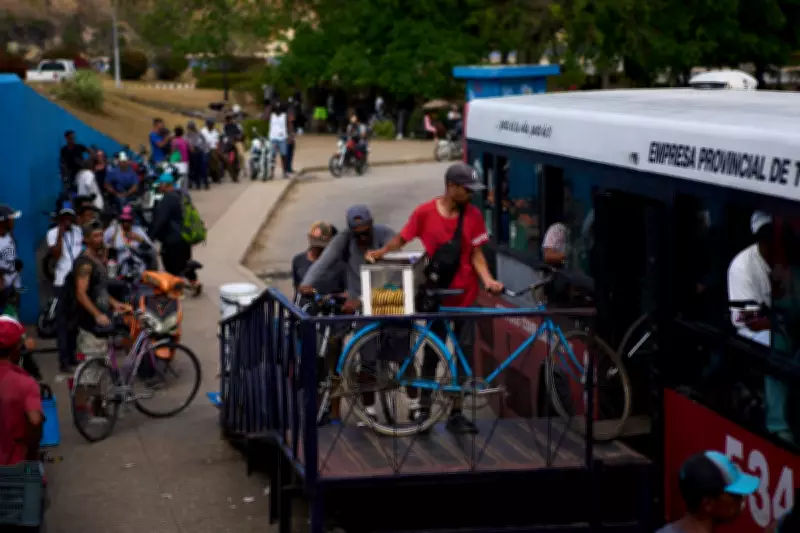
On a recent sweltering afternoon in the Cuban capital, dozens of commuters gathered at the entrance of the Havana Bay Tunnel. They were waiting for the Ciclobús, a diesel-powered bus designed to transport people and their vehicles through the underwater tunnel connecting Old Havana to the eastern side of the island. This service can accommodate around 60 travelers and their bicycles, scooters, or electric motorcycles, making multiple trips to move over 2,000 people daily.
The bus features a front seating section and an open bay for cargo, with riders entering via a specialized ramp and holding onto wall-mounted grab bars for balance during the journey. Bicycles, motorcycles, and scooters are prohibited in the tunnel, making the Ciclobús a critical alternative.

Impact of the Energy Crisis
The energy blockade imposed by the United States has forced Cuba to ration gasoline to only 20 liters per vehicle through a cumbersome appointment process that can take weeks or months, severely disrupting public transportation. As a result, Havana's streets are now almost empty of cars but teeming with thousands of bicycles and small electric motorcycles, which have become the primary means of getting around.
Ingrid Quintana, a resident of East Havana who works in the old part of the city, shared her experience while waiting for the tunnel bus. "My husband owns a bicycle, so I'm riding as his companion," she said. "It's an option we have because there's no public transportation and we can't afford to pay for a private taxi, so we ride the Ciclobús."
Route and Affordability
The Ciclobús covers the shortest public transportation route on the island, spanning 3 kilometers in about 15 minutes. After boarding near the Havana Bay Tunnel in Old Havana, passengers endure a rattling journey through the darkness of the underwater passage before emerging in eastern Havana, a sprawling residential zone home to hundreds of thousands.
In contrast, the alternative land route must skirt the massive bay, a 16-kilometer trek through sparsely populated and poorly paved industrial port areas. The fare for the Ciclobús ranges from 2 to 5 Cuban pesos, depending on whether you are transporting a bicycle or a motorcycle, which is a tiny fraction of a U.S. dollar on the informal market.
Comparatively, a ride in a shared taxi from the eastern neighborhoods costs 1,000 Cuban pesos, while a Cuban worker might earn a monthly salary of 7,000 Cuban pesos, highlighting the economic strain and the Ciclobús's affordability.
Historical Context and Resurgence
Owned by Havana's state-run transport company, the Ciclobús first emerged in the 1990s during the so-called "Special Period," a crisis triggered by the collapse of the Soviet Union that left the island isolated. Then-President Fidel Castro distributed Chinese-made bicycles among the population, and the bus service was introduced to aid transportation.
Over time, the service lost some appeal as residents turned to regular buses or shared taxis. However, it is now experiencing a resurgence as fuel shortages force more Cubans to rely on bicycles, electric tricycles, scooters, and motorcycles for their daily commutes.
Bárbaro Cabral, a 32-year-old gym teacher, emphasized the necessity of the service. "Most jobs are on the other side, in the city, and that's why we have to ride it to get across," he said, gripping his bicycle tightly as the Ciclobús began to fill with passengers.
This underwater bus has become more than just a mode of transport; it is a symbol of resilience and adaptation in the face of Cuba's ongoing energy challenges.