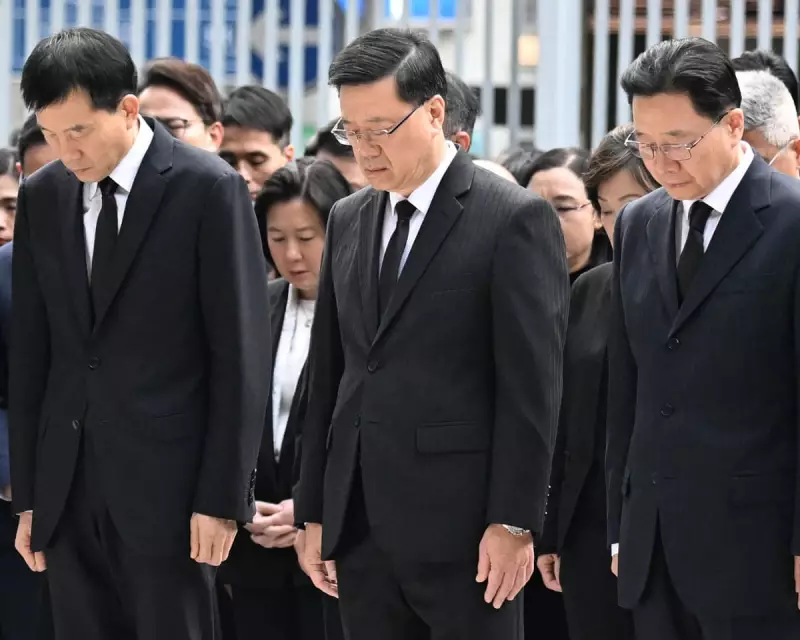
Hong Kong Begins Three Days of Mourning After Deadly Blaze
Hong Kong has entered a three-day period of official mourning following one of the city's most devastating residential fires, which claimed at least 128 lives at the Wang Fuk Court housing estate in the Tai Po district. The tragedy represents the deadliest fire to hit Hong Kong since 1948.
City Leaders Observe Silence as Grief Sweeps Hong Kong
On Saturday morning, Chief Executive John Lee led senior government officials in observing a three-minute silence outside government headquarters, where flags flew at half-mast. The solemn ceremony marked the beginning of the official mourning period as the city grapples with the scale of the disaster.
Meanwhile, ordinary citizens created spontaneous memorials near the charred remains of the residential complex, laying flowers and leaving notes of remembrance. One message read, "May your spirits in heaven always keep the joy alive," capturing the community's profound grief.
Desperate Search for Missing Continues
Approximately 200 people remain unaccounted for, with families conducting desperate searches through hospitals and victim identification centres. Of the 128 confirmed fatalities, 89 bodies have yet to be formally identified, adding to the anguish of waiting relatives.
A man surnamed Fung expressed his desperation while searching for his 80-year-old mother-in-law, telling reporters, "She is on antibiotics... so she is always sleeping. There was no fire alarm, so she might not have known there was a fire."
Another woman, surnamed Wong, aged 38, described her fruitless search for her sister-in-law and twin: "We still cannot find them. So we are going to different hospitals to ask if they have good news."
Investigation Reveals Multiple Failures
The city's anti-corruption watchdog has arrested eight individuals in connection with the blaze, including consultants, scaffolding subcontractors, and a project middleman. This comes after police previously arrested three men suspected of negligently leaving foam packaging at the site.
Fire services chief Andy Yeung confirmed that alarm systems in all eight apartment blocks were malfunctioning during the fire, vowing action against the contractors responsible. Residents corroborated this failure, reporting they heard no alarms and were forced to alert neighbours manually.
Preliminary investigations suggest the fire began on protective netting on the lower floors of one tower, with highly flammable foam boards and bamboo scaffolding contributing to its rapid spread. The flames engulfed seven of the eight high-rises within minutes, with one eyewitness describing how "one building went up in flames and it spread to two more blocks in less than 15 minutes."
Security chief Chris Tang indicated that the full investigation could take up to four weeks and didn't rule out discovering more victims during detailed evidence collection.
Community Response and Ongoing Impact
The government has established condolence points across Hong Kong and provided temporary accommodation for approximately 800 displaced residents. Nine emergency shelters operated overnight, housing about 720 people.
A remarkable community effort has emerged, with supply stations for clothing, food, and household goods organised near the disaster site, alongside medical and psychological care booths. The response became so effective that organisers eventually requested no further donations via social media.
Medical services continue to treat dozens of injured survivors, with 11 patients in critical condition and 21 listed in serious condition. Police have activated a specialist disaster victim identification system to help locate the missing.
This tragedy marks a sobering reminder of fire risks in densely populated urban areas, though improved safety measures had made such large-scale blazes increasingly rare in modern Hong Kong.