A Mother's Unanswered Cries for Help
For a moment, as she sat in a courtroom in North Wales last week, Sarah Gunther had to fight the overwhelming urge to leap from her seat. The impulse to throw herself at the young man standing in the glass-panelled dock and demand answers was almost unbearable. 'Obviously, I was trying to stay strong,' she recalls. 'But there was a point when I just wanted to get in there and shake him, to say, "What have you done?"'
She scanned the face of Tristan Roberts, once so achingly familiar—someone she'd watched grow from a sweet-faced baby to a troubled little boy, and finally to a young man on the cusp of adulthood. She searched for any sign of recognition, contrition, or humanity. There was nothing. Impassive and detached, the 18-year-old stood before Mold Crown Court to be sentenced for the incomprehensible murder of his own mother, Angela Shellis, who was also Sarah's beloved sister.
A System That Failed Repeatedly
Beside Sarah sat Tristan's elder brother, Ethan Roberts, a 20-year-old worn down by the crushing weight of grief and the void left by 'the best mum anyone could ask for'. Both agree that Angela was a mother who had loved her younger boy unconditionally and fought for him tirelessly. She was a mother who had begged for help again and again, only to be failed by a system that couldn't—or wouldn't—listen.
As evidenced in a hauntingly prescient email shared with her sister, Angela had written to her local health board just fourteen months before Tristan, who had ADHD and autism, marched her to her carefully planned execution. 'I will not give up fighting for my son,' she implored. 'I will not lose him to mental health, criminality, or worse. Do something!' In the end, both were lost: him to the criminality she feared, and her to her son's callous hand.
Chilling Details of Premeditation
Standing in the dock, Tristan showed not a flicker of emotion as he was jailed for life for murder—a crime he admitted but for which he has never offered any explanation. 'I don't think he showed any remorse. At some points, I think he was even smirking,' says Sarah, 44. What was documented during that court hearing was, even to the most hardened observers, profoundly shocking.
Fuelled by a violent hatred towards women, Tristan spent hours locked in a toxic online world, fixated on the notion that his devoted 45-year-old mother—who had given up her teaching career to care for him—was to blame for his unhappiness. He discussed plans to kill her openly. In the run-up to the murder, he used the AI search engine DeepSeek to ask for tips for a 'non-experienced killer', including whether he should use a knife or a hammer. After it refused to engage, Tristan tricked the AI by lying that he was writing a book about serial killers. DeepSeek then suggested a hammer would be better and provided the pros and cons for both weapons.
A Glimmer of Hope Before Tragedy
Angela, of course, knew none of this. It's what makes it all the more tragic when Sarah and Ethan, speaking exclusively, recall the glimmer of hope she'd clung to as Tristan prepared to celebrate his 18th birthday in October—just two weeks before he killed her. 'He didn't want a big fuss,' says Sarah, 'so I remember she was excited when he said he wanted to have an evening of whiskies and Coke, because he was 18, with a takeaway and watching Dexter together. It felt like a bonding thing.' Dexter, a cult American TV series about a serial killer, was his favourite show.
This modest request felt huge to a mother desperate to connect with the little boy who'd once run to her with a scuffed knee but who now could barely tolerate her. In court last week, it was revealed that this simple request was anything but innocent. For two days before his birthday, Tristan had also asked AI whether if someone drank 'enough whisky and Coke', would they 'be able to defend themself'.
The Brutal Execution
In the end, Tristan abandoned his birthday plans. Instead, he went to his local branch of The Range to buy a knife and disposable razors—being 18, he could legally purchase weapons now, too. Then, on October 24 last year, Tristan went through with his evil plans. First, he held his mother prisoner in her bedroom, attacking her with a hammer and strangling her. He then forced a balaclava over her head, led her to a nature reserve near their Prestatyn home, and bludgeoned her to death—while recording every moment on a dictaphone.
The depths of depravity wrought that night haunt Sarah, who worked alongside her sister as a teaching assistant at Rhyl High School, and Ethan, who has paused his second year studying computer science at Warwick University. There has been precious little time for this gentle pair to grieve. Their sorrow is layered with a litany of unanswered questions.
Unanswered Pleas for Intervention
Of course, there's the fundamental question of why Tristan did what he did. But more pressing is why, when Angela had spent years begging for help—from social services and the Child and Adolescent Mental Health Service (CAMHS)—was so little action forthcoming? The court was told Angela, who trained as a primary teacher in her 30s but opted to work as a teaching assistant to devote more time to her troubled son, had 'repeatedly tried to obtain support', with 'limited success'.
Ethan and Sarah cannot emphasise enough how tirelessly Angela fought. 'My strength is I want these people held accountable,' says Sarah. 'CAMHS, social services. Their job is to protect people, to help those who need help, and they didn't do it.' Ethan agrees: 'I'd said to Mum, "What is it going to take for them [the authorities] to see he's not well? How long can this go on?"'
A Descent Into Darkness
There has been shock upon shock. 'I'd gone months trying to think it was an in-the-moment thing, that he'd had a mental health episode or that someone else was involved,' says Sarah. 'Then getting told there was planning and purchases and online chats . . . You can't prepare yourself for that.' Tristan, it was revealed, had spent weeks in his bedroom, pouring out his thoughts on the controversial platform Discord. He posted numerous messages describing his need for 'revenge, justice, vengeance'.
Aunt and nephew hold their emotions close, but they are broken. 'I think he sort of blames himself,' Sarah says of her nephew. 'And I probably do the same. Did I miss this? Did I miss that? The questions are just forever in my head.' What's indisputable is that all Angela had ever done for her son was fight for him. Tristan was just six when diagnosed with autism. At the time, the family were living in Luton with both boys attending mainstream schools. Angela fought for Tristan to transfer to another school with the requisite resources to help him.
A Childhood Remembered
Ethan remembers: 'Obviously, he was an autistic kid, he was annoying, he caused problems, but not serious problems. We'd go out with Mum on the weekends a lot,' he says, with the flicker of a smile. 'Cinema, out with the dogs, camping, coming to Wales to visit my grandparents or Sarah.' She loved to travel, so there were countless big family holidays. Sarah and Ethan struggle to reconcile these times with the twisted tale Tristan wove online—describing an 'entire life' of 'hell, abandonment, betrayal'.
'He had the same upbringing as me,' says Ethan, betrayal flickering in his eyes. 'He had the least traumatic upbringing.' There was one significant upset, however. In 2021, Angela's 20-year marriage to husband Mark, the boys' father, had broken down, and two years later she moved to Wales to be closer to her own family and the boys' paternal grandparents. Her younger son was given a choice to stay with his dad or go with them. He opted to move to Wales.
Escalating Warning Signs
He enrolled at a local school but struggled and failed his GCSEs before beginning—and being asked to leave—an access course at college. 'Some days he'd walk around town all day, no one knows what he was doing,' says Ethan. 'At home, there'd be times he didn't leave his room for like 12 or 20 hours.' Angela, meanwhile, had discovered her son was self-harming and referred him to CAMHS.
Then in 2024, there were two significant escalations. First, Tristan disappeared on a visit to his father and was found, after frantic public appeals and police searches, sleeping on a town centre bench. Then came a caravan holiday to Scotland with his mother and aunt. There was a trivial row over a mobile phone one evening, and Tristan 'flipped'. 'He was punching her on the head, and I had to go into her bedroom and drag him off,' says Sarah.
Missed Opportunities for Help
Ethan was in the US that summer, working at an American camp before going to university, and remembers his mother telling him about it on his return. 'It was one of the only times I ever saw her upset,' he says. 'She was crying, about losing her son, that she couldn't reach him any more.' Tristan was admitted to the children's ward (not a psychiatric unit) at Glan Clwyd hospital in Rhyl. 'I'd say there were four to five days of meetings with CAMHS workers, social services, video calls of me and Ange literally screaming, "He needs help". Two minutes later, they'd go into the room with Tristan, and he'd go, "But I'm fine".'
Ethan also couldn't understand it all: 'They believed him,' he says. 'Not the responsible adults looking after him every day.' Denbighshire County Council said last week that it and 'partner organisations' had referred the case to North Wales Safeguarding Board and couldn't comment further.
Final Spiral and Tragedy
Tristan was eventually released from hospital into homeless accommodation—which he trashed—before being arrested a month later for theft and possessing a knife in a public place. There was talk of him being sectioned, but it didn't happen. So, by the summer of last year, he was back home, living with his mother. His behaviour spiralled: he began refusing to wash or care for himself, developed an obsession with knives and hammers, and all the while his animosity towards Angela grew.
The chilling parallels with the case of Axel Rudakubana, the autistic 17-year-old who murdered three girls in Southport in July 2024, are hard to ignore. Ethan worried about leaving his mother alone as he headed back to university, but Angela reassured him she would be okay.
The Final Days
Sarah and Ethan's memories of that final week in October are still raw. Angela visited her sister, as she did at least a couple of times a week, for a cup of tea on the Tuesday. Normally, there'd be bingo on a Thursday night, but after a tough day and bad weather, they both agreed they wouldn't bother. There'd been text exchanges with Ethan too—about his plans for dinner and the weekend—'just normal stuff,' he says. But that 'normal' was about to be shattered.
At first, Sarah didn't think much of it when she couldn't reach her sister the following morning, but then she saw a worrying post on Facebook about the discovery of a woman's body in Prestatyn. 'Of course, your mind starts swirling,' she says. 'There had always been a sixth sense between Ange and me. Like she'd know if there was something wrong with me, and I'd know if there was something wrong with her.'
Discovery and Aftermath
Ethan, meanwhile, was also worried when his mum didn't answer her mobile. When he received a text from her phone claiming she had a sore throat, he automatically 'knew it was Tristan'. Sarah called the police before dashing to the family home with the boys' paternal grandparents. There they found a fortress: the front door barricaded by a bookcase, the back by two dining chairs with weights taped to them.
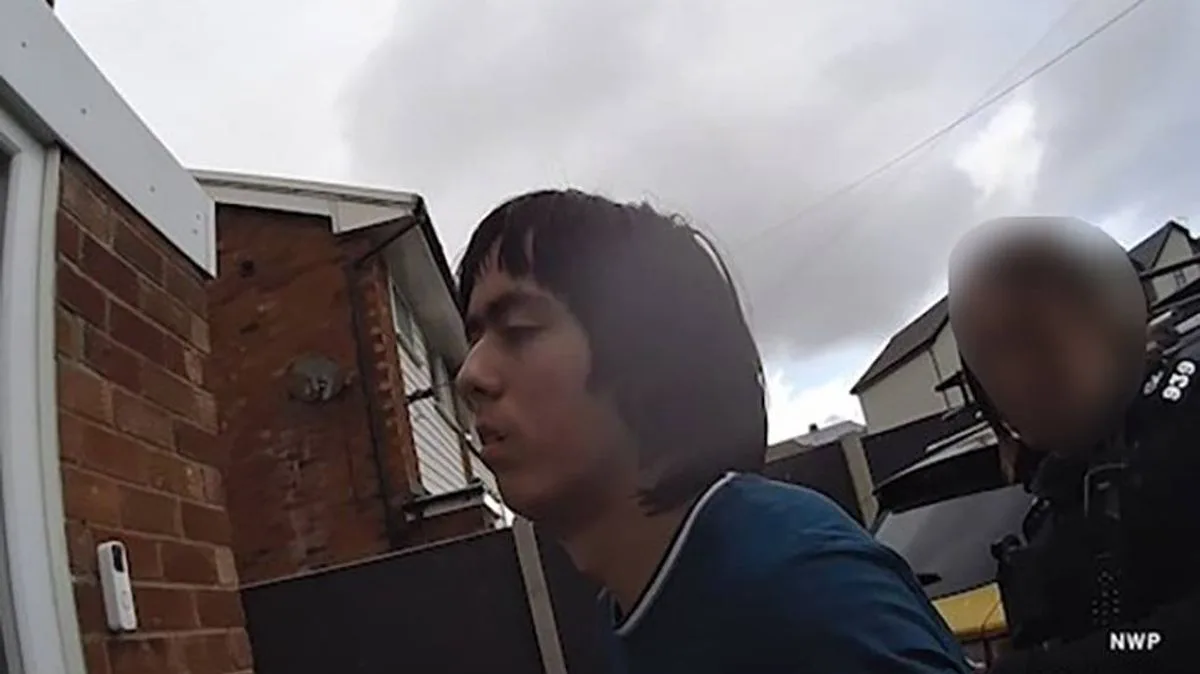
Sarah managed to push her way inside, desperate to find Angela. Instead, she found her nephew in the bathroom. 'I haven't done anything, leave me alone,' he said. The police arrived shortly afterwards, capturing his arrest on camera. Later, they found chilling Ring doorbell footage from a neighbour's home, showing Angela—limping and leaning on a crutch from earlier knee surgery—and her son, leaving the house at 3:19 am.
A Family Forever Changed
Ethan made a moving personal impact statement to the court in which he described the hell of his four-hour bus journey home, 'running over and over in my mind what could have happened'. Today, he feels anger and guilt, even a little anger towards his mum. Why didn't she fight, scream, or struggle more? 'She was probably trying to calm him down because that's what she'd always done . . . to de-escalate the situation,' says Sarah.
What haunts them most, though, is the knowledge that none of this needed to happen. Ethan doesn't know how he feels about his brother now. 'I hope he gets help, but I don't really care,' he says. Sarah adds: 'I can't say I don't love him, I can't bring myself to say that. I'm hoping that in time somebody will see that he does actually need help. I think that's what my sister would want, even after all this.'