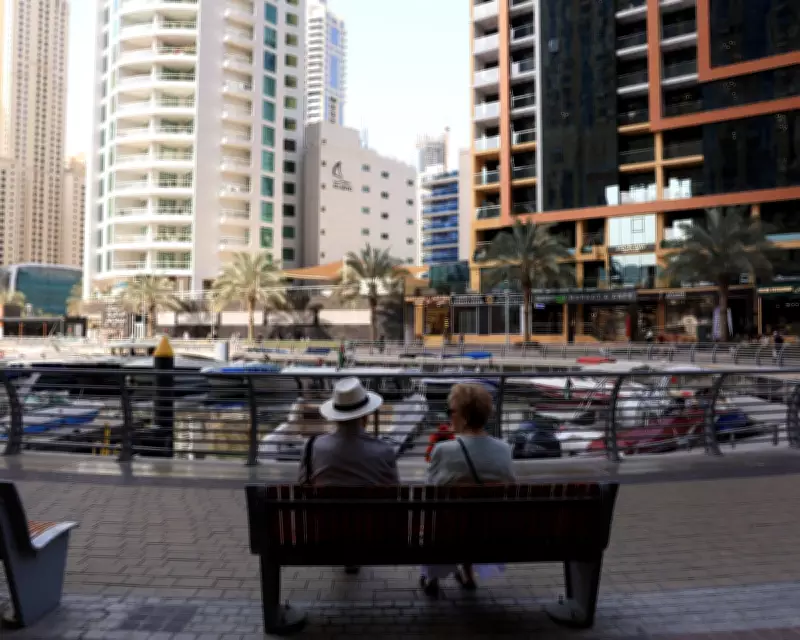
British Expats in Dubai Maintain Calm Amid Regional Conflict Escalation
As the US-Israeli conflict with Iran intensifies, sending shockwaves across the Middle East, an estimated 250,000 British nationals living in the United Arab Emirates find themselves at the epicentre of geopolitical tensions. The situation has triggered both alarm and resilience within this diverse community of fintech entrepreneurs, retirees, beauty salon workers, and early-career professionals.
Contrasting Reactions to Security Threats
The conflict's tangible impact became undeniable when falling debris from intercepted Iranian airstrikes killed at least three expat workers from Pakistan, Nepal, and Bangladesh, while injuring up to 68 others. A dramatic explosion at Dubai's world-famous Fairmont hotel provided a visual spectacle that matched alarming headlines.
For one British expat, newly arrived in Dubai's financial services sector, Saturday morning delivered a double shock. After hearing explosion booms and sharing a BBC video with colleagues, he was instructed to delete it immediately. The UAE had issued warnings that sharing unverified content constitutes an imprisonable offence, accompanied by temporary internet disruptions.

Business Continuity Versus Growing Anxiety
Despite these developments, many British residents insist on maintaining normalcy. Justin Harper, former Daily Mail journalist and current editor of CEO Middle East, was celebrating his birthday with a family road trip toward the Iranian border when missiles struck. He quickly felt assured by authorities' response.
"I don't want to sound blase but it's business as usual for me," Harper stated, having returned to work on Monday. "While my kids are still home-schooled for the next couple of days, it does feel we're getting back to normal already."
Harper emphasized the transient nature of regional tensions: "Having spoken to colleagues and a lot of Brits who've been here for 20 years-plus, they have lived through many scares and tensions and you just kind of ride it out, because they tend to be very short term."
Institutional Responses and Economic Considerations
The conflict has prompted concrete institutional measures. Private schools with British affiliations, including Repton Dubai and Dubai International Academy, have closed indefinitely. Many British nationals now work remotely following official advice. Over 100,000 British nationals in the Gulf region have registered with the Foreign Office as recommended.
Economic perspectives remain cautiously optimistic. Natasha Hatherall, a 16-year Dubai resident running a major marketing agency, signed a business contract amidst the turmoil. "I consider that I'm really tuned into the sentiment and what's going on. And I think everyone is saying: 'I feel safer here than I feel elsewhere'. We are not getting on a plane to go anywhere."
Broader Expatriate Dynamics and Future Outlook
The British community represents just one segment of Dubai's international population. Katharine Budd, a fintech entrepreneur splitting time between Dubai and Austria, noted significant Russian and Ukrainian migration following the Ukraine war. "All the big companies – MasterCard, Visa – all the big law firms just relocated all of their staff from Russia and Ukraine at the start of the war," she observed.
Budd suggested potential silver linings: "How many British people have previously lived in Dubai? There's a big pool of people who are sort of thinking: 'Yeah, I shouldn't have left. Life in the UK is not so great now, and you know, now it's getting bit cheaper to live in UAE'. I think this might be my time to go back'."
Economic analysts like Azad Zangana from Oxford Economics project tourism recovery within one to two years, with confidence that Iran will seek truce negotiations to minimize broader economic impact. The UAE's planned Disneyland theme park in Abu Dhabi, scheduled for 2030-2033, symbolizes long-term confidence in the region's stability.

Political Reactions and Social Commentary
Back in Britain, reactions have mixed sympathy with schadenfreude. Liberal Democrat leader Ed Davey referenced "tax exiles" like journalist Isabel Oakeshott, arguing that British nationals in UAE should contribute taxes "to support our armed forces, just like the rest of us do." Media headlines have ranged from sensational to skeptical, with some proclaiming "End of the Dubai dream."
Yet within Dubai itself, the ruling family's visible public engagement – exemplified by Sheikh Mohamed bin Zayed al-Nahyan and Sheikh Mohammed bin Rashid al-Maktoum's mall walkabout – represents deliberate confidence-building measures. As one social media observer noted: "The French kings always ate in public. I kinda like this."
The coming weeks will test whether Dubai's appeal – built on 0% income tax, year-round sunshine, and perceived safety – can withstand regional conflict pressures. For now, the British expat community remains divided between those eyeing exit strategies and those committed to riding out the storm.