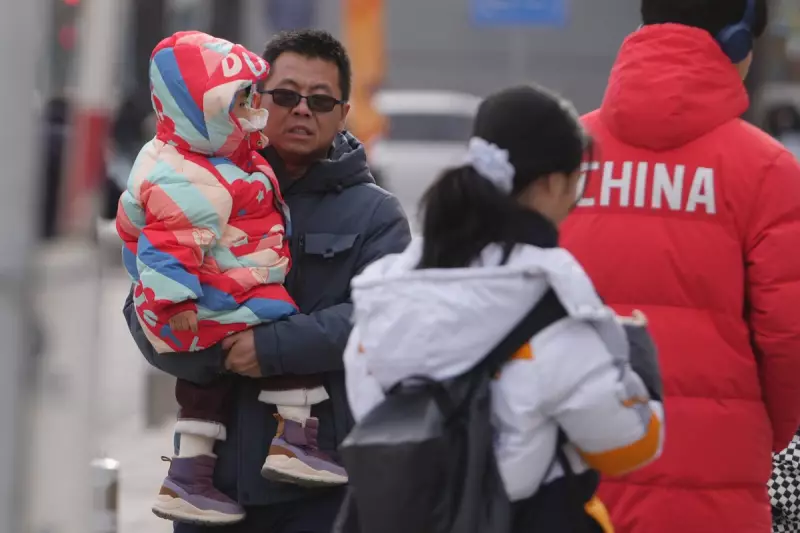
China's announcement of its lowest-ever birth rate has starkly highlighted a national challenge that has persisted for thousands of years: the complex task of managing its enormous population.
The Weight of Numbers: From Strength to Anxiety
For centuries, a vast populace has been a cornerstone of China's perceived power. Yet, as former leader Mao Zedong noted in 1957, the sheer scale of "600 million people" also brings immense pressure. Today, that dynamic is shifting profoundly. The latest figures show China's population now stands at 1.404 billion, a drop of 3 million from the previous year, with the birth rate falling to its lowest level since the founding of the People's Republic in 1949.
This decline presents a fundamental problem for Beijing. The government's perennial challenge has been to steward a citizenry that simultaneously bolsters national strength and consumes vast resources. Now, a combination of policy legacy, generational shifts, and modern lifestyles has sparked deep concern that there will be insufficient young people to build the country's future.

The Enduring Ripple Effect of the One-Child Policy
It is a stark reversal from the 1980s, when the state feared overpopulation. The one-child policy, formally introduced in 1980, strictly limited most couples to a single offspring for decades. While intended to align resources with economic growth under Deng Xiaoping, its consequences were far-reaching and often tragic.
The policy led to a widespread cultural preference for sons, resulting in the neglect and abandonment of baby girls, particularly in rural areas. In urban centres, it created a generation of only children, sometimes dubbed "little emperors," who became the sole focus of their families' attention and resources. As the Brookings Institution concluded in 2016, the policy would be remembered as "one of the costliest lessons of misguided public policymaking."
Today, the legacy is a rapidly ageing society and a growth rate that has nearly stalled. The loosening of the restrictive "hukou" household registration system has further complicated matters, leaving many elderly parents isolated as their only children move away for work, exacerbating issues of loneliness.
A National Campaign to Turn the Tide
Facing this demographic crisis, the state is now aggressively encouraging families to have three children. President Xi Jinping has reframed the population as a "great wall of steel," linking it directly to national power. This push is underscored by India surpassing China as the world's most populous nation in 2023, a shift with both domestic and international implications for China's global standing.
A multi-pronged strategy is underway to reduce the barriers to parenthood. The government has removed taxes on condoms, daycare centres, and even traditional matchmaking services. More systemically, the latest five-year plan aims to cultivate "positive views on marriage and childbearing" while enhancing financial incentives and reducing the costs of raising children. State media Xinhua has described these combined efforts as a plan to "make childbirth essentially free."
The ultimate question is whether deep-seated cultural values, which historically viewed having offspring as a duty to ancestors, can be reignited. Or will the realities shaped by decades of strict policy and modern pressures prevail? As Mao's 1957 essay "On the Correct Handling of Contradictions Among the People" suggested, managing the masses has always been a complex and contradictory endeavour—a challenge that continues to define China's path forward.