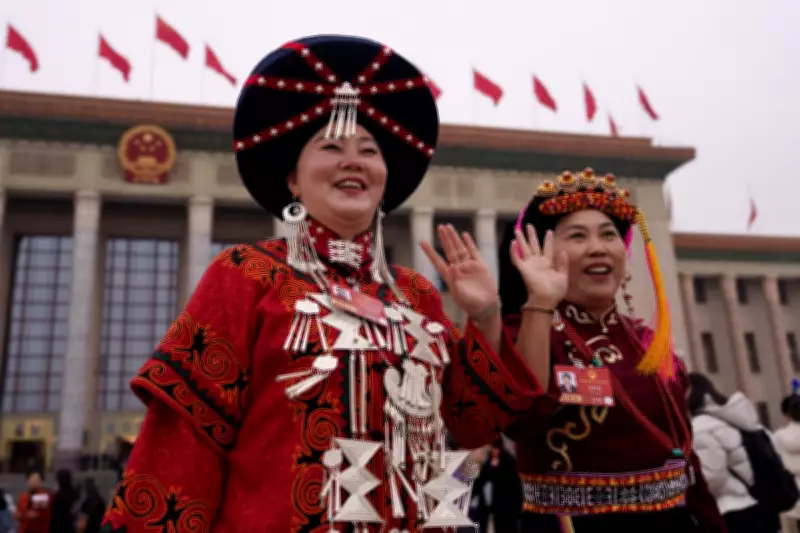
China's Ethnic Unity Law Set to Cement Assimilation Policies
China is expected to approve a comprehensive "ethnic unity" law this Thursday through its ceremonial legislature, the National People's Congress. Critics contend this legislation will significantly tighten assimilation efforts and weaken the rights of ethnic minority groups across the nation.
Law Aims to Forge National Community Consciousness
The proposed law, introduced by delegate Lou Qinjian, is designed to foster "a stronger sense of community among all ethnic groups in the Chinese nation." It mandates that all government bodies, private enterprises, local governments, and state-affiliated organizations like the All-China Women's Federation actively promote ethnic unity.
The text explicitly states: "The people of each ethnic group, all organizations and groups of the country, armed forces, every Party and social organization, every company, must forge a common consciousness of the Chinese nation according to law and the constitution, and take the responsibility of building this consciousness."

Academic Warnings of Minority Identity Setback
Academics and observers warn this provision represents a substantial setback for ethnic minority identity. A key concern is the mandate for Mandarin Chinese to be used in compulsory education from kindergarten through high school, potentially overriding constitutional protections.
China's constitution guarantees that "each ethnicity has the right to use and develop their own language" and "have the right to self-rule." The Law on Regional Ethnic Autonomy further promises limited autonomy, including flexible economic development measures. However, experts predict the new law will take precedence in practice.
James Leibold, a professor at Australia's LaTrobe University specializing in China's ethnic policies, described the measure as "a death nail in the party's original promise of meaningful autonomy" and a capstone of President Xi Jinping's major rethink of ethnic policies.
Language Education Shifts and Historical Context
Article 15 of the new law mandates Mandarin instruction throughout compulsory education. While Mandarin already serves as the primary instructional language in regions like Inner Mongolia, Tibet, and Xinjiang, the legislation explicitly states minority languages cannot be the primary medium of instruction nationwide.
This marks a significant departure from past practices. Until recently, ethnic minorities enjoyed some autonomy in school language use. For instance, students in Inner Mongolia could study much of their curriculum in Mongolian until 2020 policy changes replaced Mongolian textbooks with Chinese versions, sparking protests and crackdowns.
Currently, students in the region can only study Mongolian as a foreign language for one hour daily. Minglang Zhou, a University of Maryland professor who studied China's bilingual policies, notes the law's push for "mutually embedded community environments" may further disrupt minority-heavy neighborhoods by encouraging Han Chinese migration.
Legal Penalties and International Implications
The law establishes a legal basis for prosecuting individuals or organizations outside China if their actions are deemed harmful to "ethnic unity." This clause echoes provisions in Hong Kong's National Security Law, which allows prosecution of overseas persons for perceived secession or subversion.
Rayhan Asat, a Harvard legal scholar, argues "the law serves as a strategic tool and gives the pretext to government to commit all sorts of human rights violations." Her brother, Ekpar Asat, is serving a 15-year prison sentence in Xinjiang on charges of inciting ethnic discrimination after building a social media platform for Uyghurs.
Uyghurs, a Muslim minority group, have faced extensive detention campaigns. While short-term internment camps reportedly closed in 2019, thousands remain imprisoned for their identity rather than crimes, according to experts. Asat expressed concern about preserving Uyghur identity for future generations, stating "I think preserving any sort of Uyghur identity would be impossible."

Broader Human Rights Concerns
Maya Wang, deputy Asia director at Human Rights Watch, challenges China's development justification for these policies. She argues the law isn't truly about equitable economic participation, as policies are forcibly imposed on Tibetans and others. "A truly inclusive model does not preclude the ability of children to speak two languages," Wang emphasized.
China's United Front, responsible for ethnic minority policy, did not respond to requests for comment. The legislation arrives amid ongoing international scrutiny of China's treatment of minority groups, with critics viewing it as another step toward cultural homogenization under the banner of national unity.