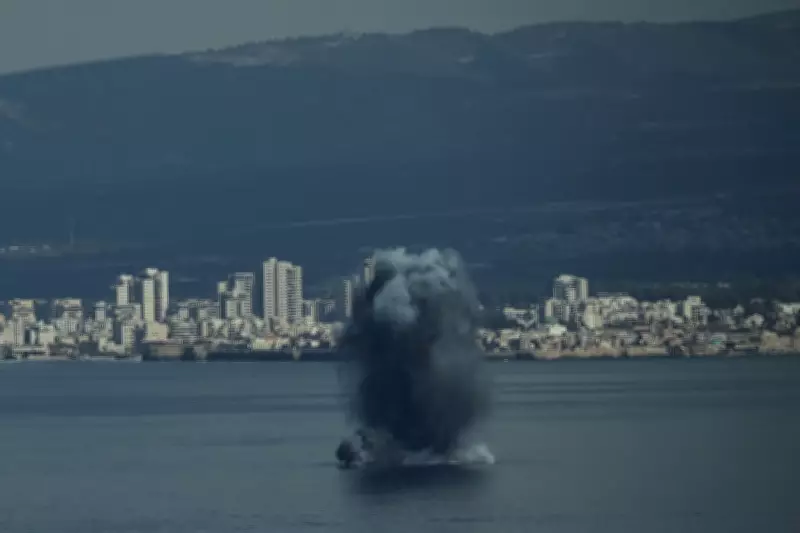
Middle East Water Crisis: Desalination Plants Targeted in Dangerous Escalation
The war in the Middle East has entered a perilous new phase, moving beyond traditional military and oil targets to strike at the region's most fundamental infrastructure. Over the weekend, both sides targeted desalination plants that provide the only reliable drinking water for millions across the Arabian Peninsula, where natural freshwater sources are virtually nonexistent.
A Long-Feared Scenario Becomes Reality
Analysts describe this development as the realization of a long-feared scenario where water becomes a weapon of war. Bahrain accused Iran of striking one of its plants with a drone on Sunday, while Iran claimed the United States hit a desalination facility on Qeshm Island in the Strait of Hormuz the previous day, cutting water supplies to thirty villages.
While earlier strikes had come close to threatening this crucial infrastructure, experts noted those appeared to be collateral damage. This weekend's attacks represent the first time either side has deliberately targeted water infrastructure, marking a significant escalation in tactics.

Vulnerable Lifelines for Water-Scarce Nations
The Middle East holds just two percent of the world's renewable freshwater yet is home to some of the world's fastest-growing cities. With virtually no rivers or reliable rainfall, Gulf states have spent decades building extensive networks of desalination plants that convert seawater into drinking water.
Kuwait and the United Arab Emirates obtain roughly ninety percent of their drinking water through desalination, with Oman at eighty-six percent and Saudi Arabia at seventy percent. These facilities represent essential lifelines for populations across the region.
Experts Warn of Critical Vulnerabilities
David Michel, senior fellow for water security at the Centre for Strategic and International Studies, stated that this shift "marks a significant increase in the potential risk, and signals potentially the willingness and the strategy of the adversaries to hold that critical civilian infrastructure at risk."
Experts emphasize that while these plants are indispensable, they remain fragile, poorly defended, and highly vulnerable to attacks. Lalit Mohan, a water management consultant, explained that "damage to any one part can halt water delivery," noting vulnerabilities span the plant itself, its power supply, and its distribution network.
Physical and Cyber Threats Converge
Ed Cullinane, Middle East Editor at Global Water Intelligence, compared desalination plants to other civilian infrastructure in the region: "Much like oil terminals, ports and other fixed civilian infrastructure, desalination plants are large open-air facilities exposed to the same weapons being used on military and civilian infrastructure across the Gulf."
Physical attack is not the only threat. Iran has previously demonstrated a willingness to target water systems through cyber means, including breaking into a dam control system in New York in 2013 and tampering with multiple US water treatment systems in 2023 and 2024. Michel noted that such cyber attacks could be deployed against Gulf desalination infrastructure with plausible deniability.
Decades of Warnings Ignored
Despite these vulnerabilities being known for decades, Gulf states have struggled to make their water supplies more secure. A 2008 US State Department cable, later exposed by WikiLeaks, warned that Riyadh would have to be evacuated within a week if its main desalination plant were seriously damaged.
A 2010 CIA analysis found that more than ninety percent of the Gulf's desalinated water came from just fifty-six plants, each described as "extremely vulnerable to sabotage or military action." Plans for a more secure, unified Gulf-wide water strategy have been discussed but never implemented due to regional mistrust and reluctance to coordinate.

Iran's Paradoxical Position
Iran, paradoxically, faces greater long-term water risks than its Gulf neighbors. Its reservoirs are severely depleted after years of drought, its rivers rank among the most stressed globally, and its cities compete with agriculture for dwindling groundwater. President Masoud Pezeshkian has warned that Tehran may one day require evacuation if shortages worsen.
According to the World Resources Institute's Aqueduct Water Risk Atlas, eighty-three percent of the Middle East's population already faces severe water scarcity, creating a precarious foundation for any conflict.
Legal and Strategic Implications
Legal experts emphasize that attacks on civilian infrastructure raise serious questions under international humanitarian law. Dr. Evelyne Schmid, professor of international law at the University of Lausanne, stated: "Desalination plants are civil objects – they must never be targeted, and doing so is a serious violation of international law."
Strategically, Michel explains that targeting water infrastructure offers Iran precision that blocking the Strait of Hormuz does not. While closing Hormuz inflicts pain on the entire international community, including ally China, striking desalination plants allows for more targeted escalation aimed at civilian populations.
The ultimate logic involves civilian pressure: if people cannot access water from their taps, they must decide whether to stay or flee. Iran's calculation appears to be that Gulf populations would blame both Iran for the attacks and the US and Israel for a conflict that has degraded their cities and disrupted water systems, potentially pushing them to demand a ceasefire.