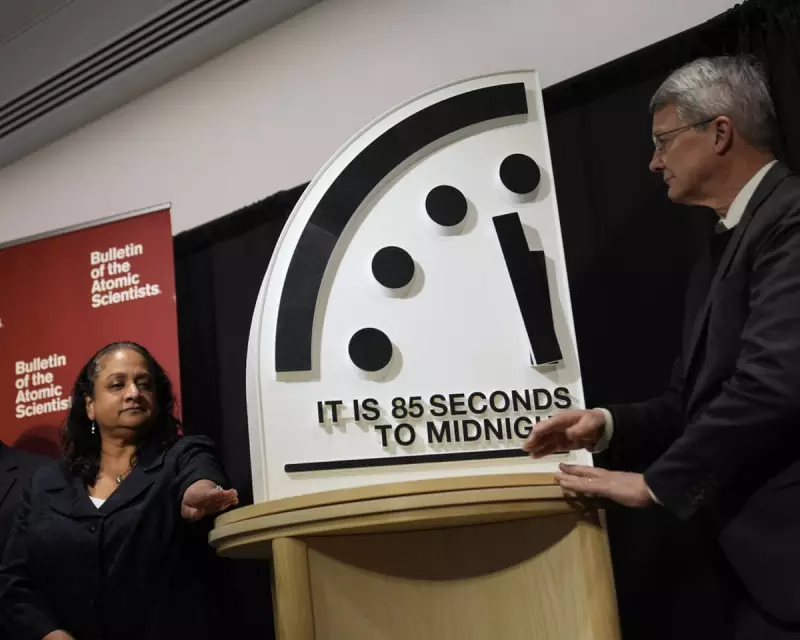
The symbolic Doomsday Clock has been advanced to just 85 seconds to midnight, marking humanity's closest ever proximity to global catastrophe according to leading scientists. The Bulletin of the Atomic Scientists announced this alarming adjustment during a news conference in Washington DC, highlighting multiple converging threats that have pushed the planet toward unprecedented danger.
Escalating Global Tensions and Existential Risks
Earth faces greater peril than at any previous point in history as major powers including Russia, China, and the United States adopt increasingly aggressive, adversarial, and nationalistic postures. The advocacy group's annual assessment points to collapsing international cooperation and deteriorating global understandings that previously helped mitigate existential risks.
Multiple Converging Threats
The scientists identified several critical areas of concern that contributed to moving the clock forward from last year's setting of 89 seconds to midnight. These include:

- Nuclear warfare risks escalating through conflicts involving nuclear-armed nations
- Climate crisis impacts including droughts, heatwaves, and floods exacerbated by global warming
- Potential misuse of biotechnology without adequate international controls
- Artificial intelligence development proceeding without sufficient safeguards or regulation
Daniel Holz, chair of the group's science and security board, emphasized that international trust and cooperation have become essential for survival. "If the world splinters into an us-versus-them, zero-sum approach, it increases the likelihood that we all lose," he warned during the announcement.
Specific Conflict Zones and Environmental Failures
The assessment specifically highlighted several ongoing conflicts and environmental policy failures:
- The continuing Russia-Ukraine war involving nuclear-armed nations
- May's conflict between India and Pakistan, both nuclear powers
- Concerns about Iran's nuclear capabilities following strikes by the US and Israel
- Global failure to adopt meaningful agreements combating climate change
- Political efforts to boost fossil fuels while hindering renewable energy production
Historical Context and Measurement Changes
Since its creation in 1947, the Doomsday Clock has served as a powerful symbol of humanity's potential to bring about its own destruction. The measurement has evolved significantly over decades, reflecting changing global circumstances:
At the end of the Cold War, the clock reached its most optimistic setting at 17 minutes to midnight. In recent years, responding to rapid global changes and accelerating threats, the Bulletin has shifted from counting down minutes to counting seconds until midnight, reflecting the increased precision needed to measure contemporary dangers.
Pathway to Reversal
Despite the dire assessment, the group maintains that the clock's hands can be turned back through concerted international action. They emphasize that leaders and nations working together to address existential risks could reverse the current trajectory toward catastrophe. This requires rebuilding international cooperation mechanisms and developing comprehensive approaches to nuclear disarmament, climate mitigation, and technological governance.
The announcement follows an initial demonstration by Bulletin members on Friday, with formal results presented on Tuesday. The timing underscores the urgency with which scientists view current global developments and their potential consequences for human civilization.