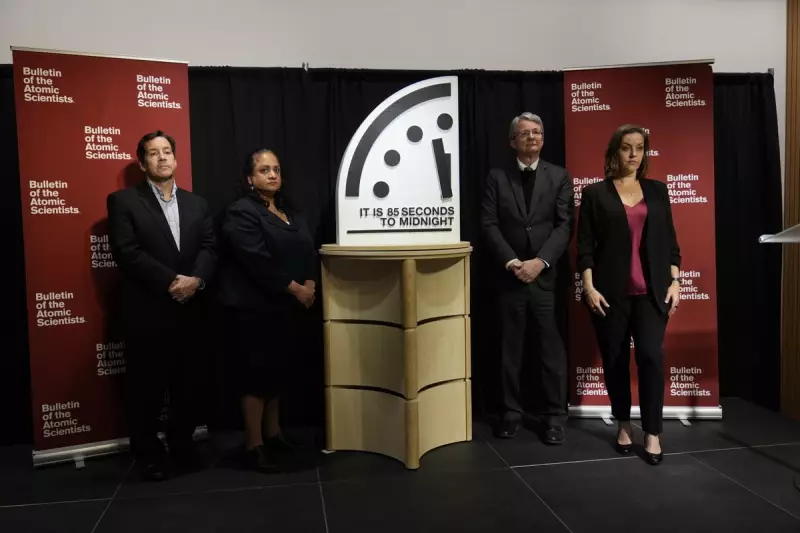
The symbolic Doomsday Clock has been advanced to just 85 seconds to midnight, marking humanity's closest ever proximity to global catastrophe according to the science advocacy group that maintains it. This annual adjustment reflects growing concerns about multiple converging threats that challenge our collective survival.
Escalating Global Tensions and Existential Risks
The Bulletin of the Atomic Scientists announced this sobering adjustment on Tuesday, pointing to what they describe as "increasingly aggressive, adversarial, and nationalistic" behaviour among major world powers including Russia, China, and the United States. This geopolitical fragmentation is undermining international cooperation precisely when coordinated action is most urgently needed.
Primary Threats Driving the Clock Forward
The organisation cited four interconnected danger areas that have contributed to this year's advancement:

- Nuclear escalation risks highlighted by ongoing conflicts involving nuclear-armed states
- Climate change impacts and insufficient global response mechanisms
- Potential misuse of biotechnology without adequate safeguards
- Artificial intelligence development proceeding without proper controls or regulation
Daniel Holz, chair of the group's science and security board, emphasised that "if the world splinters into an us-versus-them, zero-sum approach, it increases the likelihood that we all lose." This warning underscores the critical need for renewed international trust and collaboration.
Specific Concerns Behind the Adjustment
The Bulletin pointed to several concrete developments that have eroded global security since last year's setting of 89 seconds to midnight. These include the continuing Russia-Ukraine war, renewed tensions between India and Pakistan, and concerns about Iran's nuclear capabilities following military strikes by the United States and Israel.
Climate change represents another major area of concern, with the group highlighting increasingly severe droughts, heatwaves, and flooding events linked to global warming. They specifically criticised the failure of nations to implement meaningful climate agreements, noting efforts by some political leaders to prioritise fossil fuel development over renewable energy transitions.
Historical Context and Measurement Changes
First established in 1947, the Doomsday Clock was originally conceived as a visual metaphor for humanity's proximity to self-annihilation through nuclear conflict. At its most optimistic point following the Cold War, the clock stood at 17 minutes to midnight.
In recent years, the Bulletin has shifted from measuring minutes to counting seconds until midnight, reflecting both the acceleration of global threats and the need for more precise measurement of rapidly evolving risks. This change acknowledges that existential dangers now develop at a pace requiring more granular assessment.
Pathways to Turning Back the Clock
Despite this year's concerning adjustment, the organisation maintains that reversal remains possible through concerted international effort. They argue that if political leaders and nations can rediscover cooperative approaches to addressing these existential risks, the clock's hands could theoretically move away from midnight once more.
The Bulletin's announcement serves as both a warning and a call to action, emphasising that humanity's future depends on our ability to transcend national rivalries and address shared threats through collective responsibility and evidence-based policymaking.