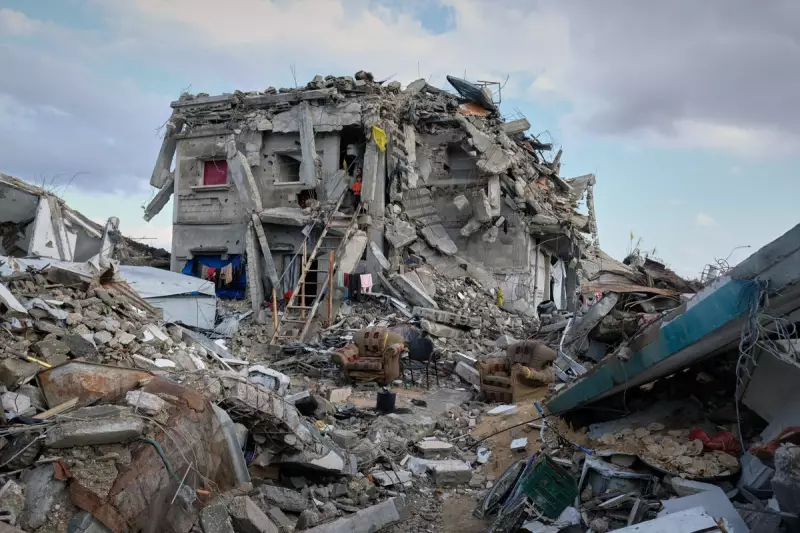
In the shattered landscape of Gaza City, Palestinian families are piecing together fragments of their former lives amidst the ruins of their homes. This effort comes during a fragile pause in hostilities, following a ceasefire brokered in October 2025.
A Home Amidst the Rubble
The Halawa family's residence in Gaza City stands as a testament to both devastation and stubborn survival. Their building still rises two storeys above the debris, a structure heavily damaged by two years of Israeli airstrikes but partially standing. One section has completely collapsed, with twisted metal reinforcement bars protruding where a roof once was.
The family has built a precarious set of wooden steps to access their home, which creak underfoot with the constant threat of giving way. Despite the danger and damage, for the Halawas, it remains home. The conflict began with the Hamas attack on October 7, 2023, which killed approximately 1,200 people in Israel and saw over 250 taken hostage. Israel's subsequent offensive in Gaza has resulted in tens of thousands of Palestinian deaths, widespread destruction, and the displacement of most of the territory's 2 million residents.

Daily Life in Damaged Dwellings
With a tenuous calm in place since the US-brokered truce, families who fled have begun returning. For many, including the seven-member Halawa household, living in damaged buildings feels preferable to tents, especially with the onset of winter rains. Inside one compromised room, Amani Halawa heats a small tin of coffee over an open fire as slivers of light filter through gaps in the concrete.
Her husband, Mohammed, and their children have carried out makeshift repairs using concrete scraps. They hang backpacks from exposed metal rods and arrange pots and pans on the kitchen floor. The walls are adorned with a painted tree and messages to loved ones separated by the war.
This scene of adaptation is repeated across Gaza City. In her damaged apartment, Sahar Taroush sweeps dust from carpets laid over rubble. Her daughter Bisan's face is illuminated by the glow of a computer screen as she watches a film next to gaping holes in the wall.
Uncertain Future and Fatal Risks
Despite these attempts at normalcy, profound uncertainty and danger persist. Families lie awake at night fearing their unstable homes could collapse. This fear is well-founded: health officials reported at least 11 people killed in building collapses in just one week in December 2025.
Amidst the cracks and ruins, families cling to symbols of familiarity. On one fractured wall, a family has hung a torn photograph of their grandfather on horseback from his time in the Palestinian Authority's cavalry during the 1990s. Nearby, a man rests on a bed perilously close to the edge of a damaged balcony, scrolling on his phone above the shattered Al-Karama neighbourhood.
While the ceasefire initiated by US President Donald Trump in October 2025 has brought relief, large-scale reconstruction has not begun and is anticipated to take years. As the truce extends into 2026, families across Gaza are left to rebuild their lives with whatever they can salvage, restoring small pockets of order in a landscape defined by loss.