History is often shaped in concentrated bursts of drama, where pivotal events across politics, conflict, and science converge within a matter of days. A retrospective look at a single week from The Independent's archives reveals such a moment, capturing a world in flux from the corridors of the Kremlin and the White House to the dusty surface of Mars.
Political Upheaval and State-Sponsored Violence
The week of 20-25 January has repeatedly proven fateful. On 21 January 1989, George H. W. Bush was sworn in as the 41st President of the United States. His inaugural address promised a departure from the "selfish" excesses of the Reagan era, heralding what he called "a new breeze" for America and the world.
Just a year later, on 23 January 1990, a starkly different political scene unfolded in the Soviet Union. Tens of thousands gathered in Baku, Azerbaijan, to mourn victims of a brutal military assault by Moscow. This crackdown, which would become known as Black January, saw funerals transform into acts of defiance, fuelling nationalist sentiment as the USSR's grip began to falter.

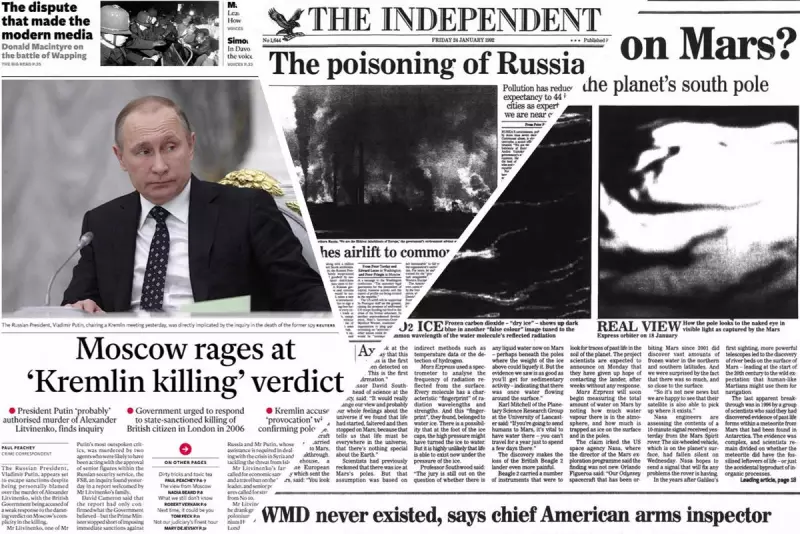
The shadow of Russian state violence extended into the 21st century. On 22 January 2016, a British public inquiry delivered a landmark verdict, concluding that Russian President Vladimir Putin had "probably" authorised the murder of Alexander Litvinenko. The former spy was poisoned in London in 2006 with the radioactive substance polonium-210. The findings labelled it a state-sponsored killing, triggering a major diplomatic crisis with Moscow dismissing the report as a "provocation".
Environmental and Social Crises Unfold
Amidst the political turmoil, a grave environmental and public health catastrophe was coming to light in Russia. On 24 January 1992, reports linked severe industrial pollution across the country to a catastrophic fall in life expectancy. In some areas, the average lifespan was estimated to be as low as 44 years, with experts warning "we are near catastrophe" due to decades of Soviet-era environmental neglect.
Elsewhere in Europe, war loomed. On 25 January 1993, a Croatian offensive against Serb-held positions escalated sharply, with tank battles raging near key sites. This occurred despite an existing UN ceasefire, leading to warnings of all-out war as peace talks in Geneva were suspended.
In the UK, a different kind of controversy brewed. On 23 January 1997, it was revealed that taxpayers were to fund a new royal yacht at an estimated cost of £60 million. The commitment sparked fierce debate over public spending priorities, with commentators noting the sum could alternatively fund dozens of new primary schools or a hospital.
Scientific Discovery and Modern Scandals
While Earth-bound conflicts raged, humanity's gaze turned outward. On 24 January 2004, new images from a Mars orbiter revealed definitive evidence of frozen water on the planet's surface. This discovery was a monumental step in planetary science, raising profound new questions about the Red Planet's past climate and its potential to have once supported life.
The week also recorded moments that defined modern anxieties and scandals. On 20 January 2006, an audio recording from Osama bin Laden was released, his first message in over a year, which renewed global questions about the al-Qaeda leader's whereabouts and plans.
Closer to home, the UK media landscape was rocked. On 23 January 2015, the phone-hacking scandal at the Daily Mirror was described in the High Court as potentially "worse than at Murdoch's papers". Revelations suggested up to 41 journalists may have illegally accessed voicemails, exposing the publisher to millions in compensation claims.
This snapshot of a single week across the decades illustrates the relentless interplay of human ambition, failure, violence, and curiosity. From the poisoning of a dissident in London to the discovery of water on a distant world, these front-page stories chart a history of turning points that continue to resonate today.