Iran's Brutal Crackdown Emerges Despite Internet Blackout
The true scale of nationwide protests in Iran and the bloody government crackdown that followed is gradually coming into focus, despite authorities having severed the country from the internet and much of the wider world. The suppression represents the most violent assault on dissent since the 1979 Islamic Revolution.
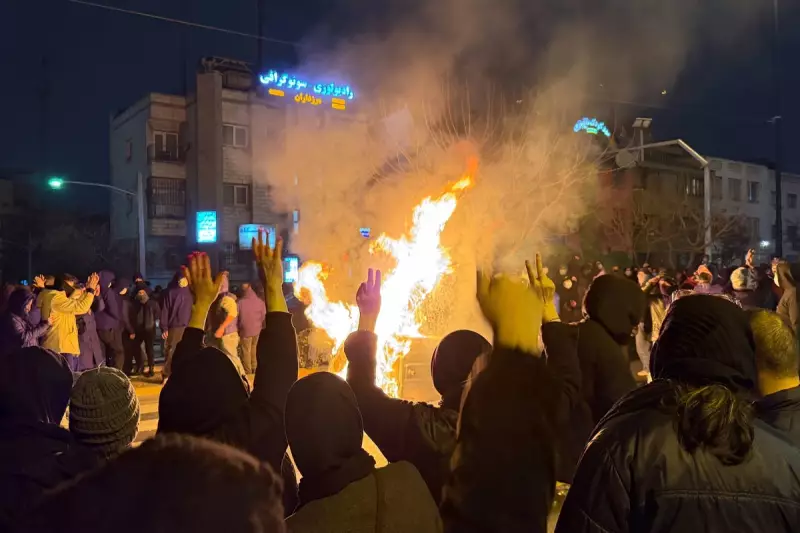
Scenes of Destruction and Violence
Cities and towns across Iran reportedly smell of smoke, with fire-damaged mosques and government offices lining the streets. Banks have been torched and their ATMs smashed. Officials estimate the damage to be at least $125 million, according to an Associated Press tally of reports from over twenty cities via the state-run IRNA news agency.
The number of dead demonstrators continues to swell, with activists warning that Iran is employing decades-old tactics at an unprecedented scale. These include firing from rooftops onto demonstrators, shooting birdshot into crowds, and deploying motorcycle-riding paramilitary Revolutionary Guard volunteers to beat and detain those unable to escape.

"The vast majority of protesters were peaceful. The video footage shows crowds of people — including children and families — chanting, dancing around bonfires, marching on their streets," said Raha Bahreini of Amnesty International. "The authorities have opened fire unlawfully."
Origins and Escalation of the Protests
The demonstrations began on December 28th at Tehran's historic Grand Bazaar, initially sparked by the collapse of Iran's currency, the rial, before spreading nationwide. Tensions exploded on January 8th following calls for demonstrations by Iran's exiled crown prince, Reza Pahlavi.
Witnesses in Tehran told the AP, before authorities cut internet and phone communications, that they saw tens of thousands of demonstrators on the streets. As communications failed, gunfire echoed through the capital.
"Many witnesses said they had never seen such a large number of protesters on the streets," said Bahar Saba of Human Rights Watch. "Iranian authorities have repeatedly shown they have no answers other than bullets and brutal repression to people taking to the streets."
Ali Akbar Pourjamshidian, a deputy interior minister, acknowledged on state television that the violence began in earnest on January 8th, stating "More than 400 cities were involved."
The Role of the Basij and Security Forces
In Iran, one of the primary mechanisms for quashing dissent is the Basij, the volunteer arm of the Revolutionary Guard. Mosques often include facilities for the Basij, with an estimated 79% of Basij resistance bases located in mosques according to a 2024 report.
Videos show Basij members holding long guns, batons, and pellet guns. Anti-riot police can be seen in helmets and body armor, carrying assault rifles and submachine guns. Footage shows police firing shotguns into crowds—a tactic authorities deny, despite corpses showing wounds consistent with metal birdshot. Scores have reportedly suffered blinding eye wounds from such ammunition.
"We received accounts that the security forces were just firing relentlessly at protesters," said Bahreini. "They're not just targeting one or two people to create a climate of terror... but just relentlessly firing at thousands of protesters and chasing after them, even as they were fleeing."
Mounting Casualties and Official Figures
For two weeks, Iran offered no overall casualty figures. Then, on a recent Wednesday, the government stated that 3,117 people had been killed, including 2,427 civilians and security forces. Pourjamshidian identified another 690 dead as "terrorists."
This conflicts sharply with figures from the U.S.-based Human Rights Activists News Agency, which put the death toll at 5,137 based on verification by activists inside Iran. Their breakdown included 4,834 demonstrators, 208 government-affiliated personnel, 54 children, and 41 civilians not participating in protests.

The fact that Iran's theocracy offered any death toll—and one surpassing any other political unrest in the modern era—underscores the scale of the events. It also provides a justification for the ongoing mass arrest campaign and internet shutdown, with state media reporting dozens to hundreds detained daily.
International Context and Future Uncertainty
The killing of peaceful protesters and the threat of mass executions have been described as a red line for military action by U.S. President Donald Trump. An American aircraft carrier and warships are approaching the Middle East, raising the risk of a new regional conflict.
Meanwhile, uncertainty looms within Iran. Traditionally, Iranians hold memorial services forty days after a death, meaning the country could see renewed demonstrations around February 17th. Online videos from Behesht-e Zahra cemetery on Tehran's outskirts show mourners chanting "Death to Khamenei!"
Satellite photos analysed by the AP show large numbers of cars daily at the cemetery's southern reaches, where those killed in the demonstrations are being buried. Journalist Elaheh Mohammadi, whose pro-reform newspaper was shut by authorities, wrote online: "The city smells of death. Hard days have passed and everyone is stunned; a whole country is in mourning, a whole country is holding back tears, a whole country has a lump in its throat."
Iran's mission to the United Nations did not respond to detailed questions from the AP regarding the suppression of the demonstrations.