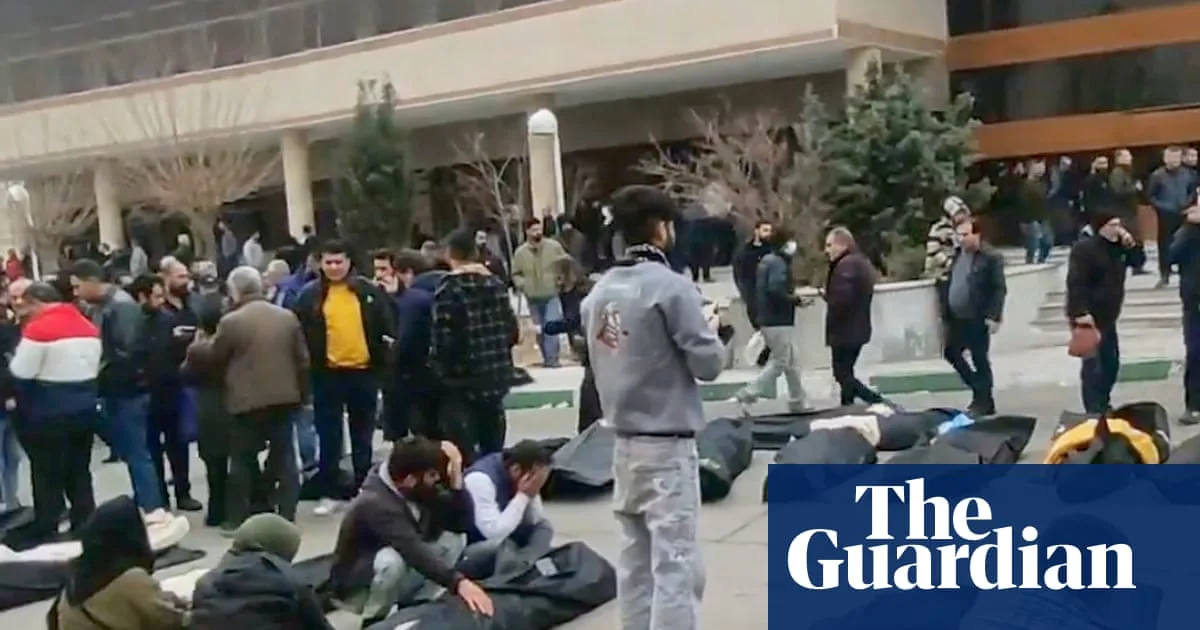
Iranian Regime's Hospital Massacre Exposed Through Chilling Evidence
Following the execution of hospital patients by Iranian regime forces, authorities made no attempt to conceal the crime scenes. Disturbing evidence reveals an adhesive monitoring pad remains attached to the chest of one victim whose heart was being monitored by medical staff moments before his death. Government forces removed him from medical care, executed him with a bullet to the forehead, and discarded his body alongside others.
Graphic Evidence of Systematic Executions
Among rows of discarded corpses, another patient still has a breathing tube inserted in their throat, while others remain draped in medical gowns. Forensic examination reveals each victim received "finishing shots" to the skull, indicating systematic execution rather than spontaneous violence.
These harrowing images originate from thousands of clips that courageous activists have risked their lives to transmit from Iran, despite the regime's internet shutdown designed to conceal atrocities. The visual evidence corroborates survivor testimonies describing how Islamic Republic forces tracked protesters to hospitals, removed them from their beds, and executed them.
Medical Professionals Witness Atrocities
"Security forces would stand beside the beds of injured patients," one medical professional revealed. "We explained they required oxygen and hospital care, but officials responded, 'No, they're fine.' We merely stitched their wounds before they were taken away."
Ground-level doctors estimate at least 16,500 protesters were slaughtered, primarily during January 8th and 9th, for daring to demand the return of exiled Crown Prince Reza Pahlavi. Many Iranians believe the actual death toll substantially exceeds even this devastating figure.
Bloodshed on Unprecedented Scale
Accepting the medical professionals' conservative estimate means over 80,000 litres of blood was shed—sufficient to fill and overflow a residential swimming pool. Most victims were educated young men and women in their teens and twenties, their promising lives brutally terminated.
The bloodshed in Tehran during those two nights was so extensive that drainage systems ran crimson the following morning. Two weeks later, bloodstains still mark the city, providing vivid evidence of regime crimes. Blood smears trace streets where bodies were dragged, walls at execution sites remain splattered, and escape routes of wounded survivors are mapped through blood trails.
International Silence and Comparisons
Medical professionals report Supreme Leader's forces killed over twelve times more people than Hamas did on October 7th, 2023. The Gaza death toll took two months to reach what Iran suffered in just two nights.
This represents potentially the largest killing of street protesters in modern history, surpassing the Rabaa al-Adawiya massacre in Egypt (2013) where 1,000 were killed, and approaching the scale of Syria's 1982 Hama massacre. Iranian commentator Nazenin Ansari described events as "the Iranian Holocaust," stating: "What has happened is beyond a nightmare. This violence is not new, but its scale is unprecedented."
Personal Tragedies Amid Systematic Violence
Saeed Golsorkhi, a muscular powerlifter, was shot in the leg during protests and hospitalized. Learning regime forces were conducting bed-to-bed arrests, he fled to his mother's home in Shahrud County. Four days later, security services located him. As a six-year-old neighbor clung to him, he surrendered to protect the child. After signing documents, he was marched outside and executed with a shot to the back of the head.
Graphic images show the bullet exited through his left eye, with additional shots marking his abdomen. The child's black-and-white scarf remains tied around his forehead. His brother Mohammad, speaking from Germany, stated: "I want the world to be aware of the crimes committed by these people."
Further Atrocities and Evidence
A dramatic photograph of dozens of abandoned trainers beside Rasht Grand Bazaar evokes comparisons to shoes left at Auschwitz. Regime commandos encircled protesters at this historic marketplace, set the bazaar ablaze, and shot those attempting to flee. Estimates of deaths here range from hundreds to 3,000.
One Iranian exile, who lost her cousin Parnia at Rasht, described subsequent horrors: "Bodies were deliberately mutilated. Some were run over by trucks so families couldn't recognize them. Some were so badly damaged they couldn't be placed in body bags. Some bodies were thrown into rivers."
Mortuary Horrors and Financial Extortion
At Kahrizak mortuary in Tehran province, hundreds of bodies were dumped outside in body bags. Amid grieving relatives' wails, phones rang incessantly from within the body pile as loved ones attempted contact. One family miraculously found their missing child alive—severely wounded by gunfire, he had remained motionless for three days inside a body bag, fearing "finishing shots" by security forces.
Among the dead was physiotherapist Masoud Bolourchi, 37, shot in the back of the head. His parents were compelled to pay "bullet money" to retrieve his body for burial. Stage actor Ahmad Abbasi, gunned down in Tehran, required similar payment for release—a practice so widespread some families bury children in their gardens, unable to afford official burial costs reaching £5,000.
Media Response and International Reaction
Iranians express betrayal by Western media coverage, with BBC Persian described as a "nest" for "accomplices of the criminal Khamenei and his regime." Some Voice of America Persian staff claim they were instructed to avoid mentioning Crown Prince Pahlavi in reports, diminishing his role in unifying opposition.
Despite Donald Trump's declaration that "killing has stopped" following Tehran's announcement about cancelling 800 protester executions, violence continues. Mohammad Golsorkhi warns: "If the international community doesn't act, many more innocent people will be killed."
While Trump recently announced a US "armada" heading toward Iran, having promised on January 2nd that "the United States of America will come to their rescue" if protesters were killed, survivors remain determined. "I will never be the same person," one protester stated. "I don't know who I am anymore. But I know that I will avenge my friends, even if it is my last day alive."