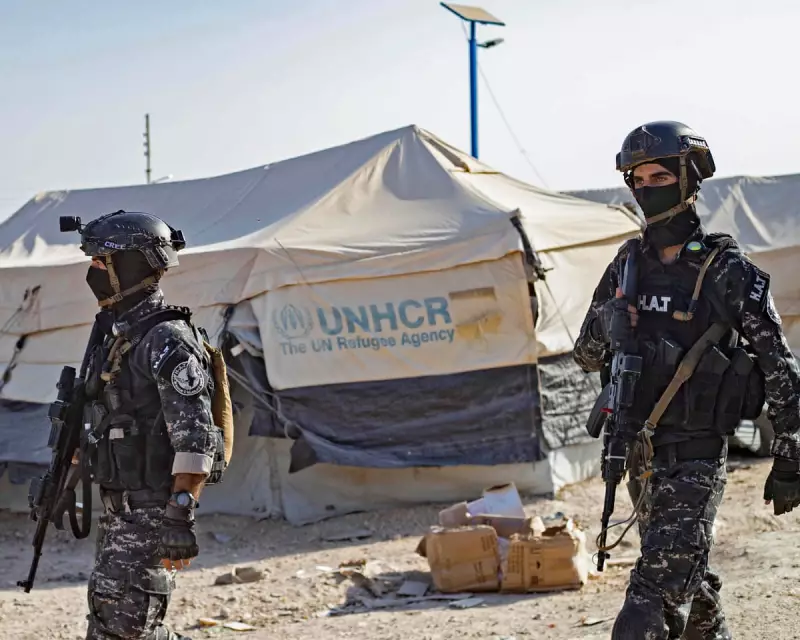
Kurdish Forces Withdraw from IS Detention Camp in North-East Syria
Kurdish-led forces in Syria have announced a withdrawal from a critical detention camp in the north-east of the country, which houses tens of thousands of individuals linked to Islamic State. This move comes as Syrian government forces continue to make significant advances in the region, leading to heightened concerns among neighbouring states and the international community.
Al-Hol Camp: A Hotbed of Extremism
The al-Hol camp, managed by Kurdish authorities, is home to some of the most radical foreign women and children suspected of having been members of IS, along with their families. For years, neighbouring nations have warned that this facility represents a dangerous hotbed of extremism. There are fears that any potential jailbreak could unleash chaos and violence across the area.
A smaller number of female detainees are held at the al-Roj camp, further to the north-east, which remains under Kurdish control. This includes Shamima Begum, the British woman who was stripped of her UK citizenship due to her alleged connections with IS.

Withdrawal and Accusations
A spokesperson for the Syrian Democratic Forces (SDF), the Kurdish-led military group, stated that their forces were compelled to withdraw from Al-Hol camp. They have redeployed to areas around cities in northern Syria that are facing increasing risks and threats. The SDF described this withdrawal as a direct result of the international community's failure to provide adequate support and resources.
In response, the Syrian government has declared that it will assume control of the camp. Officials have accused the SDF of abandoning the facility without proper guards, potentially allowing detainees to escape. Similar claims have been made regarding a prison in Raqqa, where 120 prisoners are alleged to have fled—an accusation that the SDF has firmly denied.
Rapid Syrian Government Advances
The withdrawal coincides with a swift and unprecedented advance by Syrian government forces through north-east Syria. Over just a few days, the SDF has lost vast swathes of territory, including key locations such as Raqqa and Deir el-Zour. This rapid shift in frontlines marks the most significant change since the fall of former Syrian president Bashar al-Assad in December 2024.
Damascus's forces have benefited from defections among tribal elements previously aligned with the SDF, pushing the Kurdish-led group to withdraw from Arab-majority areas. The SDF, which had controlled nearly a third of Syria with US support since 2019, now faces a partial collapse almost overnight.
Ceasefire Collapse and Escalating Tensions
A 14-point ceasefire agreement, signed on Sunday by Syrian president Ahmad al-Sharaa and SDF head Mazloum Abdi, collapsed the following day after a disastrous meeting in Damascus. Syrian government sources accused Abdi of attempting to stall the implementation of the agreement, which would transfer most Kurdish-led institutions and governance to Damascus.
Ilham Ahmed, a senior leader within the Kurdish-led authority, reported that Abdi requested a five-day grace period to implement the terms, but this was rejected by the Syrian government. Ahmed claimed that Damascus was intent on war, with plans to massacre the Kurdish population, pointing to past mass killings in Suweida province and the Syrian coast as grim precedents.
In the aftermath, Kurdish officials, including Abdi, have called for a general mobilisation across Kurdish-majority areas, urging resistance against the government's advance. SDF media has released images showing people of all ages holding assault rifles, seemingly preparing for further conflict.
Clashes and Future Prospects
Clashes between the two sides continued on Tuesday, with shelling reported in Kobane, a Kurdish-majority area on the Turkish border, and Syrian government forces entering Hasakeh. The areas lost to Damascus thus far have been predominantly Arab-majority, where residents held long-standing resentments against the SDF.

The SDF has now entrenched itself in areas closer to the borders with Iraq and Turkey, which are mainly populated by Kurds. If government forces advance into these Kurdish-majority regions, fighting is expected to be deadlier, given the SDF's infrastructure, including heavy artillery, drones, and underground tunnel networks.
The Syrian government has stated that it does not intend to enter Kurdish areas, aiming instead to restore stability and protect government institutions. However, the SDF views this conflict as existential, with deep fears over their safety and autonomy.
Historical Context and International Response
The SDF served as the primary partner for the United States in Syria, playing a crucial role in defeating the IS caliphate in 2019. As the military wing of an autonomous Kurdish-led area, it protected Kurdish rights that had long been repressed under the Assad regime.
Following al-Assad's fall, negotiations between the SDF and Damascus focused on retaining Kurdish autonomy versus consolidating government control. Despite an agreement signed on 10 March to integrate the SDF into Syria's army, tensions persisted, leading to occasional clashes.
The US had urged the Syrian government to halt its advance at the Euphrates river, but these calls were ignored as government forces pushed forward. The international community has largely remained silent as Damascus extends control over most of the country, including key oil and gas fields and vital dams.
It remains unclear whether the government will continue its advance or if both sides will return to negotiations. The SDF has appealed to the US for assistance, but so far, no intervention has materialised, leaving the future of the region in a state of uncertainty.