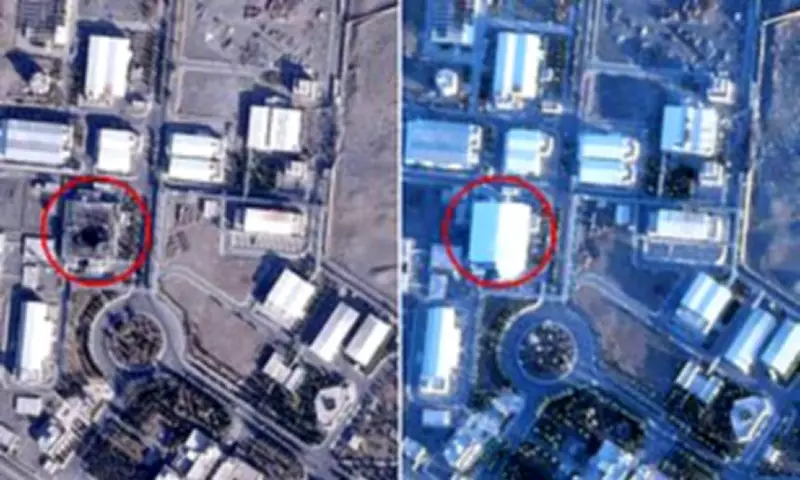
Recent satellite imagery has revealed significant activity at two key Iranian nuclear facilities that were bombed last year by Israel and the United States, occurring against a backdrop of escalating tensions over Tehran's brutal crackdown on nationwide protests. The images, captured by Planet Labs PBC, clearly show that new roofs have been constructed over two severely damaged buildings at the Isfahan and Natanz nuclear sites. This marks the first major activity detectable by satellite at any of Iran's stricken nuclear installations since the conclusion of Israel's 12-day war with the Islamic Republic in June.
Analysis of the New Construction
Experts who have examined the satellite data suggest that the new roofing does not indicate the commencement of full-scale reconstruction at these heavily damaged facilities. Instead, analysts believe this activity is likely part of a covert Iranian operation to assess the extent of the damage and recover any valuable assets that may have survived the intense aerial bombardments.
Andrea Stricker, a researcher focusing on Iran for the Washington-based Foundation for Defence of Democracies, explained the likely motivation behind these actions. 'They want to be able to get at any recovered assets they can get to without Israel or the United States seeing what survived,' she stated. The organisation she represents has itself been sanctioned by Tehran. Stricker further elaborated that Iran is probably attempting to determine whether critical components, such as limited stocks of highly enriched uranium, endured the strikes.

Context of the Damaged Sites
Prior to the outbreak of hostilities in June, Iran maintained three major nuclear sites associated with its controversial program. The Natanz facility, located approximately 135 miles south of the capital, was a complex mix of above- and below-ground laboratories responsible for the majority of Iran's uranium enrichment activities. Before the conflict, the International Atomic Energy Agency (IAEA) reported that Iran was using advanced centrifuges at Natanz to enrich uranium up to 60%, which is merely a short technical step from the 90% level considered weapons-grade.
The facility near the city of Isfahan was primarily known for producing uranium hexafluoride gas, which is fed into centrifuges for the enrichment process. A third site, Fordo, situated about 60 miles southwest of Tehran, housed a heavily fortified enrichment plant built deep under a mountain.
The Course of the Conflict and Its Aftermath
During last year's military confrontation, Israel initiated the attacks on these nuclear sites, with the United States following up using bunker-busting bombs and Tomahawk cruise missiles. The White House's National Security Strategy, published in November, asserted that these US strikes 'significantly degraded Iran's nuclear program,' although specific details regarding the extent of the damage have remained scarce in the public domain.
Rafael Mariano Grossi, the Director-General of the IAEA, stated at the time that Israel's strike on June 13 left the main above-ground enrichment building at Natanz, known as the Pilot Fuel Enrichment Plant, 'functionally destroyed,' while also inflicting serious damage to underground halls containing cascades of centrifuges. A subsequent US attack on June 22 targeted Natanz's underground facilities with bunker-busting munitions, likely decimating any remaining infrastructure.
Detailed Satellite Observations
The Planet Labs PBC imagery indicates that Iran began constructing a roof over the devastated Pilot Fuel Enrichment Plant at Natanz in December, completing the work by the end of the month. Tehran has not publicly acknowledged this construction activity. Furthermore, the electrical system at Natanz appears to remain in a destroyed state.
Satellite images also reveal that Iran is continuing excavation work at Kūh-e Kolang Gaz Lā, or 'Pickaxe Mountain,' located just a few hundred meters south of the Natanz complex's perimeter fence. The growing piles of dirt from this digging operation suggest Tehran may be constructing a new underground nuclear facility at this location, a project that reportedly began in 2023.

At the Isfahan site, a similar roof was being finished over a structure near the facility's northeast corner in early January. While the exact function of this building is not publicly known, the Israeli military stated at the time of the strikes that its targets at Isfahan were associated with centrifuge manufacturing.
Additional imagery shows that two tunnels leading into a mountain near the Isfahan facility have been packed with dirt, a defensive measure against missile strikes that Iran also implemented just before the June war. Intriguingly, a third tunnel appears to have been cleared of such fill, with new walls constructed near its entrance, likely as an enhanced security precaution.
Expert Interpretation and Broader Implications
Sarah Burkhard, a senior research associate at the Washington-based Institute for Science and International Security, which has long monitored Iran's nuclear activities, concurred with the assessment that the new roofs are part of a recovery operation. She suggested Iran is attempting to 'recover any sort of remaining assets or rubble without letting us know what they are getting out of there.'
Iran has consistently insisted that its nuclear program is entirely peaceful. However, Iranian officials have increasingly issued threats in recent years about potentially pursuing nuclear weapons development. The West and the IAEA maintain that Iran had an organised nuclear weapons program that continued until 2003.
Notably, Iran has not permitted IAEA inspectors to visit the bombed sites since the attacks occurred. This lack of access has made independent verification of the facilities' status and Iran's activities there extremely difficult.
The revelation of this new construction comes as US President Donald Trump has repeatedly demanded that Iran negotiate a deal concerning its nuclear program, ostensibly to avert threatened American military strikes linked to the country's violent suppression of protesters. The United States has already deployed the USS Abraham Lincoln aircraft carrier and several guided-missile destroyers to the Middle East, although it remains uncertain whether the Trump administration will ultimately decide to employ military force.